
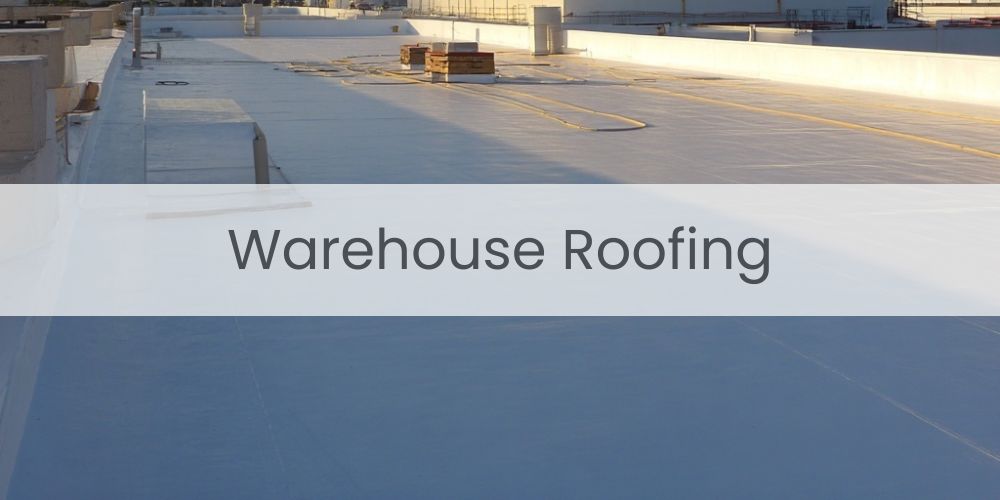
Warehouse roofing requires continuous watertight performance across large, low-slope roof fields where long seam runs, frequent penetrations, curb transitions, and high drainage demand create concentrated stress on the membrane system. TPO warehouse roofing restores and maintains that performance by using a heat-welded thermoplastic membrane assembly designed to keep membrane continuity intact at seams, terminations, penetrations, transitions, attachments, and drainage interfaces under warehouse operating forces. In warehouse environments, failure rarely originates in the middle of an intact membrane sheet. Failure initiates at interface zones where thermal movement across long spans, wind uplift at perimeters, vibration from rooftop units, and hydraulic loading at drains and low points combine to open discontinuities that allow water to bypass the membrane surface. Because warehouse interiors store inventory, equipment, and racking systems that are highly sensitive to moisture, warehouse roofing decisions are governed by whether the roof can maintain controlled water-shedding behavior without intermittent bypass and subsurface migration. Unlike small-roof applications where defects may stay localized, warehouse roof behavior is system-level: water can migrate beneath an intact-appearing membrane field and surface far from the entry interface. TPO warehouse roofing is used to create a single, welded waterproofing plane that resists movement, uplift, vibration, and hydraulic pressure across the full building footprint. TPO Roofing Contractor performs warehouse roofing as membrane-continuity engineering, focused on seam fusion integrity, interface geometry control, attachment restraint stability, and drainage behavior that prevents bypass under real operating conditions.
How Does TPO Warehouse Roofing Control Leak Risk and Moisture Migration?
Warehouse roof failures escalate because large roof geometry amplifies the forces that act on interfaces and because moisture can travel laterally beneath the membrane before becoming visible inside. Thermal expansion and contraction loads long seam networks and terminations, wind uplift applies cyclic peel stress at perimeters and corners, vibration repeatedly loads penetration interfaces at equipment bases, and hydraulic pressure concentrates at drains, sumps, low points, and transition zones where water is forced against detailing. On large warehouses, these forces decouple interior symptoms from entry locations, allowing a small interface discontinuity to feed widespread subsurface moisture migration across insulation and deck planes. TPO warehouse roofing controls this risk by establishing continuous heat-welded seam networks, stabilizing terminations and edge restraint, engineering penetration and curb detailing that tolerates vibration and movement, and maintaining drainage interfaces that prevent standing water and hydraulic forcing. When membrane continuity and interface geometry remain stable across the roof field, water cannot bypass the membrane surface, migration pathways collapse, and leak initiation risk is reduced at building scale.
The TPO warehouse roofing process creates the following system-level performance relationships:
- Long seam runs across large roof spans → thermal cycling increases movement stress → welded seam continuity controls opening risk
- Perimeter edge zones on wide roofs → uplift peel stress concentrates → termination restraint prevents interface separation
- Rooftop unit curbs and penetrations → vibration loads detailing repeatedly → reinforced geometry prevents bypass at bases
- Low-slope roof drainage demands → hydraulic pressure concentrates at low points → drain detailing prevents forced entry
- Distributed roof traffic and service activity → localized mechanical stress increases → protected interfaces reduce puncture initiation
- Subsurface moisture migration potential → interior symptoms decouple from entry → continuous membrane plane prevents lateral spread
Each of these outcomes results from warehouse-scale continuity control decisions rather than localized patch logic, ensuring that TPO warehouse roofing maintains watertight performance by preventing bypass at the interfaces where warehouse roofs actually fail.
What Conditions Trigger TPO Warehouse Roof Replacement?
TPO warehouse roof replacement is triggered when a warehouse roofing system shows distributed membrane continuity loss across seams, terminations, penetrations, transitions, attachment zones, and drainage interfaces such that localized TPO roof repair cannot restore stable watertight behavior at building scale. Warehouse roofs amplify replacement triggers because large uninterrupted roof fields, long seam runs, high wind exposure, rooftop equipment, and high-volume drainage demand create repeatable operating forces that re-open weakened interfaces across wide areas. Replacement is required when the roof is no longer failing at a single repairable breach, but is operating with multiple active bypass pathways that allow water to enter the roof assembly, migrate laterally beneath the TPO membrane surface, and present as recurring leakage that cannot be reliably tied to one isolated entry interface. Warehouse-specific water-entry triggers include recurring interior leaks over broad zones, repeat wet-insulation findings across multiple areas, and moisture patterns that shift with wind direction, rainfall intensity, or drain loading because entry occurs at more than one interface. Warehouse-specific interface triggers include repeated seam failure across long welded runs, termination instability along extended perimeters, widespread penetration detailing fatigue around RTUs, vents, and pipe clusters, and recurring defects at expansion joints, curbs, and transitions where movement is concentrated. Warehouse-specific force-response triggers include thermal cycling that re-opens seam networks across large roof fields, wind uplift that destabilizes perimeters and attachment zones, vibration from mechanical equipment that accelerates penetration interface fatigue, and hydraulic pressure or ponding that forces water against degraded drains, sumps, and low-point transitions. Because these triggers indicate that the warehouse roof cannot sustain membrane continuity as a unified waterproofing plane, TPO warehouse roof replacement becomes the corrective strategy that resets seam fusion, interface geometry, attachment restraint, and drainage control across the entire roof system rather than repeatedly chasing distributed bypass pathways.
The conditions that trigger TPO warehouse roof replacement create the following system-level performance relationships:
- Distributed seam failures across long weld runs → continuity cannot be stabilized by spot repairs → roof-level replacement required
- Recurring leakage in shifting interior locations → multiple entry interfaces remain active → replacement eliminates distributed bypass paths
- Perimeter termination instability along extended edges → uplift peel stress re-opens interfaces → replacement resets restraint and geometry
- Widespread penetration fatigue at RTUs and equipment curbs → vibration-driven separation persists → replacement rebuilds detailing tolerance
- Chronic ponding or drain overload at low points → hydraulic forcing persists at interfaces → replacement rebuilds drainage-controlled detailing
- Repeat repairs in the same warehouse roof zones → underlying interface network still failing → replacement removes the failure-prone assembly
- Broad wet insulation mapping across sections → lateral subsurface migration persists → replacement removes saturated layers and restores system integrity
- Age-driven loss of seam weld reliability → fusion performance no longer predictable → replacement resets heat-welded seam networks
Each of these conditions represents loss of system-level control in a warehouse roofing environment, not an isolated defect suitable for repeated patching. TPO warehouse roof replacement is required when these trigger states are present to restore a unified TPO membrane system, eliminate distributed bypass pathways, and return the warehouse roof to controlled watertight performance under thermal movement, wind uplift, vibration, and hydraulic pressure.
Have a question about an upcoming project?
How Does TPO Warehouse Roof Replacement Restore Warehouse Roof Performance?
TPO warehouse roof replacement restores warehouse roofing performance by resetting the roof to a single heat-welded waterproofing plane and rebuilding every warehouse-critical interface where bypass and moisture migration originate. On warehouses, replacement restores performance by (1) eliminating distributed bypass pathways created by degraded seam networks, penetrations, terminations, transitions, attachment zones, and drainage interfaces, and (2) rebuilding those interfaces so they remain stable under long-span thermal movement, perimeter uplift pressure, rooftop vibration, and hydraulic loading at low points. Replacement restores predictable water-shedding behavior by re-establishing weldable seam fusion across long runs, restoring edge restraint across extended perimeters, rebuilding curb and penetration geometry to tolerate vibration and service activity, and resetting drainage performance so ponding-driven forcing does not re-create entry pathways. When the warehouse roof is returned to unified membrane continuity with stable restraint and controlled drainage, subsurface moisture migration collapses, interior symptoms stop decoupling from entry locations, and warehouse roofing returns to consistent watertight behavior at building scale.
The TPO warehouse roof replacement process creates the following system-level performance relationships:
- Distributed bypass pathways across interfaces → roof behavior becomes unstable → replacement restores unified membrane control
- Degraded long seam networks → thermal cycling re-opens openings → new welded seams restore continuity across spans
- Extended perimeter zones → uplift peel stress concentrates → rebuilt terminations and restraint prevent edge opening
- Equipment curbs and penetrations → vibration-driven fatigue increases → rebuilt flashing geometry prevents interface separation
- Drain low points and sumps → hydraulic loading increases → rebuilt drainage interfaces prevent forced entry
- Subsurface moisture migration in assembly → symptoms shift from entry locations → removal of wet layers collapses migration paths
Each of these outcomes results from system renewal decisions that restore warehouse roofing control across the full TPO membrane and its interfaces, ensuring that TPO warehouse roof replacement eliminates distributed bypass behavior rather than stabilizing isolated defects.
How Is TPO Warehouse Roof Replacement Installed and Verified?
TPO warehouse roof replacement is installed by removing the failure-prone roof assembly and installing a new heat-welded TPO membrane system that functions as one continuous waterproofing plane across the full warehouse roof field and every interface where bypass pathways form. Because warehouse roofs are large, low-slope, and interface-dense, installation rebuilds seams, terminations, penetrations, transitions, attachment zones, and drainage interfaces to remain stable under thermal movement, wind uplift, vibration, and hydraulic loading. Installation begins by isolating the roof areas scheduled for removal, controlling moisture exposure to the warehouse interior, and removing the compromised membrane and any saturated insulation so subsurface migration pathways are physically eliminated rather than covered. Substrate condition is then restored so attachment restraint and seam fusion can behave predictably across long spans. New insulation and coverboard layers are installed to restore slope, reduce low-point hydraulic loading, and create a stable welding substrate. The new TPO membrane is installed and heat-welded into a continuous seam system designed for long seam runs, with detailing rebuilt at perimeter edges, terminations, RTU curbs, penetrations, transitions, and expansion interfaces where movement and vibration concentrate. Drainage interfaces are rebuilt so discharge capacity is restored and hydraulic pressure at low points cannot force water against weakened geometry. The replacement is considered complete only when the new warehouse roofing system behaves as one continuous membrane plane: seams remain fused, interfaces remain restrained, and drainage behavior prevents ponding-driven forcing under real rain and wind conditions. Verification of TPO warehouse roof replacement confirms that continuity and interface control have been restored at warehouse scale, not just that new material has been installed. Seam verification confirms continuous weld integrity along long warehouse seam runs so openings do not recur under thermal cycling. Perimeter and termination verification confirms that edge restraint and geometry resist uplift peel stress across extended warehouse perimeters and corners. Penetration and equipment-zone verification confirms that curb flashings, pipe boots, and transitions remain stable under vibration and service activity without opening bypass paths at bases. Drainage verification confirms that drains, sumps, low points, and transition zones discharge as designed and do not create standing water that increases hydraulic loading at interfaces. Warehouse roofing verification is achieved when the system demonstrates continuous membrane behavior across the roof field and all interfaces under conditions that previously triggered failure—thermal movement, wind uplift, vibration, and hydraulic pressure—so water cannot bypass the TPO membrane surface and subsurface migration pathways remain collapsed.
The TPO warehouse roof replacement installation and verification process creates the following system-level performance relationships:
- Removal of saturated warehouse roof layers → subsurface migration pathways eliminated → hidden moisture no longer propagates
- Rebuilt insulation and slope control → low-point hydraulic loading reduced → drains and transitions see less forcing pressure
- Continuous heat-welded seam network installed → seam fusion restored → long seam runs resist thermal cycling
- Perimeter restraint and terminations rebuilt → uplift peel stress controlled → edge openings do not recur across long perimeters
- RTU curbs and penetration detailing rebuilt → vibration tolerance restored → bypass paths do not initiate at equipment zones
- Drainage interfaces rebuilt and tested → discharge behavior verified → ponding-driven forcing does not reopen interfaces
- Final continuity verification completed → seams and interfaces confirmed watertight → warehouse roof returns to predictable system control
Each of these outcomes verifies that warehouse roofing performance has been restored as a unified TPO system, ensuring that TPO warehouse roof replacement eliminates distributed bypass pathways and returns the warehouse roof to continuous watertight behavior at full building scale.
When Should a Warehouse Engage a TPO Roofing Contractor for Warehouse Roof Replacement?
A warehouse should engage a TPO roofing contractor for warehouse roof replacement when a TPO warehouse roofing system has verified loss of system-level membrane continuity and long-term watertight performance can no longer be restored or maintained through localized repair across seams, terminations, penetrations, transitions, attachment zones, and drainage interfaces under warehouse operating forces. This applies when recurring leakage persists after verified repairs, when multiple active bypass pathways exist across the warehouse roof assembly, or when testing and investigation confirm that continuity loss is distributed across interface networks rather than isolated to a single correctable entry point. Engagement is appropriate when long-span thermal movement is re-opening seam networks and terminations across wide roof fields, when wind uplift is destabilizing extended perimeters and attachment zones, when vibration from rooftop units is accelerating fatigue at curb flashings and penetrations, or when hydraulic loading and ponding at drains and low points is forcing water against degraded drainage interfaces in multiple roof areas. At this decision point, the risk in warehouse roofing is defined by inventory exposure, operational disruption, and persistent subsurface moisture migration across insulation and deck planes rather than a single visible defect or localized interior symptom. Delaying professional replacement planning increases the likelihood that concealed moisture spreads laterally, insulation remains saturated across sections, thermal performance declines, attachment corrosion expands, and the project shifts from controlled warehouse roof renewal to wider operational and structural remediation. Because warehouse roof leak behavior can be decoupled from entry locations at building scale, engaging a qualified contractor ensures the corrective strategy matches the verified failure state and replaces the failure-prone assembly rather than repeatedly chasing distributed bypass pathways. For this reason, TPO Roofing Contractor provides warehouse roof replacement services focused on confirming loss-of-system-control conditions, defining replacement scope for large roof fields, removing compromised roof components, and installing a new TPO warehouse roofing system that restores heat-welded seam continuity, stable attachment restraint, engineered interface geometry, and drainage-controlled detailing under thermal movement, wind uplift, vibration, and hydraulic pressure. Engaging a TPO roofing contractor for warehouse roof replacement at the correct decision point aligns capital scope with verified system condition, eliminates distributed bypass pathways, protects warehouse operations and stored goods, and restores long-term watertight performance across the full warehouse footprint.