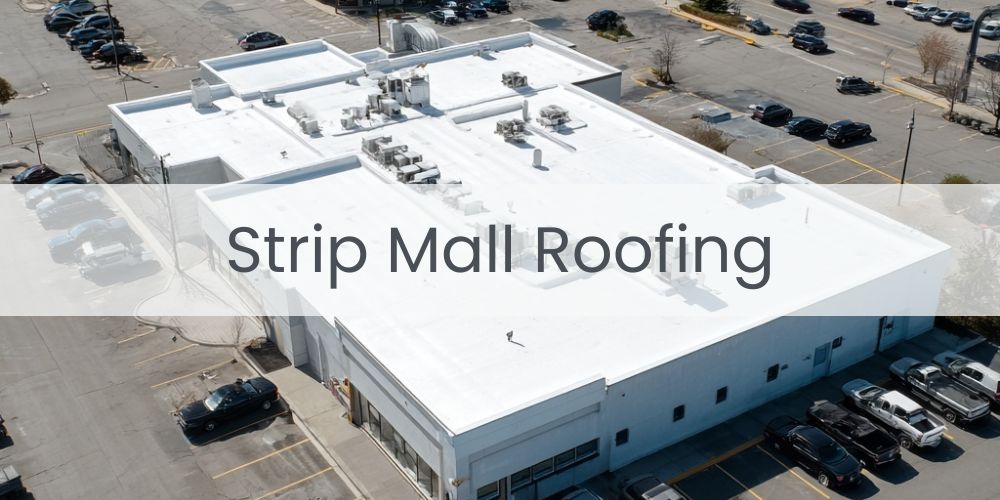
TPO roofing supports strip mall roofing systems by maintaining thermal stability, moisture control, and envelope reliability across linear, multi-tenant retail properties with shared roof assemblies. Strip malls operate with continuous public access, high tenant turnover, and closely connected retail units that place concentrated and uneven demands on roof systems. TPO roofing systems are used on strip malls where uncontrolled heat gain, moisture intrusion, or membrane failure would disrupt multiple tenant spaces simultaneously, damage interior finishes, or create safety and liability risks in publicly occupied areas. Strip mall roofing systems are subjected to sustained solar heat exposure, long uninterrupted roof runs, shared drainage infrastructure, dense rooftop HVAC units serving individual tenant bays, and frequent service access concentrated along roof edges and mechanical zones. If strip mall roof assemblies are not engineered to manage heat reflection, seam continuity, attachment performance, and drainage behavior, failures can propagate laterally beneath the membrane surface across multiple tenant units. Once moisture enters a strip mall roof assembly, it can migrate through shared insulation zones, reduce thermal resistance, damage ceilings across adjacent businesses, and introduce slip, safety, and operational risks within customer-facing retail environments below. TPO roofing for strip malls focuses on preventing these system-wide failure mechanisms rather than addressing isolated surface defects. TPO strip mall roofing is the process of installing a continuous, heat-welded thermoplastic membrane system with defined attachment methods, reflective surfaces, and engineered detailing to create a watertight and thermally controlled roof assembly across connected retail bays. Unlike generic commercial roofing applications, strip mall roofing systems must perform consistently under shared roof conditions, uneven tenant mechanical loads, and limited disruption tolerance during active trading hours. Without proper system design, minor deficiencies at seams, penetrations, or drainage transitions can escalate into multi-tenant disruption, repeated maintenance events, and revenue loss. TPO Roofing Contractor installs TPO roofing systems for strip malls as operational control systems, engineered to regulate heat, block moisture intrusion, and preserve interior stability across neighborhood retail plazas, convenience strips, and linear commercial developments throughout the United States.
How Does TPO Strip Mall Roofing Control Heat, Moisture, and Tenant Disruption Risk?
Strip mall roof failures occur when heat, moisture, and mechanical stress exceed the control capacity of roofing assemblies that are not designed for shared, linear retail environments. Persistent solar exposure raises roof surface temperatures along extended roof runs, daily thermal cycling stresses seams across long membrane spans, and rooftop HVAC units serving individual tenants concentrate vibration, penetrations, and load at repeated intervals. On strip malls, these forces act continuously and unevenly, increasing the risk that localized defects will spread laterally beneath the membrane and affect multiple tenant units. TPO roofing systems control these risks by forming a monolithic, non-porous membrane barrier that manages thermal movement and prevents moisture migration across connected roof areas. Heat-welded seams create continuous joints that maintain integrity under daily expansion and contraction along long roof lines. Reflective membrane surfaces reduce roof surface temperatures, limiting heat transfer into tenant interiors and stabilizing indoor conditions critical to retail comfort and energy efficiency. Engineered attachment systems secure the membrane under wind exposure and equipment vibration, preventing displacement that could compromise watertight integrity across shared roof sections. Integrated flashing and drainage layouts seal HVAC units, parapets, and transition points where strip mall roofs experience the highest failure pressure.
When TPO roofing systems are engineered around the operating conditions of strip malls, performance outcomes follow predictable cause-and-effect patterns at the system level. Heat, moisture, and mechanical stress are controlled by how the membrane, attachments, and drainage geometry function together across the entire connected roof assembly.
In strip mall roofing, heat, moisture, and tenant disruption risk are controlled through the following system-level relationships:
- Heat-welded TPO seams → maintain continuity along long roof runs → thermal cycling does not open shared leak paths
- Reflective membrane surfaces → limit solar heat gain → tenant interior temperatures remain stable
- Non-porous TPO structure → blocks lateral moisture migration → water does not spread between tenant units
- Engineered attachment systems → resist vibration and wind uplift → membrane remains securely anchored
- Integrated flashing at repeated penetrations → seals HVAC service zones → moisture does not enter retail spaces
- Designed drainage geometry → manages shared runoff → ponding does not stress seams or insulation
These outcomes result from coordinated system design rather than isolated material selection, allowing TPO roofing to function as a stability and risk-control layer across revenue-generating, publicly occupied strip mall environments.
What Conditions Require TPO Roofing on Strip Malls?
TPO roofing is required on strip malls when the operating conditions of the property create shared risk across multiple tenant units if heat or moisture control is lost. Strip malls function as connected roof systems, not isolated buildings. Long linear roof runs, shared insulation zones, and common drainage infrastructure mean that a single membrane failure can impact several businesses simultaneously. When roof assemblies are exposed to sustained solar heat gain, repeated thermal cycling along extended seams, and dense rooftop HVAC installations serving individual tenant bays, the roofing system must control stress across the entire roof field rather than at isolated points. Conditions that necessitate TPO roofing on strip malls arise when traditional roofing systems cannot prevent lateral failure propagation. Daily expansion and contraction along long roof lines place continuous stress on seams and attachments. Rooftop mechanical units installed at regular intervals introduce repeated penetrations, vibration, and concentrated loading. Shared drainage systems increase hydraulic pressure during rainfall events, raising the risk of ponding and water intrusion above occupied retail spaces. If these forces are not engineered into the roof design, moisture entering at one location can migrate beneath the membrane and affect adjacent tenant units, damaging ceilings, finishes, and inventory while creating safety and liability exposure in publicly accessible areas. TPO roofing is selected for strip malls when the roof must function as a system-level control layer rather than a patchwork of localized repairs. Heat-welded seams provide continuous membrane integrity along long roof runs, limiting the ability of leaks to spread between units. Reflective membrane surfaces reduce surface temperatures across wide roof areas, stabilizing interior conditions and lowering thermal stress on shared assemblies. Defined attachment strategies resist vibration and wind uplift across repeated mechanical zones, while engineered drainage layouts manage runoff consistently across the entire strip mall footprint. These characteristics make TPO particularly suitable where multiple tenants depend on a single roof system performing predictably under continuous public operation.
The conditions that require TPO roofing on strip mall properties create the following system-level performance relationships:
- Sustained solar exposure along long roof runs → increases thermal movement → heat-welded seams maintain continuity
- Repeated HVAC penetrations per tenant → concentrate vibration and load → engineered attachments resist displacement
- Shared insulation zones → amplify lateral moisture spread → non-porous membrane blocks migration
- Common drainage infrastructure → increases hydraulic stress → designed falls prevent ponding
- Publicly occupied retail spaces below → elevate leak impact severity → watertight membrane protects interiors
- Active trading hours → restrict repair windows → durable systems reduce intervention frequency
Each of these conditions reflects an operational requirement, not a material preference. TPO roofing is required on strip malls when the roof must reliably protect multiple tenant environments, control shared risk, and prevent localized failures from escalating into multi-tenant disruption and revenue loss.
Have a question about an upcoming project?
What Types of Strip Malls Use TPO Roofing Systems In the United States?
TPO roofing systems are used on strip malls where roof performance must protect multiple tenant units simultaneously under shared structural, drainage, and mechanical conditions. Strip malls differ from other retail assets because they operate as linear, connected buildings with continuous roof assemblies spanning multiple businesses. In these environments, roof failures rarely remain isolated. Heat, moisture, and structural stress introduced at one location can migrate laterally beneath the membrane and affect adjacent tenant spaces. TPO roofing is selected where strip mall roof assemblies must control heat gain, prevent lateral moisture migration, and remain stable across long roof runs with repeated penetrations and uneven mechanical loading. Neighborhood strip malls commonly use TPO roofing where long, uninterrupted roof spans cover rows of tenant bays with shared insulation zones and drainage infrastructure. These properties typically support individual rooftop HVAC units per tenant, creating repeated penetration patterns and concentrated vibration along the roof field. TPO roofing systems provide continuous membrane coverage with heat-welded seams that maintain watertight continuity across connected retail units, reducing the risk that localized failure escalates into multi-tenant disruption. Convenience strip malls anchored by grocery stores, pharmacies, or service retailers also rely on TPO roofing where extended operating hours, refrigeration loads, and customer traffic increase interior sensitivity to heat and moisture fluctuation. In these facilities, TPO roofing functions as an operational control layer that stabilizes interior conditions while preventing moisture intrusion above customer-facing spaces, storage areas, and service corridors. Urban and suburban strip plazas with mixed tenant sizes apply TPO roofing where roof geometry varies across connected units and drainage transitions are frequent. These properties often experience uneven thermal behavior due to differing tenant uses, lighting loads, and HVAC demand. TPO roofing systems are engineered to accommodate this variability by maintaining seam integrity, attachment stability, and controlled drainage across shared roof assemblies. Older strip malls undergoing refurbishment or tenant turnover also adopt TPO roofing where legacy roof systems no longer control heat or moisture effectively across connected spaces. TPO systems allow predictable performance upgrades without introducing excessive structural load, making them suitable for retrofit scenarios where continuity and minimal disruption are critical.
Once strip mall configurations, tenant behavior, and roof geometry are evaluated together, TPO roofing suitability can be expressed through clear system-level relationships.
- Long, connected roof assemblies → increase lateral failure risk → continuous TPO membranes limit migration
- Repeated HVAC penetrations → concentrate vibration and stress → engineered flashing maintains seal integrity
- Shared insulation zones → amplify leak impact → non-porous membrane blocks spread
- Uneven tenant heat loads → drive thermal cycling → heat-welded seams maintain continuity
- Public occupancy below → raises liability exposure → watertight assemblies protect interiors
- Limited disruption tolerance → restrict repair access → durable systems reduce intervention frequency
Each of these relationships reflects how strip mall form and operation dictate roofing requirements. TPO roofing systems are used where the roof must function as a shared, controlled envelope that protects multiple tenants, preserves revenue continuity, and prevents isolated defects from becoming system-wide failures across strip mall environments.
When Should A Strip Mall Engage A TPO Roofing Specialist?
A strip mall should engage a TPO roofing specialist when the roof assembly must protect multiple tenant spaces under shared structural, drainage, and mechanical conditions with little tolerance for disruption. Strip malls operate as connected systems. When heat, moisture, or attachment performance degrades at one point on the roof, the resulting failure can migrate laterally and affect adjacent businesses, amplifying operational, financial, and liability risk. Indicators such as recurring leaks in multiple units, ponding along long roof runs, seam stress near repeated HVAC penetrations, flashing deterioration at tenant transitions, or rising cooling demand across several bays often signal that the existing roof system is no longer controlling heat and moisture effectively under real operating conditions. Strip malls also engage TPO roofing specialists during roof replacement planning, tenant reconfiguration, anchor store upgrades, or capital improvement programs. At this stage, roofing decisions made at the specification and tender level directly influence long-term performance across the entire property. Membrane selection, insulation strategy, attachment design, seam layout, drainage geometry, and penetration detailing must be engineered around shared roof behavior, uneven tenant mechanical loads, and active trading hours rather than minimum-code compliance. A TPO roofing system evaluation examines how the strip mall roof performs as a connected assembly. This includes assessing seam continuity along long roof spans, attachment stability under vibration and wind exposure, drainage behavior across shared systems, and moisture risk at repeated penetrations and tenant boundaries. For existing strip malls, this process determines whether targeted corrective work, system reinforcement, or full replacement is required to prevent recurring multi-tenant disruption. For planned projects, it validates that roofing specifications align with real strip mall operating conditions rather than isolated tenant assumptions. Engaging a TPO roofing specialist at the evaluation or specification stage is a risk-management decision. It ensures the roof functions as a controlled, shared envelope that protects tenants, customers, and revenue continuity, rather than becoming a recurring source of leaks, disputes, and operational instability across the life of the strip mall property.