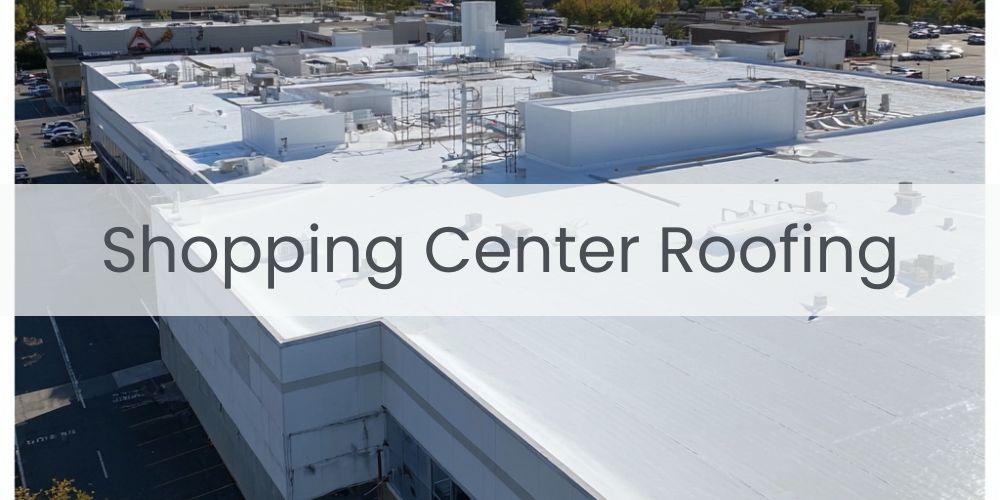
TPO roofing supports shopping center roofing systems by maintaining thermal stability, moisture control, and envelope reliability under continuous public occupancy and mixed-use commercial operation. Shopping centers operate with extended hours, fluctuating foot traffic, and a combination of retail, dining, and service tenants that place sustained and variable demands on roof assemblies. TPO roofing systems are used on shopping centers where uncontrolled heat gain, moisture intrusion, or membrane failure would disrupt tenant operations, damage interior finishes, or compromise customer safety and business continuity. Shopping center roofing systems are subjected to sustained solar heat exposure, large uninterrupted roof spans, dense rooftop mechanical equipment for tenant HVAC, frequent service access, and seasonal environmental stress common to retail properties. If shopping center roof assemblies are not engineered to manage heat reflection, seam integrity, attachment performance, and drainage behavior, failures can propagate beneath the membrane surface. Once moisture enters a shopping center roof assembly, it can migrate laterally through insulation layers, reduce thermal resistance, damage ceilings and tenant spaces, and introduce slip, safety, and operational risks in occupied retail environments below. TPO roofing for shopping centers focuses on preventing these failure mechanisms, not merely improving surface efficiency. TPO shopping center roofing is the process of installing a continuous, heat-welded thermoplastic membrane system with defined attachment methods, reflective surfaces, and engineered detailing to create a watertight and thermally controlled roof assembly. Unlike generic commercial applications, shopping center roofing systems must maintain consistent performance under continuous occupancy, tenant turnover, rooftop congestion, and limited disruption tolerance during trading hours. Without proper system design, minor deficiencies in seams, flashings, or drainage geometry can escalate into tenant disruption, revenue loss, and repeated maintenance events. TPO Roofing Contractor installs TPO roofing systems for shopping centers as operational control systems, engineered to regulate heat, block moisture intrusion, and preserve interior stability across strip malls, lifestyle centers, open-air plazas, and enclosed shopping centers throughout the United States.
How Does TPO Shopping Center Roofing Control Heat, Moisture, and Revenue Risk?
Shopping center roof failures occur when heat, moisture, and mechanical stress overwhelm roofing assemblies that are not designed for continuous public occupancy and tenant-driven mechanical demand. Persistent solar exposure raises roof surface temperatures across large retail spans, daily thermal cycling stresses seams and attachments, and rooftop HVAC units serving multiple tenants concentrate vibration, penetrations, and load at service zones. On shopping centers, these forces act continuously and unevenly across the roof field, increasing the risk of seam fatigue, attachment loosening, and drainage restriction over time. TPO roofing systems control these risks by forming a monolithic, non-porous membrane barrier that resists thermal movement and prevents moisture migration beneath the roof surface. Heat-welded seams create continuous joints that do not separate under repeated thermal cycling. Reflective membrane surfaces reduce roof surface temperatures, limiting heat transfer into tenant spaces and supporting HVAC efficiency across retail units. Engineered attachment systems maintain secure connection to the roof deck, preventing uplift or movement that could compromise watertight integrity during storms or high-wind events. Integrated flashing and drainage layouts prevent water from entering at penetrations, parapets, and mechanical interfaces where shopping center roofs are most vulnerable.
The shopping center TPO roofing system creates the following system-level performance relationships:
- Heat-welded TPO seams → form continuous membrane joints → thermal cycling does not separate seams
- Reflective membrane surfaces → limit solar heat gain → tenant interior temperatures remain stable
- Non-porous TPO structure → blocks moisture migration → water cannot spread beneath the roof
- Engineered attachment systems → secure membrane under load → mechanical movement does not loosen assemblies
- Integrated flashing at penetrations → seals HVAC and service zones → moisture does not enter tenant spaces
- Designed drainage geometry → evacuates water efficiently → ponding does not stress seams or insulation
Each of these outcomes results from coordinated system design decisions, ensuring that TPO roofing functions as a stability and risk-control layer rather than a passive surface covering in shopping center and retail environments.
What Conditions Require TPO Roofing on Shopping Centers?
TPO roofing is required on shopping centers when the operating conditions of the property create sustained exposure to heat, moisture, and mechanical stress that cannot be reliably controlled by conventional roofing systems. Shopping centers operate under continuous public occupancy, extended trading hours, and multi-tenant configurations that leave little tolerance for roof failure, interior disruption, or reactive maintenance. When uncontrolled heat gain, moisture intrusion, or membrane instability threatens tenant operations, customer safety, or revenue continuity, the roof assembly must function as an engineered control system rather than a basic weather barrier. Shopping center roofing systems are subjected to large uninterrupted roof spans, sustained solar heat exposure, dense rooftop HVAC equipment serving multiple tenants, and frequent service access for mechanical maintenance. These conditions create repeated thermal cycling across the membrane surface, concentrated vibration and penetration density at service zones, and elevated drainage demand during seasonal rainfall. If seam integrity, attachment performance, and drainage behavior are not engineered to operate together at the system level, localized defects allow moisture to enter and migrate laterally beneath the membrane, impacting tenant interiors, ceilings, inventory areas, and publicly occupied spaces below. TPO roofing becomes necessary on shopping centers when traditional systems cannot maintain seam continuity, control roof surface temperature, or prevent moisture migration under continuous operational stress. Heat-welded seams provide continuity across wide retail roof spans, reflective membrane surfaces limit solar heat gain that would otherwise destabilize tenant interior conditions, and defined attachment strategies resist movement caused by wind exposure and rooftop equipment vibration. Engineered drainage layouts are critical where large roof areas must evacuate water efficiently without creating ponding above occupied retail environments. Shopping centers also require TPO roofing when disruption tolerance is low. Tenant turnover, fixed lease obligations, and live trading conditions restrict shutdown windows for corrective work. In these environments, roofing systems must deliver predictable long-term performance with minimal intervention. TPO roofing is selected when the roof must protect revenue-generating spaces, maintain customer safety, and preserve operational continuity across retail properties with mixed-use occupancy and constant public exposure.
The conditions that require TPO roofing on shopping centers create the following system-level performance relationships:
- Sustained solar exposure → raises roof surface temperatures → reflective TPO limits heat transfer
- Large uninterrupted roof spans → increase thermal movement → heat-welded seams maintain continuity
- Dense rooftop HVAC equipment → concentrates vibration and penetrations → engineered attachments resist movement
- Seasonal rainfall over large roof areas → increases drainage demand → designed falls prevent ponding
- Occupied tenant spaces below → amplify impact of leaks → non-porous membrane blocks migration
- Limited disruption tolerance → restricts repair windows → durable systems reduce intervention needs
Each of these conditions represents an operational requirement rather than a material preference. TPO roofing is required on shopping centers when the roof must function as a controlled environmental system that protects tenants, customers, and revenue continuity under constant occupancy and commercial pressure.
Have a question about an upcoming project?
What Types of Shopping Centers Use TPO Roofing Systems in the United States?
TPO roofing systems are used on shopping centers where roof performance directly affects tenant operations, customer safety, and revenue continuity. Shopping centers are not uniform assets. Differences in roof span, occupancy density, mechanical loading, drainage configuration, and operating hours determine where TPO roofing is technically required rather than cosmetically preferred. TPO is selected where the roof must reliably control heat gain, moisture movement, and structural stress across large, publicly occupied commercial environments. Open-air shopping centers and lifestyle centers commonly use TPO roofing where multiple retail units are arranged beneath expansive low-slope roof areas exposed to sustained solar radiation. These properties support dense rooftop HVAC systems serving individual tenants, frequent service access, and continuous public circulation. TPO roofing is used to maintain seam integrity across wide roof spans, limit heat transfer into tenant interiors, and prevent moisture migration above walkways, storefronts, and occupied exterior zones. Strip malls and neighborhood retail plazas also utilize TPO roofing, particularly where long linear roof sections cover multiple tenant bays with shared drainage systems. In these facilities, localized roof failure can affect several businesses simultaneously. TPO systems provide continuous membrane coverage with heat-welded seams that restrict lateral moisture migration between units while reflective surfaces help stabilize interior conditions during peak trading hours. Enclosed shopping malls apply TPO roofing on large roof decks spanning anchor stores, interior corridors, food courts, and common areas. These buildings operate for extended hours with high public occupancy and complex mechanical infrastructure. TPO roofing systems are engineered to manage thermal cycling across massive roof areas, seal penetrations around mechanical equipment, and evacuate water efficiently without introducing risk to interior public environments. Big-box retail buildings and anchor tenants within shopping centers rely on TPO roofing where large-format interiors, high internal heat loads, and uninterrupted roof spans demand predictable membrane performance. In these environments, TPO roofing functions as an operational control layer that protects inventory, lighting systems, and customer areas from moisture intrusion and temperature instability. Mixed-use retail developments that combine shopping, dining, entertainment, and service tenants use TPO roofing where roof assemblies must perform consistently across varying occupancy patterns and mechanical demands. TPO systems allow uniform performance across diverse tenant uses while minimizing maintenance disruption in live trading environments.
Once the applicable shopping center property types are defined, TPO roofing performance can be expressed through direct system-level cause-and-effect relationships driven by how these buildings are used.
- Large uninterrupted retail roof spans → amplify thermal movement → heat-welded seams maintain continuity
- Dense rooftop HVAC serving multiple tenants → increases penetration density → engineered flashing controls entry points
- Sustained public occupancy below → raises leak impact severity → non-porous membrane blocks migration
- Extended trading hours → limit repair windows → durable TPO systems reduce intervention frequency
- Shared drainage systems → increase hydraulic stress → designed falls prevent ponding
- Revenue-generating tenant spaces → demand interior stability → reflective membranes limit heat gain
Each of these relationships reflects an operational requirement specific to shopping center environments. TPO roofing is selected where the roof must function as a controlled system that protects tenants, customers, and commercial continuity rather than as a passive weather barrier.
When Should a Shopping Center Engage a TPO Roofing Specialist?
A shopping center should engage a TPO roofing specialist when the roof assembly must operate as a revenue-protection system rather than a basic weather covering. This typically occurs when the property supports multiple tenants, extended trading hours, dense rooftop HVAC infrastructure, and continuous public occupancy that leaves little tolerance for leaks, heat instability, or unplanned disruption. Indicators such as recurring leaks affecting multiple units, localized ponding, seam stress, flashing deterioration, rising cooling demand, or tenant complaints about interior temperature fluctuation often signal that the existing roof system is no longer controlling heat and moisture effectively under live operating conditions. Shopping centers also engage TPO roofing specialists during planned roof replacement cycles, tenant reconfiguration projects, capital improvement programs, or major HVAC upgrades, where roofing decisions made at the specification and tender stage directly affect long-term commercial risk. At this stage, membrane selection, insulation thickness, attachment strategy, seam design, drainage layout, and penetration detailing must be engineered around tenant density, roof span, trading schedules, and maintenance access rather than minimum commercial specifications. A TPO roofing system evaluation or design review examines how an existing or proposed roof assembly will perform under real shopping center operating conditions. This includes assessing membrane and seam integrity, attachment performance, insulation behavior, drainage capacity, and interface detailing around tenant HVAC systems and service zones. For operating properties, this process determines whether targeted corrective work, system reinforcement, or full replacement is required to prevent tenant disruption and revenue loss. For new developments or major refurbishments, it validates that roofing specifications align with long-term retail use rather than short-term cost assumptions. Engaging a TPO roofing specialist at the evaluation or specification stage is a risk-management decision that aligns roof performance with tenant stability, customer safety, and commercial continuity. It ensures the roof supports uninterrupted trading rather than becoming a recurring source of leaks, disputes, and operational disruption across the life of the shopping center.