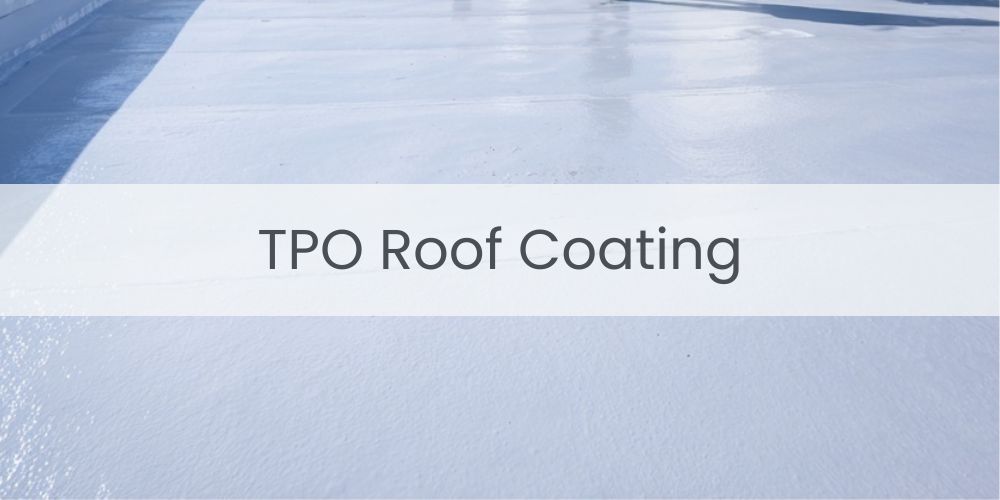
TPO roof coating controls surface-level membrane degradation by shielding the exposed TPO membrane field from ultraviolet radiation, thermal cycling, and environmental weathering. In TPO roofing systems, long-term performance loss does not originate uniformly across the roof assembly. It originates at the membrane surface where prolonged exposure to sunlight, temperature extremes, and atmospheric contaminants degrade reflectivity, elasticity, and material stability. These surface conditions govern whether a TPO roof assembly retains its designed service life and thermal performance or experiences accelerated aging that increases system vulnerability over time. Unlike welded seams and system interfaces, the membrane field is a continuous surface exposed primarily to environmental forces rather than concentrated mechanical stress. Ultraviolet radiation breaks down polymer chains at the membrane surface. Thermal cycling repeatedly expands and contracts the exposed membrane layer. Weather exposure introduces oxidation, surface erosion, and contaminant buildup. Because these forces act broadly across the membrane field rather than at discrete interfaces, surface degradation progresses gradually but affects large roof areas simultaneously. TPO roof coating is used where the membrane field remains structurally intact but surface degradation threatens long-term performance. When surface aging is left uncontrolled, TPO membranes can lose reflectivity, become less elastic, and exhibit increased brittleness, reducing tolerance to thermal movement and increasing the likelihood that future stress concentrates at seams, penetrations, and terminations. Surface degradation does not immediately create leak paths, but it shortens membrane service life and elevates downstream failure risk. For this reason, TPO Roofing Contractor treats TPO roof coating as a system-preservation measure rather than a leak-repair method. The process focuses on forming a continuous protective layer over the membrane field to limit ultraviolet exposure, moderate surface temperature fluctuation, and slow material aging. TPO roof coatings do not restore seam fusion or correct interface failures. Without intact seams and details, coatings cannot maintain watertight performance. When applied to sound membrane systems, however, TPO roof coating preserves surface integrity and extends functional service life under real environmental loading conditions.
How Does TPO Roof Coating Protect the Membrane Field Without Controlling Leaks?
TPO roof coating protects the membrane field by reducing the rate at which environmental forces degrade the exposed TPO surface. Ultraviolet radiation is reflected or absorbed by the coating layer rather than the membrane itself. Thermal cycling is moderated as surface temperatures fluctuate less dramatically. Weather exposure and airborne contaminants are resisted at the coating surface, limiting oxidation and erosion of the underlying membrane. Because these forces act uniformly across the membrane field, coating performance influences durability and longevity rather than immediate leak prevention. TPO roof coating does not control leak initiation because it does not restore membrane continuity at seams or interfaces. Instead, it preserves the physical properties of the membrane field so that stress does not prematurely transfer to system-critical details. By slowing surface aging, coatings reduce the rate at which membranes lose elasticity and reflectivity, supporting long-term system stability when seams and flashings are already performing as designed.
When TPO roof coating is engineered around how environmental forces act on exposed membrane surfaces, performance follows direct causal pathways:
- Ultraviolet exposure → polymer degradation at membrane surface → accelerated aging
- Reflective coating layer → reduced UV absorption → membrane surface stability preserved
- Thermal cycling at membrane surface → repeated expansion and contraction → material fatigue
- Coating thermal moderation → reduced surface temperature swing → membrane elasticity retained
- Weather exposure and oxidation → surface erosion → loss of reflectivity and durability
- Protective coating barrier → environmental isolation → service life extended
These outcomes result from treating the membrane field as a surface-exposed durability domain rather than a primary leak-control interface, ensuring that environmental degradation does not prematurely shorten the functional life of an otherwise intact TPO roofing system.
What Conditions Make TPO Roof Coating Appropriate or Inappropriate?
TPO roof coating is appropriate when the membrane field remains continuous and watertight but is experiencing surface-level degradation from ultraviolet exposure, thermal cycling, and environmental weathering. In TPO roofing systems, coating suitability is determined by membrane condition, not by age alone. Coatings are appropriate where seams, flashings, and penetrations are performing as designed and where surface oxidation, reflectivity loss, or gradual material stiffening threatens long-term durability rather than immediate leak control. TPO roof coating is used where environmental forces act uniformly across the membrane field and failure risk originates from surface aging rather than interface separation. Ultraviolet radiation degrades exposed polymer surfaces. Repeated thermal cycling reduces surface elasticity over time. Atmospheric contaminants accelerate oxidation and surface erosion. Because these forces do not create discrete leak paths, coatings function effectively as protective overlays that slow degradation when membrane continuity is intact. TPO roof coating is inappropriate where welded seams, terminations, penetrations, or transitions have lost functional integrity. When membrane continuity is compromised at interfaces, water can bypass the membrane surface and migrate beneath the roof assembly regardless of coating presence. Coatings cannot restore weld fusion, correct seam separation, or resolve flashing failures. Applying coatings under these conditions can conceal active failure pathways, delay detection, and allow subsurface moisture migration to expand unchecked. Coating suitability is therefore governed by system condition thresholds rather than surface appearance. Intact seams and details are a prerequisite. Where verification confirms membrane continuity and interface performance, coating can preserve surface properties and extend service life. Where interface failure exists, corrective system repairs must precede any coating application.
The conditions that determine whether TPO roof coating is appropriate or inappropriate create the following system-level performance relationships:
- Intact membrane field → continuous surface protection → coating preserves durability
- Ultraviolet exposure on intact membrane → surface degradation risk → coating reduces aging rate
- Verified seam and flashing integrity → no subsurface migration → coating does not mask failure
- Seam separation or flashing failure → membrane discontinuity → coating cannot prevent leaks
- Coating over failed interfaces → concealed water entry → system damage escalates
- Correct sequencing of repair before coating → restored system control → coating performs as intended
Each of these conditions represents a distinction between surface preservation and system repair. TPO roof coating is appropriate only when applied to structurally sound membrane systems where failure risk is environmental rather than interface-driven. For this reason, TPO Roofing Contractor evaluates membrane continuity and interface performance before recommending coating, ensuring that coating application extends service life without masking underlying system failure.
Have a question about an upcoming project?
How Is TPO Roof Coating Applied and Verified for Long-Term Performance?
TPO roof coating is applied to preserve membrane surface integrity by forming a continuous protective layer over the intact TPO membrane field. In TPO roofing systems, coating performance depends on surface preparation, material compatibility, and controlled application rather than thickness alone. Proper application ensures that the coating functions as an environmental barrier that reduces ultraviolet exposure, moderates thermal cycling, and limits surface oxidation without interfering with membrane flexibility. Application begins with verifying that the membrane field is clean, dry, and structurally sound. Surface preparation removes dirt, oxidation, biological growth, and contaminants that would prevent uniform adhesion. Areas of the membrane field are assessed to confirm continuity, while seams, flashings, and penetrations are verified separately to ensure that coating is not being used to compensate for interface failure. Once preparation is complete, coating material is applied at controlled coverage rates to achieve a continuous, uniform film across the membrane surface. Proper coating application must account for operating conditions across the roof field. Application thickness, curing time, and environmental conditions are managed to ensure that the coating bonds consistently without trapping moisture or restricting membrane movement. Correctly applied coatings remain flexible, accommodate thermal expansion and contraction of the underlying membrane, and maintain surface reflectivity under prolonged exposure. Verification focuses on confirming that the coating performs as a surface-protection system rather than a cosmetic layer. Visual inspection confirms uniform coverage and absence of voids, pinholes, or thin spots. Adhesion testing verifies that the coating remains bonded under expected environmental stress. Surface continuity is confirmed to ensure that the coating forms an uninterrupted protective barrier across the membrane field. Verification does not replace seam or interface testing, as coating performance is independent of weld integrity.
The coating application and verification process establishes the following system-level performance relationships:
- Prepared membrane surface → contaminants removed → coating adhesion is uniform
- Controlled coating thickness → continuous protective layer → UV exposure is reduced
- Flexible cured coating → accommodates thermal movement → membrane elasticity is preserved
- Uniform surface coverage → environmental isolation → oxidation and erosion are limited
- Verified coating adhesion → resistance to weather exposure → surface durability maintained
- Coating applied to intact membrane field → surface preservation achieved → service life extended
Each of these outcomes confirms that TPO roof coating is functioning as a surface-preservation system rather than a leak-control measure. TPO roof coating achieves long-term performance only when applied and verified under controlled conditions on membranes with intact seams and details. For this reason, TPO Roofing Contractor applies and verifies TPO roof coatings based on membrane condition, environmental exposure, and performance thresholds to ensure durability without masking system-level failure.
When Should a Property Engage a TPO Roofing Contractor for Roof Coating?
A property should engage a TPO roofing contractor for roof coating when the membrane field remains watertight but surface degradation threatens long-term performance and service life. This applies when inspection confirms intact seams, flashings, and penetrations, and when ultraviolet exposure, thermal cycling, or environmental weathering is accelerating surface aging rather than creating active leak pathways. At this stage, coating is a preventive control decision, not a repair response. Engagement is appropriate once surface conditions indicate declining reflectivity, early oxidation, or reduced surface elasticity that, if left unaddressed, would shorten membrane life and increase downstream stress at seams and details. Delaying coating under these conditions allows surface degradation to progress until corrective options become more limited, costly, or invasive. Conversely, applying coating before membrane continuity is verified risks concealing interface failures and misallocating capital toward surface treatment instead of system repair. TPO Roofing Contractor provides TPO roof coating services based on membrane condition verification, interface performance confirmation, and exposure-driven risk assessment. This ensures that roof coating is applied only when it functions as a system-preservation measure, extending service life and maintaining thermal performance without masking seam or detail failure. Engaging a TPO roofing contractor at the correct decision point aligns coating application with long-term roof system integrity, allowing properties to preserve functional membranes rather than defer inevitable system repairs through surface treatment alone.