
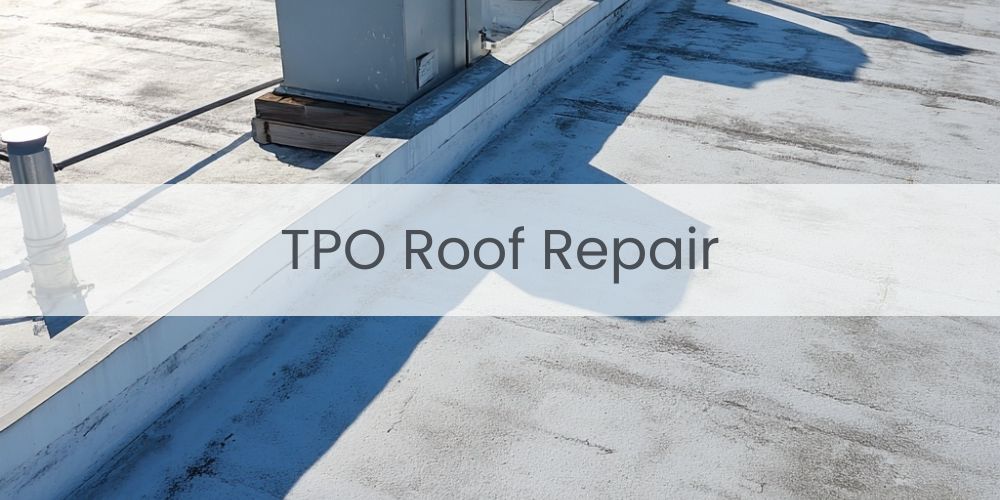
TPO roof repair restores watertight performance by restoring membrane continuity at a verified failure interface where water is bypassing the TPO membrane surface and entering the roof assembly. In TPO roofing systems, active failure does not originate uniformly across intact membrane sheets. Active failure originates at a specific failure interface where weld integrity, detailing geometry, attachment restraint, or drainage behavior has degraded enough to create a discontinuity. That failure interface governs whether the roof returns to controlled watertight performance or continues operating with active leak pathways and subsurface moisture migration beneath an intact-appearing membrane field. Unlike maintenance, which preserves continuity while it is still intact, TPO roof repair begins after continuity loss has already occurred and the objective is restoration of system control. Thermal movement repeatedly opens and closes weakened seams and terminations, wind uplift applies cyclic peel stress at lap edges and perimeter zones, vibration concentrates fatigue at equipment bases and penetrations, and hydraulic pressure loads drains, low points, and transitions where water is forced against compromised details. Because these forces remain active after failure begins, TPO roof repair must restore continuity at the failure interface in a way that remains stable under movement and pressure rather than masking symptoms. TPO Roofing Contractor performs TPO roof repair as failure-interface restoration, targeting the interface that is allowing bypass so subsurface migration collapses and watertight behavior is restored under real operating forces.
How Does TPO Roof Repair Restore System Control and Stop Leak Escalation?
TPO roof failures escalate because water, movement, and pressure exploit a failure-interface discontinuity and drive subsurface moisture migration beyond the visible defect. Thermal movement widens openings at weakened seams and terminations, wind uplift increases peel stress at lap edges and perimeter zones, vibration repeatedly loads penetration interfaces at equipment bases, and hydraulic pressure concentrates at drains, low points, and transitions where water is forced against compromised detailing. On large commercial roofs, these forces allow moisture to migrate laterally beneath the membrane surface so interior symptoms can appear far from the verified failure interface. TPO roof repair restores system control by isolating the verified failure interface, re-establishing membrane continuity through heat-welded fusion or membrane patch continuity, and re-forming interface geometry so water cannot bypass the TPO membrane surface under operating loads. When the repaired seam, penetration, transition, termination, attachment zone, or drainage interface returns to continuous watertight behavior, subsurface migration collapses and localized continuity loss does not expand into system-wide roof failure.
The TPO roof repair process creates the following system-level performance relationships:
- Water bypass at failure interface → discontinuity confirmed → failure interface isolated
- Failure interface isolated → repair scope defined → correction targets source interface
- Membrane continuity restored at breach → bypass path eliminated → water entry stops
- Membrane continuity restored at welded seam → lap interface sealed → migration path collapses
- Penetration detailing geometry restored → vibration tolerance restored → leak path eliminated at equipment bases
- Termination restraint and geometry restored → uplift peel resisted → edge opening does not recur
- Drainage interface continuity restored → hydraulic forcing blocked → water does not enter at low points
- Subsurface migration present → symptom location misleads → source-interface correction restores repair accuracy
Each of these outcomes results from restoration decisions that restore membrane continuity at the verified failure interface, ensuring that TPO roof repair stops active leak pathways rather than masking downstream symptoms.
What Conditions Trigger TPO Roof Repair?
TPO roof repair is triggered when a TPO roofing system has verified membrane continuity loss at a specific failure interface and watertight performance can no longer be maintained under normal operating forces. Repair triggers are not defined by interior staining alone. Repair triggers are defined by confirmed discontinuity at seams, penetrations, transitions, terminations, attachment zones, or drainage interfaces where water can bypass the membrane surface and enter the roof assembly. Unlike maintenance triggers, which indicate rising risk while continuity is intact, repair triggers indicate continuity has already failed and restoration is required. Water-entry triggers include active leakage during rainfall, recurring interior leakage patterns that correlate with roof-level failure interfaces, wet insulation mapping that confirms moisture within the assembly, or moisture intrusion confirmed at an interface even when interior symptoms are intermittent. Interface-failure triggers include seam separation confirmed by probe testing, lap-edge peel opening, penetration detailing discontinuity, transition discontinuity at a change in plane, termination pull-back, membrane punctures or tears, and drainage-interface defects that allow bypass under hydraulic loading. Force-response triggers include thermal movement that opens seams or terminations during temperature cycling, wind uplift that produces lap-edge peel stress or edge instability at perimeter zones, vibration-driven fatigue at equipment bases and penetrations, and ponding-driven hydraulic pressure that forces water through compromised drains, low points, and transitions. Because these triggers indicate active or imminent water entry at a known failure interface, TPO roof repair is required to restore membrane continuity and stop subsurface moisture migration before the failure zone expands. TPO Roofing Contractor treats repair triggers as verified continuity-loss thresholds that require failure-interface restoration rather than monitoring, surface patching, or preservation work.
The conditions that trigger TPO roof repair create the following system-level performance relationships:
- Verified seam separation → membrane continuity lost → water bypass occurs
- Lap-edge peel opening → uplift peel stress increases → separation widens under cycling
- Membrane puncture or tear → direct discontinuity forms → water enters the roof assembly
- Penetration detailing discontinuity → vibration stress concentrates → concentrated entry path develops
- Transition discontinuity at change in plane → movement stress concentrates → bypass pathway forms
- Termination pull-back → edge restraint reduces → opening propagates under uplift and cycling
- Drain or low-point defect → hydraulic pressure concentrates → forced entry occurs at the interface
- Subsurface moisture migration confirmed → symptom location misleads → source-interface correction required
Each of these conditions represents confirmed membrane continuity loss at a failure interface, not a maintenance risk signal. TPO roof repair is required when these triggers are present to restore membrane continuity, stop subsurface moisture migration, and return the roof assembly to controlled watertight performance under thermal movement, wind uplift, vibration, and hydraulic pressure.
Have a question about an upcoming project?
How Is TPO Roof Repair Verified After Continuity Restoration?
TPO roof repair is verified by confirming that the repaired failure interface maintains membrane continuity under mechanical stress and does not permit bypass under the operating forces that created the failure state. Verification focuses on the same interfaces that govern failure behavior: seams, penetrations, transitions, terminations, attachment zones, and drainage interfaces. Seam verification confirms that the repaired lap interface resists separation under probe resistance and maintains continuous fusion behavior. Penetration and termination verification confirms that restored interface geometry remains stable under vibration and uplift-induced peel stress. Drainage-interface verification confirms that hydraulic loading at low points and drains does not force water against a remaining discontinuity. Repair is considered complete only when the repaired interface is verified to behave as a continuous watertight plane under the expected thermal movement, wind uplift, vibration, and hydraulic pressure of service conditions.
The verification process creates the following system-level performance relationships:
- Probe resistance at repaired seam → continuity confirmed → lap interface does not reopen
- Stable penetration detailing under vibration → geometry maintained → entry path eliminated
- Stable termination restraint under uplift → peel resisted → edge opening does not recur
- Drainage behavior under loading → hydraulic forcing controlled → bypass at low points prevented
- Verified interface continuity → subsurface migration collapses → leak escalation stops
Each of these outcomes confirms restoration of failure-interface control rather than cosmetic surface change. TPO roof repair is verified only when the repaired failure interface maintains membrane continuity under real operating forces.
When Should a Property Engage a TPO Roofing Contractor for Roof Repair?
A property should engage a TPO roofing contractor for roof repair when a TPO roofing system has verified membrane continuity loss and watertight performance can no longer be maintained at seams, penetrations, transitions, terminations, attachments, or drainage interfaces under normal operating conditions. This applies when active water entry is occurring, when recurring leakage persists after prior interventions, or when inspection and testing confirm discontinuity at a specific failure interface even if interior symptoms are intermittent. Engagement is appropriate when thermal movement is opening weakened seams or terminations, when wind uplift is producing edge instability or lap-edge peel opening, when vibration is stressing penetration interfaces at equipment bases, or when hydraulic pressure at drains and low points is forcing water through compromised detailing. At this decision point, the risk is defined by continued subsurface moisture migration within the roof assembly rather than visible staining alone. Delaying professional repair increases the likelihood that concealed moisture expands laterally through insulation layers and deck planes, reduces thermal resistance, corrodes attachments, and enlarges the corrective scope beyond the original discontinuity. Because symptom location can be decoupled from entry location on large roofs, engaging a qualified contractor ensures that repair targets the true failure interface and restores membrane continuity rather than masking effects. For this reason, TPO Roofing Contractor provides TPO roof repair services focused on isolating the failed interface, restoring membrane continuity, and verifying that repaired seams, penetrations, transitions, terminations, attachments, and drainage interfaces return to controlled watertight behavior under thermal movement, wind uplift, vibration, and hydraulic pressure. Engaging a TPO roofing contractor at the correct decision point aligns repair scope with verified system failure, stops ongoing moisture migration, and prevents localized continuity loss from escalating into system-wide roof degradation.