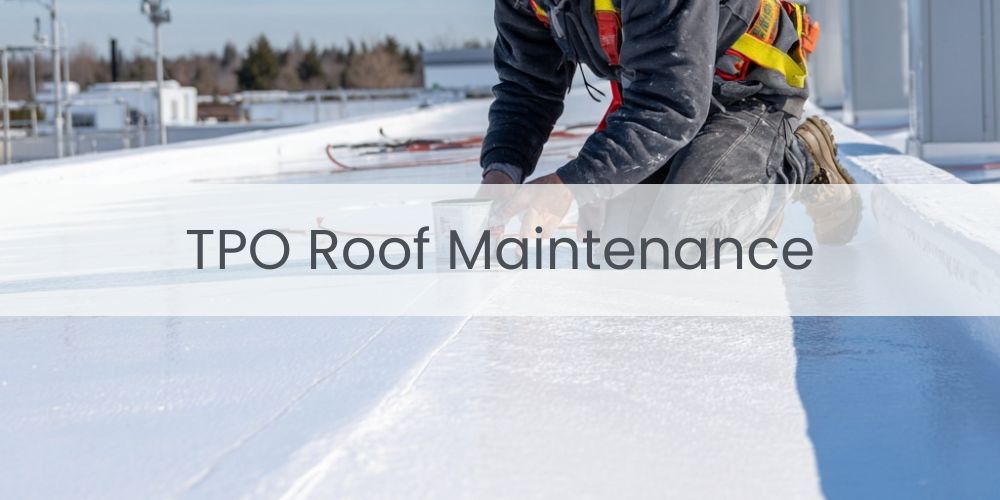
TPO roof maintenance preserves membrane continuity and watertight performance while the roof assembly remains intact by controlling degradation at seams, penetrations, transitions, attachments, and drainage interfaces where thermal movement, wind uplift, vibration, and hydraulic pressure act on the system. Maintenance conditions occur when cyclic loading, environmental exposure, debris accumulation, and drainage restriction are increasing stress at these interfaces, even though the membrane field remains continuous and active water entry has not begun. These interface conditions govern whether a TPO roof assembly continues to absorb movement, resist uplift, and shed water without loss of continuity or develops latent discontinuities that progress into leak initiation. TPO roof maintenance focuses on sustaining interface performance and drainage function before separation forms at seams and details. TPO roof maintenance is the process of verifying and correcting early-stage interface vulnerabilities by maintaining drainage flow paths, stabilizing seam and termination condition, preserving penetration and transition detailing, and removing stress-concentrating conditions across the roof field. Unlike leak detection, which is performed after membrane continuity has failed, maintenance is performed while continuity is intact and the objective is preservation rather than failure-path tracing. Under these conditions, roof systems experience repeated thermal cycling, wind-induced loading, equipment vibration, and rainfall-driven hydraulic loading that can gradually reduce interface tolerance without obvious surface indicators. Without disciplined maintenance, interface degradation progresses from early fatigue to discontinuity. TPO Roofing Contractor performs TPO roof maintenance as a system-preservation service designed to preserve interface continuity, maintain drainage performance, and sustain long-term watertight behavior under real operating forces.
How Does TPO Roof Maintenance Preserve Interface Performance and Prevent Leak Initiation?
TPO roof failures initiate when unmanaged movement, pressure, and contamination concentrate stress at seams, terminations, penetrations, transitions, and drainage points until interface continuity is reduced. Thermal expansion and contraction repeatedly loads seams and terminations. Wind uplift applies cyclic stress at attachment zones and perimeter conditions. Vibration transmits localized stress into penetrations and equipment bases. Hydraulic pressure increases at drains, low points, and transitions when flow paths are restricted. On large commercial roofs, these forces act repeatedly across seasons, allowing small interface weaknesses to progress into discontinuities that become leak initiation points. TPO roof maintenance preserves interface performance by sustaining drainage capacity, stabilizing seam and termination condition, and correcting early degradation before continuity loss occurs. By preserving interface behavior under operating forces, maintenance prevents latent discontinuities from progressing into active leak pathways.
The TPO roof maintenance process creates the following system-level performance relationships:
- Debris accumulation at drains → restricts flow paths → hydraulic pressure increases at low points
- Restricted drainage flow → standing water persists → interface loading increases at transitions
- Thermal cycling at seams → fatigue accumulates → seam continuity is preserved
- Wind uplift at attachment zones → cyclic pull stress increases → membrane displacement is prevented
- Vibration at penetrations → detailing stress concentrates → interface separation is prevented
- Interface fatigue at terminations → continuity tolerance declines → early correction preserves continuity
Each of these outcomes results from system-preservation decisions made before continuity loss occurs, ensuring that interface degradation and drainage stress do not progress into leak initiation or system-wide roof failure.
What Conditions Trigger TPO Roof Maintenance?
TPO roof maintenance is triggered when a TPO roofing system remains watertight but measurable site conditions indicate that interface stress is increasing and membrane continuity is likely to degrade if not corrected. Maintenance is initiated when drainage performance changes, interface condition indicators appear, or rooftop use and exposure cycles create repeatable stress at seams, penetrations, transitions, attachments, and drains. These triggers are defined by early loss of control signals rather than interior leakage. Drainage-related triggers include debris at drains, slowed flow, recurring ponding, overflow staining, or sediment lines that indicate reduced discharge capacity. Interface-related triggers include seam edge irregularities, early termination movement, penetration detailing wear, attachment zone looseness, or prior repair concentration in the same interface band. Exposure and use triggers include post-storm debris loading, sustained seasonal temperature cycling, increased rooftop traffic, equipment servicing activity, or new mechanical vibration sources that elevate localized fatigue risk. Because these triggers emerge while the membrane field can still appear intact, maintenance is required to preserve membrane continuity and prevent latent interface degradation from progressing into discontinuity and leak initiation. For this reason, TPO Roofing Contractor treats maintenance triggers as verifiable risk thresholds that signal the need for proactive interface management and drainage control before system behavior degrades.
The conditions that trigger TPO roof maintenance create the following system-level performance relationships:
- Drainage restriction indicators → reduced discharge capacity → ponding stress increases at low points
- Recurring ponding patterns → sustained interface loading → discontinuity risk rises at transitions
- Seam edge irregularities → early interface change detected → continuity preservation required
- Termination or penetration wear → detailing tolerance declines → separation risk increases
- Attachment zone looseness → restraint performance reduces → displacement risk rises under uplift
- High traffic or new vibration sources → localized fatigue increases → penetration interfaces degrade faster
Each of these conditions represents a rising risk state while membrane continuity is still intact, not an active leak condition. TPO roof maintenance is required when these triggers are present to preserve interface performance, maintain drainage function, and prevent early degradation from progressing into leak initiation and system-wide roof failure.
Have a question about an upcoming project?
How Is TPO Roof Maintenance Performed and Verified?
TPO roof maintenance is performed by systematically preserving membrane continuity and interface performance at seams, penetrations, transitions, attachments, and drainage points while the roof assembly remains watertight. Unlike leak detection, which traces active moisture intrusion after continuity loss, maintenance acts before discontinuities form by reducing stress concentration and restoring functional condition at existing interfaces. The process focuses on maintaining seam stability, confirming attachment resistance, preserving detailing integrity at penetrations and transitions, and sustaining drainage flow so hydraulic pressure does not accumulate at low points. Because thermal movement, wind uplift, vibration, and hydraulic loading act continuously during service life, maintenance is performed as repeatable control work that keeps interfaces operating within tolerance rather than allowing fatigue to progress into separation. Verification is achieved when maintenance actions confirm that interfaces remain continuous under expected loading and that drainage performance prevents standing water and pressure concentration that would accelerate degradation. TPO roof maintenance is considered complete only when critical interfaces and drainage paths are confirmed to preserve watertight system behavior without reliance on assumption or deferred corrective action.
The TPO roof maintenance process creates the following system-level performance relationships:
- Seam condition evaluated → early fatigue identified → continuity preserved
- Attachment stability verified → uplift resistance confirmed → displacement risk reduced
- Penetrations and transitions reviewed → detailing integrity confirmed → separation prevented
- Drainage paths cleared → flow capacity restored → hydraulic pressure reduced
- Localized vibration zones assessed → stress concentration controlled → interface fatigue reduced
- Maintenance verification completed → system behavior confirmed → leak initiation risk lowered
Each of these outcomes results from proactive interface control rather than reactive repair. TPO roof maintenance is performed and verified when seams, attachments, details, and drainage paths are confirmed to preserve membrane continuity and stable watertight behavior under real thermal movement, wind uplift, vibration, and hydraulic loading.
When Should a Property Engage a TPO Roofing Contractor for Roof Maintenance?
A property should engage a TPO roofing contractor for roof maintenance when a TPO roof remains watertight but operating conditions indicate rising risk that seams, penetrations, transitions, attachments, or drainage interfaces may lose membrane continuity under thermal movement, wind uplift, vibration, or hydraulic pressure. This applies when debris accumulation, drainage restriction, recurring ponding, interface contamination, minor seam fatigue indicators, or increased rooftop activity suggests that stress is concentrating at system interfaces even though active water intrusion has not begun. Engagement is also appropriate on a scheduled basis after seasonal exposure cycles or storm periods, when repeated loading increases the probability that interface performance has degraded beneath an intact-appearing membrane surface. Decisions made at this stage govern whether interface degradation is controlled early or allowed to progress into discontinuity that later presents as leak initiation and subsurface migration. Delaying professional maintenance increases the likelihood that drainage stress, seam fatigue, attachment loosening, and detailing wear will compound until corrective work shifts from preservation to repair. TPO Roofing Contractor provides TPO roof maintenance services focused on preserving membrane continuity through seam stability verification, attachment performance confirmation, interface detailing preservation, and drainage function control. This ensures that maintenance sustains system behavior under real operating forces rather than relying on surface appearance or waiting for failure indicators. Engaging a TPO roofing contractor for roof maintenance at the correct decision point aligns preventive control with verified interface condition, allowing properties to preserve long-term watertight performance before operating forces convert early degradation into active failure.