
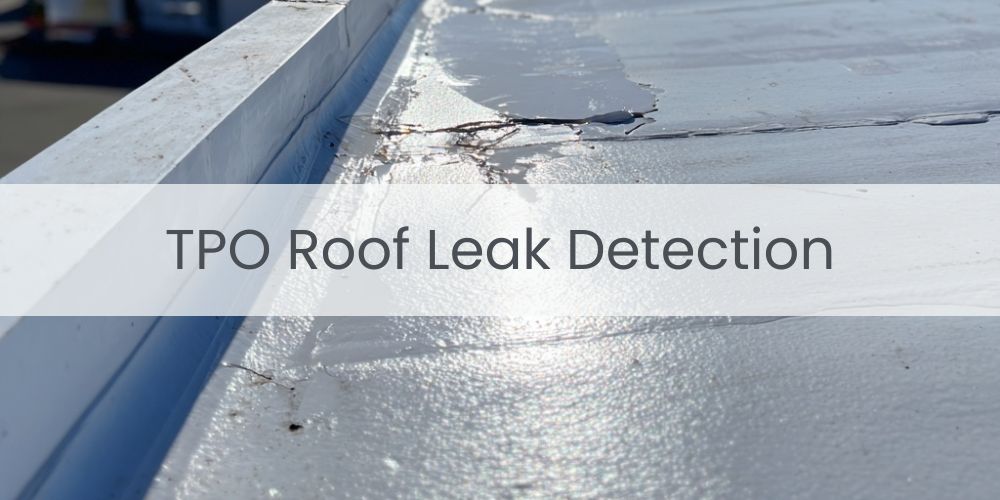
TPO roof leak detection identifies active moisture intrusion when membrane continuity has already failed and water is entering the roof assembly. Leak conditions occur when TPO membranes, seams, flashings, penetrations, transitions, or drainage interfaces are compromised by thermal movement, wind uplift, mechanical stress, or hydraulic pressure, allowing water to bypass the membrane surface. Once water enters a TPO roof system, it can migrate laterally through insulation layers, reduce thermal resistance, corrode attachments, and cause interior damage far from the original point of entry. TPO roof leak detection focuses on locating the true breach locations that allow active moisture intrusion rather than addressing visible interior symptoms alone. TPO roof leak detection is the process of tracing water migration back to its point of entry by evaluating how the roof system behaves under live environmental conditions. Unlike inspection, which verifies intact system performance, leak detection is performed when membrane continuity has already been lost and moisture movement may be occurring beneath an intact-appearing membrane surface. Under these conditions, roof systems experience combined hydraulic pressure, wind-driven moisture, and thermal movement that can obscure the true source of leakage. Without accurate leak detection, repairs risk targeting secondary damage while allowing continued subsurface migration. TPO Roofing Contractor performs TPO roof leak detection as a failure-path identification service, designed to locate active breach points, isolate moisture entry routes, and ensure corrective work addresses the actual source of leakage rather than downstream effects.
How Does TPO Roof Leak Detection Control Active Water Intrusion?
TPO roof leak failures escalate because water exploits breached interfaces and migrates beneath the membrane surface under the influence of movement and pressure. Thermal expansion and contraction open failed seams and terminations, wind-driven rain forces water laterally beneath the membrane, and hydraulic pressure concentrates at drains, low points, and transitions. On large commercial roofs, these forces act simultaneously, allowing moisture to travel significant distances from the original breach before becoming visible inside the building. TPO roof leak detection controls this escalation by identifying the exact points where water enters the roof system and tracing subsurface migration paths back to their origin. By isolating active leak pathways, leak detection enables corrective work to address the actual failure interface rather than masking symptoms, restoring control over moisture movement before further escalation occurs.
The TPO roof leak detection process creates the following system-level performance relationships:
- Active membrane breach → allows water entry → breach location identified
- Failed seam interface → opens migration path → leak source isolated
- Flashing failure at penetration → concentrates leak flow → entry point traced
- Hydraulic pressure at drains → forces water beneath membrane → migration path mapped
- Wind-driven moisture → spreads subsurface leakage → origin distinguished from symptom
- Lateral insulation saturation → masks leak source → detection restores repair accuracy
Each of these outcomes results from failure-path identification decisions rather than surface-level assumptions, ensuring that leak correction addresses the true cause of water intrusion instead of secondary effects.
What Conditions Trigger TPO Roof Leak Detection?
TPO roof leak detection is triggered when a TPO roofing system experiences active loss of membrane continuity that allows water to enter the roof assembly, but the true point of entry is unknown or cannot be reliably inferred from visible symptoms. Unlike routine inspection, leak detection is required when seams, penetrations, transitions, flashings, or drainage interfaces have already failed under thermal movement, wind uplift, mechanical stress, or hydraulic pressure, permitting moisture to bypass the membrane surface. These conditions typically arise during or after storm events, prolonged or intense rainfall, freeze–thaw cycles, rooftop mechanical activity, or following unsuccessful prior repairs where leakage persists despite surface intervention. Leak conditions are defined not by the presence of interior water alone, but by uncertainty in the failure pathway and risk of continued subsurface migration within the roof assembly. Once water enters a TPO roof system through an unidentified breach, it can migrate laterally through insulation layers, reduce thermal resistance, corrode attachments, and surface far from the original entry point. On large commercial roofs, leak behavior rarely remains localized. Wind-driven rain, thermal expansion and contraction, and hydraulic pressure at drains and low points can decouple interior symptoms from roof-level defects, allowing small breaches to feed widespread moisture movement. TPO roof leak detection is required when failure-path identification is necessary to locate active entry interfaces and prevent continued moisture migration before targeted corrective work can be engineered.
The failure conditions that trigger TPO roof leak detection create the following system-level performance relationships:
- Loss of membrane continuity at seams → water enters roof assembly → lateral subsurface migration begins
- Breached penetrations or transitions → concentrated entry points form → moisture spreads beneath intact membrane areas
- Hydraulic pressure at drains or low points → water forced through discontinuities → entry location obscured
- Wind-driven rainfall → lateral moisture movement beneath membrane → interior leaks appear remote from breach
- Thermal movement at failed interfaces → openings widen intermittently → leak behavior becomes inconsistent
- Recurring leaks after prior repairs → original failure path unresolved → continued bypass at source interface
Each of these conditions represents an active failure state with an unidentified or misleading entry path, not a cosmetic defect. TPO roof leak detection is required when these conditions are present to locate the true breach interface, interrupt ongoing subsurface migration, and ensure that subsequent repairs address the actual source of water intrusion rather than its secondary effects.
Have a question about an upcoming project?
How Is TPO Roof Leak Detection Performed and Verified?
TPO roof leak detection is performed by systematically tracing active moisture migration within the roof assembly back to its point of entry at failed system interfaces. Unlike inspection, which evaluates intact performance, leak detection is carried out after membrane continuity has already been lost and water is moving beneath the membrane surface. The process focuses on identifying breach locations at seams, penetrations, transitions, flashings, and drainage interfaces where thermal movement, wind uplift, and hydraulic pressure are allowing water to bypass the membrane. Because water can migrate laterally through insulation layers and along deck planes, the visible interior leak location cannot be used to infer the entry point. TPO roof leak detection therefore evaluates how moisture behaves under live or simulated operating conditions to distinguish the true breach interface from downstream symptoms. Verification is achieved when the identified entry location explains the observed migration pattern and moisture behavior within the roof assembly. Leak detection is considered complete only when the active failure path is isolated with sufficient certainty to allow targeted corrective work without reliance on assumption or trial repair.
The TPO roof leak detection process creates the following system-level performance relationships:
- Active moisture migration observed → subsurface pathways traced → entry interface isolated
- Water appearing distant from roof features → lateral movement confirmed → symptom decoupled from breach
- Hydraulic pressure applied at drains or low points → moisture response monitored → forced entry points identified
- Thermal movement during wet conditions → intermittent openings exposed → failed seams or transitions located
- Wind-driven moisture exposure → lateral spread evaluated → breach orientation determined
- Confirmed breach interface → migration path explained → corrective scope accurately defined
Each of these outcomes results from failure-path tracing rather than surface-level observation. TPO roof leak detection is performed and verified when the true point of water entry is identified, the subsurface migration route is understood, and corrective work can be directed at the actual failure interface rather than secondary damage caused by moisture movement within the roof assembly.
When Should a Property Engage a TPO Roofing Contractor for Leak Detection?
A property should engage a TPO roofing contractor for leak detection when a TPO roof is experiencing active or recurring water intrusion and the true point of entry cannot be reliably identified through visual observation or symptom location alone. This applies when interior leakage, moisture staining, or insulation saturation is present but does not align with visible roof defects, indicating that water may be migrating laterally beneath the membrane surface. Engagement is also appropriate when prior repairs have failed to resolve leakage, suggesting that the original failure interface was not correctly identified and that water is continuing to bypass the membrane system under operating conditions. Decisions made at this stage govern whether corrective work will be accurately targeted or whether additional trial repairs will allow continued subsurface migration and escalation of damage. Delaying professional leak detection increases the likelihood that concealed moisture, insulation saturation, attachment corrosion, and deck deterioration will expand beyond the original failure zone before the true entry interface is addressed. TPO Roofing Contractor provides TPO roof leak detection services focused on failure-path identification, moisture migration tracing, and entry-point isolation. This ensures that subsequent repairs address the actual breach interface rather than secondary damage caused by water movement within the roof assembly. Engaging a TPO roofing contractor for leak detection at the correct decision point aligns corrective action with verified system behavior, allowing properties to resolve active leakage based on confirmed entry paths rather than assumption, surface appearance, or repeated symptom-based repair.