
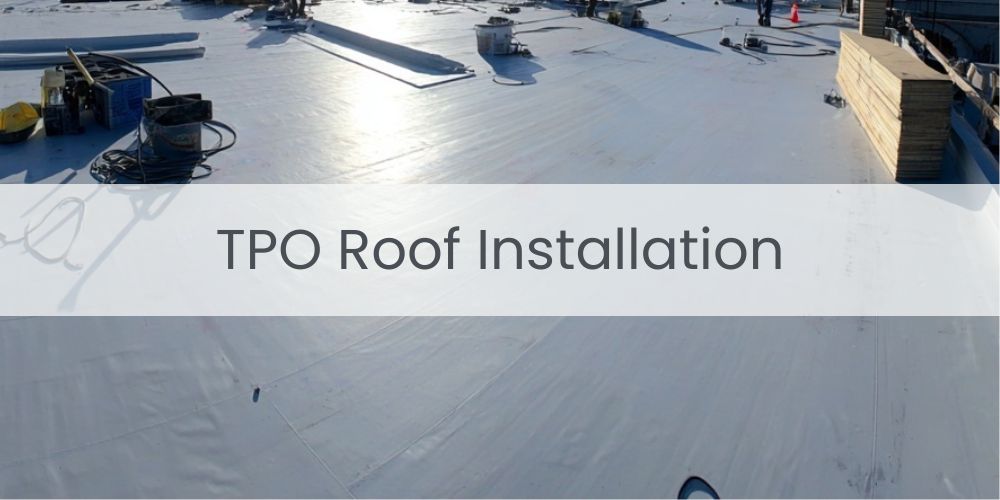
TPO roof installation controls system-level watertight performance by establishing continuous membrane integrity across the roof field, seams, and interfaces where movement, uplift, and water exposure act on the assembly. In TPO roofing systems, long-term failures do not originate uniformly across installed materials. They originate at interfaces created during installation where membrane sheets, attachments, seams, penetrations, and transitions must function together as a single waterproofing system. These installation-formed interfaces govern whether a TPO roof assembly maintains watertight performance under operating conditions or develops latent failure pathways beneath an otherwise intact membrane surface. Unlike surface preservation measures, roof installation creates the primary system geometry that must absorb structural and environmental forces from the outset. Thermal expansion and contraction act on membrane sheets and substrates simultaneously. Wind uplift applies negative pressure across the roof field, edges, and corners, stressing attachments and seams. Hydraulic pressure concentrates at drains, low points, and transitions, forcing water against installed interfaces. Because these forces act across the entire assembly rather than at a single location, installation quality determines whether the system manages movement, resists uplift, and controls water flow without loss of continuity. TPO roof installation is used where a complete roofing system must be assembled to control these forces from initial service life. When installation is improperly executed, stress concentrates at seams, terminations, and penetrations created during assembly. Once membrane continuity is compromised at these locations, water can bypass the surface layer and migrate laterally through insulation and deck assemblies, often surfacing far from the original defect. Installation-related failures frequently propagate beneath the membrane before becoming visible, undermining system performance without obvious surface indicators. For this reason, TPO Roofing Contractor treats TPO roof installation as system-critical engineering rather than material placement. The process focuses on establishing continuous membrane integrity through proper substrate preparation, controlled attachment, precise heat-welded seams, and engineered transitions at all interfaces. TPO roof installation does not compensate for later surface treatments or coatings. Without correct initial installation, even high-quality TPO membranes cannot maintain long-term watertight performance under real thermal, wind, and hydraulic loading conditions.
How Does TPO Roof Installation Establish System Integrity From the Start?
TPO roof installation establishes system integrity by coordinating membrane layout, attachment methods, seam welding, and interface detailing into a continuous waterproofing assembly. Membrane sheets are positioned and secured to accommodate thermal movement without excessive stress concentration. Heat-welded seams fuse adjacent sheets into a single continuous membrane plane rather than independent layers. Attachments and terminations are engineered to resist wind uplift while maintaining continuity at edges and transitions. Installation controls leak initiation by ensuring that water is managed at every interface created during assembly. Drainage components direct water away from vulnerable transitions. Seams and terminations are detailed to prevent water from bypassing the membrane surface. Because installation defines how the system responds to movement, uplift, and hydraulic pressure, correct execution prevents stress from concentrating at weak points that would otherwise develop into failure pathways.
When TPO roof installation is engineered around how forces act on the assembled system, performance follows direct causal pathways:
- Thermal movement across installed membrane → accommodated by layout and attachment → seams do not split
- Heat-welded seams during installation → continuous membrane plane → water cannot bypass the roof field
- Engineered attachment patterns → resistance to wind uplift → membrane remains secured under load
- Properly detailed transitions and penetrations → controlled water flow → leaks do not initiate at interfaces
- Coordinated drainage installation → reduced hydraulic pressure → water does not force entry at low points
- Continuous system geometry → balanced stress distribution → failure does not propagate beneath the membrane
These outcomes result from treating roof installation as the formation of a load-bearing waterproofing system rather than the placement of roofing materials, ensuring that the TPO roof assembly performs as intended under real operating conditions.
What Conditions Cause TPO Roof Installation to Fail or Require Correction?
TPO roof installation fails when the installed roofing system cannot maintain continuous membrane integrity under normal thermal movement, wind uplift, and hydraulic loading. In TPO roofing systems, failure does not originate from the membrane material itself. It originates from installation-created interfaces such as seams, attachments, penetrations, terminations, and transitions that were not formed to function together as a single load-bearing waterproofing system. These installation-defined interfaces determine whether a TPO roof assembly performs as designed or develops latent failure pathways beneath an otherwise intact membrane surface. TPO roof installation fails where system geometry does not align with operating forces. Thermal expansion and contraction act across membrane sheets and substrates. If installation layout and attachment do not accommodate this movement, stress concentrates at seams and terminations. Wind uplift applies negative pressure across the roof field, edges, and corners. Insufficient attachment patterns allow membrane displacement and loss of continuity. Hydraulic pressure concentrates at drains, low points, and transitions. Inadequately detailed interfaces permit water to bypass the membrane surface under normal loading conditions. When installation-created interfaces lose continuity, water entry does not remain localized. Once continuity is broken at an installed seam, termination, or penetration, water bypasses the membrane surface and migrates laterally through insulation layers and deck assemblies. This migration reduces thermal performance, accelerates attachment corrosion, and produces interior leakage far from the original installation defect. Installation-related failures frequently propagate beneath the membrane before becoming visible, allowing system degradation to progress without early surface indicators. Correction is required when TPO roof installation no longer allows the assembled system to absorb movement, resist uplift, and control water flow simultaneously. Where installation-created interfaces cannot perform these functions, the roof assembly cannot operate as a unified waterproofing system. In these conditions, corrective work must restore proper interface formation and membrane continuity rather than address surface symptoms.
The conditions that cause TPO roof installation to fail or require correction create the following system-level performance relationships:
- Inadequate attachment patterns → membrane displacement under uplift → continuity loss occurs
- Improper seam welding during installation → incomplete membrane fusion → water bypasses the roof field
- Insufficient accommodation of thermal movement → stress accumulation at interfaces → separation develops
- Poorly detailed penetrations and transitions → hydraulic pressure concentration → leaks initiate at interfaces
- Installation-defined discontinuities → lateral subsurface migration → failure propagates beneath the membrane
- Loss of interface continuity → breakdown of system behavior → roof performance degrades
Each of these conditions represents a loss of installation-level system control rather than a material defect. TPO roof installation requires correction when these failure states are present to re-establish membrane continuity, restore interface performance, and prevent localized installation deficiencies from escalating into system-wide roof failure.
Have a question about an upcoming project?
How Are TPO Roof Installation Failures Identified and Evaluated?
TPO roof installation failures are identified by evaluating whether installation-created interfaces maintain membrane continuity under mechanical stress without separation. In TPO roofing systems, evaluation does not rely on visible leaks alone. It focuses on whether seams, attachments, penetrations, terminations, and transitions formed during installation can absorb movement, resist uplift, and control water flow as a unified system. These interfaces determine whether the roof assembly is functioning as designed or operating with latent failure pathways beneath an intact membrane surface. Evaluation is performed at installation-defined interfaces because these locations govern system behavior. Mechanical stress from thermal expansion and contraction is assessed by observing movement response at seams and terminations. Wind uplift resistance is evaluated by inspecting attachment patterns and membrane stability across the roof field, edges, and corners. Hydraulic performance is assessed at drains, low points, and transitions where water pressure concentrates against installed details. These assessments determine whether installation geometry aligns with operating forces. Inspection methods focus on continuity and load response rather than surface appearance. Seam probing confirms whether welded seams maintain fusion under applied force. Attachment inspection verifies fastener spacing, engagement, and resistance to uplift loads. Transition and penetration detailing is examined to confirm that water is directed and sealed without bypass paths. Where necessary, controlled water testing and movement observation are used to identify subsurface migration risk that may not yet be visible at the surface. When evaluation identifies loss of continuity or inadequate force resistance at installation interfaces, the condition is classified as an installation-level failure rather than a material defect. These findings indicate that the roof assembly cannot perform as a continuous load-bearing waterproofing system under normal operating conditions.
The evaluation of TPO roof installation failures establishes the following system-level performance relationships:
- Probe resistance at seams → weld continuity confirmed → membrane integrity maintained
- Stable attachment patterns → resistance to uplift loads → membrane displacement prevented
- Properly detailed transitions → controlled water flow → bypass paths eliminated
- Verified drainage integration → reduced hydraulic pressure → water does not force entry
- Observed movement accommodation → stress distributed across system → interfaces remain intact
- Detected discontinuity at interfaces → loss of system behavior → corrective work required
Each of these evaluation outcomes confirms whether TPO roof installation is performing as a unified system or operating with latent failure risk. Installation failures are identified and evaluated by testing interface performance under expected forces, allowing corrective action to be based on system behavior rather than surface symptoms.
When Should a Property Engage a TPO Roofing Contractor for Installation Correction or Replacement?
A property should engage a TPO roofing contractor when evaluation confirms that installation-created interfaces cannot maintain membrane continuity under normal thermal movement, wind uplift, and hydraulic loading. In TPO roofing systems, this decision point is reached when seams, attachments, penetrations, terminations, or transitions formed during installation no longer function together as a unified waterproofing system. At this stage, performance risk is defined by loss of system behavior, not by isolated surface defects or material age. Engagement is appropriate once diagnostic findings show that installation deficiencies are allowing membrane displacement, seam separation, or water bypass at interfaces. Delaying corrective action under these conditions increases the likelihood that subsurface migration, insulation saturation, and attachment corrosion will expand beyond the original installation fault. Because installation-related failures often propagate beneath the membrane before becoming visible, postponement shifts remediation from targeted correction to broader system intervention. TPO Roofing Contractor provides installation correction and replacement services based on verified interface performance and force-response alignment rather than visible symptoms alone. This ensures that corrective work restores membrane continuity, re-establishes proper attachment and detailing, and returns the roof assembly to unified load-bearing behavior. Engaging a TPO roofing contractor at the correct decision point aligns corrective scope with actual system condition, preventing localized installation deficiencies from escalating into full roof system failure or premature replacement.