
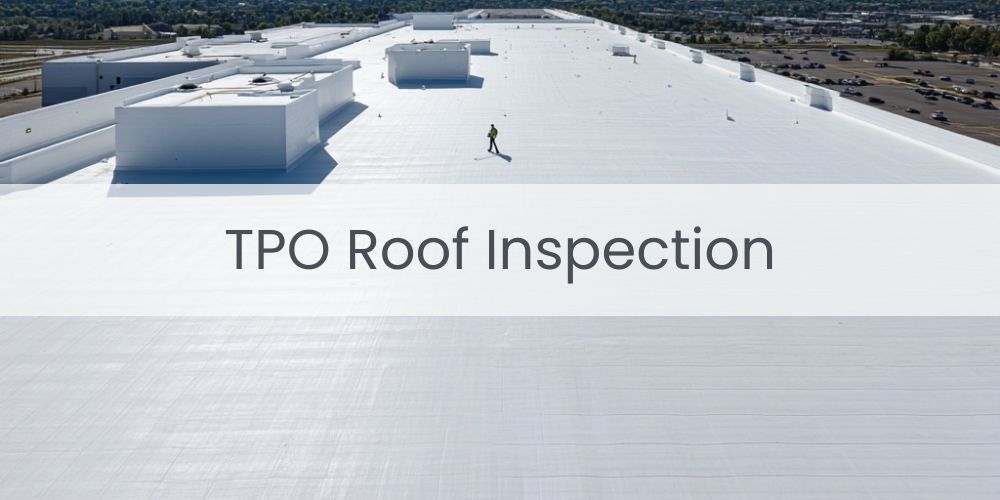
TPO roof inspection controls system-level failure risk by verifying membrane continuity at seams, penetrations, transitions, and drainage interfaces where movement, uplift, and water exposure act on the roof assembly. In TPO roofing systems, long-term failures do not originate uniformly across the membrane field. They originate at existing interfaces where membrane sheets, attachments, seams, penetrations, and transitions must continue to function together as a single waterproofing system over time. These inspection-defined interfaces govern whether a TPO roof assembly remains watertight under operating conditions or develops latent failure pathways beneath an otherwise intact membrane surface. Unlike installation or surface-preservation measures, roof inspection evaluates existing system geometry rather than creating or modifying it. Thermal expansion and contraction repeatedly load seams, terminations, and penetrations as materials move at different rates. Wind uplift applies cyclic stress at the roof field, edges, and corners, testing attachment stability and interface continuity. Hydraulic pressure concentrates at drains, low points, and transitions, forcing water against existing details rather than across the membrane surface. Because these forces act continuously throughout the roof’s service life, inspection determines whether the system continues to absorb movement, resist uplift, and control water flow without loss of continuity. TPO roof inspection is used where ongoing system performance must be verified rather than assumed. When material aging, movement fatigue, or detailing wear progresses unchecked, stress concentrates at seams, terminations, and penetrations already present within the system. Once membrane continuity is compromised at these locations, water can bypass the membrane surface and migrate laterally through insulation and deck assemblies, often surfacing far from the original defect. Because these failure conditions propagate beneath the membrane before becoming visible, roof performance can degrade significantly without obvious surface indicators. For this reason, TPO Roofing Contractor treats TPO roof inspection as system-critical verification rather than visual observation. The process focuses on confirming seam integrity, attachment stability, interface detailing, and drainage performance under real thermal, wind, and hydraulic loading. TPO roof inspection does not repair defects or restore membrane continuity. Without disciplined inspection that verifies ongoing system behavior, even properly installed TPO roofs can develop undetected failure pathways that undermine long-term watertight performance.
How Does TPO Roof Inspection Detect System Failure Before Leaks Develop?
TPO roof inspection detects early system failure by identifying loss of membrane continuity and interface performance before water entry becomes visible inside the building. Seam probing confirms whether welded seams maintain fusion under mechanical stress. Attachment evaluation determines whether uplift resistance remains intact across the roof field, edges, and corners. Drainage and transition inspection identifies areas where hydraulic pressure may concentrate against weakened details. By evaluating interface behavior under expected operating forces, inspection reveals latent failure conditions before subsurface migration escalates into active leakage.
When TPO roof inspection is engineered around how forces act on existing interfaces, performance follows direct causal pathways:
- Thermal movement at existing seams → interface fatigue detected → corrective action occurs before separation
- Wind uplift at attachments → resistance verified → membrane displacement is prevented
- Hydraulic pressure at drains → interface condition evaluated → water bypass risk identified
- Probe testing at seams → fusion integrity confirmed → membrane continuity preserved
- Inspection of transitions and penetrations → detailing performance verified → leaks do not initiate
These outcomes result from treating roof inspection as a system-verification process rather than a surface check, ensuring that latent failure pathways are identified and addressed before they escalate into system-wide roof failure.
What Conditions Trigger a TPO Roof Inspection?
TPO roof inspection is triggered when operating conditions indicate increased risk that existing membrane interfaces may no longer maintain continuity under normal thermal movement, wind uplift, and hydraulic loading. In TPO roofing systems, inspection is not triggered by visible leaks alone. It is triggered by conditions that elevate stress at seams, penetrations, terminations, transitions, and drainage points where system performance depends on continued interface integrity. These trigger conditions determine whether a TPO roof assembly should be verified for latent failure pathways before surface breach occurs. Inspection is required following events or conditions that alter force exposure across the roof assembly. Thermal cycling over time increases fatigue at seams and terminations. High-wind events elevate uplift forces at the roof field, edges, and corners, stressing attachments and interface detailing. Prolonged or intense rainfall increases hydraulic pressure at drains, low points, and transitions, forcing water against existing details. Aging, environmental exposure, and repeated movement cycles compound these forces, increasing the probability that interface performance has degraded beneath an intact membrane surface. TPO roof inspection is also triggered by observable indicators that suggest potential loss of system control without confirming failure. These indicators include changes in membrane tension, attachment movement, seam edge irregularities, drainage performance issues, or prior repair history at interfaces. While these signs do not confirm leakage, they signal that verification is required to determine whether membrane continuity and interface performance remain intact under operating conditions. For this reason, TPO Roofing Contractor treats inspection triggers as system-risk thresholds rather than reactive responses to leaks. Inspection is initiated when force exposure, system age, environmental conditions, or observed indicators suggest that latent failure pathways may be developing at critical interfaces. By triggering inspection at the correct conditions, system performance can be verified and corrective action planned before localized degradation escalates into active leakage or system-wide roof failure.
When conditions trigger a TPO roof inspection, the following system-level performance relationships apply:
- Elevated thermal cycling → increased interface fatigue risk → inspection required
- High-wind exposure → increased uplift stress at attachments → interface performance verified
- Sustained rainfall or ponding → increased hydraulic pressure at drains → bypass risk assessed
- System aging and environmental exposure → gradual degradation of details → continuity verification triggered
- Observable interface indicators → potential loss of system control → inspection initiated
Each of these trigger conditions represents a proactive verification point rather than a failure event. TPO roof inspection is triggered to confirm that the roof assembly continues to absorb movement, resist uplift, and control water flow as a unified waterproofing system under real operating conditions.
Have a question about an upcoming project?
How Is TPO Roof Inspection Performed and Verified?
TPO roof inspection is performed by systematically evaluating membrane continuity and interface performance at seams, penetrations, transitions, attachments, and drainage points under expected operating forces. In TPO roofing systems, inspection performance is verified by confirming that existing interfaces continue to absorb thermal movement, resist wind uplift, and control water flow without separation. These verification targets determine whether the roof assembly is functioning as a unified waterproofing system or operating with latent failure pathways beneath an intact membrane surface. Inspection execution begins at installation-formed interfaces because these locations govern system behavior. Seams are examined for fusion continuity and fatigue response. Attachments are evaluated for stability and resistance to uplift across the roof field, edges, and corners. Transitions, penetrations, and terminations are assessed to confirm that water is directed and sealed without bypass paths. Drainage components are inspected at low points to evaluate hydraulic loading and pressure concentration against existing details. Verification focuses on mechanical performance rather than appearance. Seam probing is used to confirm that welded seams resist separation under applied force. Attachment inspection verifies fastener engagement, spacing, and load resistance. Transition and penetration detailing is examined to confirm continuity at changes in plane. Where required, controlled water exposure and movement observation are used to identify subsurface migration risk that may not yet present as visible leakage. These methods confirm whether membrane continuity is maintained under real service conditions. Inspection results are verified by aligning observed interface behavior with operating force expectations. Interfaces that maintain continuity under thermal movement, uplift stress, and hydraulic pressure are verified as performing within design limits. Interfaces that exhibit reduced fusion, instability, or bypass risk are classified as loss-of-control conditions requiring corrective action.
When TPO roof inspection is performed and verified around how forces act on existing interfaces, performance confirmation follows direct causal pathways:
- Probe resistance at seams → fusion continuity verified → membrane integrity confirmed
- Stable attachment response under uplift → load resistance verified → displacement risk eliminated
- Controlled water behavior at transitions → interface continuity confirmed → bypass paths absent
- Drainage performance under load → hydraulic pressure managed → forced entry prevented
- Observed movement accommodation → stress absorbed without separation → system behavior maintained
Each of these verification outcomes confirms whether TPO roof inspection has validated system-level control rather than surface condition. TPO roof inspection is considered complete only when existing interfaces are verified to maintain membrane continuity and unified system behavior under thermal, wind, and hydraulic loading. For this reason, TPO Roofing Contractor performs and verifies TPO roof inspections based on interface performance and force-response alignment to ensure that inspection conclusions reflect actual system condition rather than visual appearance alone.
When Should a Property Engage a TPO Roofing Contractor After Inspection?
A property should engage a TPO roofing contractor after inspection when verified findings show that existing interfaces can no longer maintain membrane continuity under normal thermal movement, wind uplift, and hydraulic loading. In TPO roofing systems, this decision point is reached when inspection confirms loss of system behavior at seams, attachments, penetrations, transitions, or drainage points rather than isolated surface wear. Engagement is driven by verified performance limits, not by the presence or absence of visible leaks. Engagement is appropriate when inspection identifies reduced seam fusion, attachment instability, interface discontinuity, or water bypass risk that indicates loss of unified system control. Delaying action under these conditions allows subsurface migration, insulation saturation, and attachment degradation to progress beyond the original interface failure. Because inspection findings often reveal latent failure states before surface breach occurs, corrective timing directly governs whether intervention remains localized or escalates into broader system remediation. TPO Roofing Contractor engages after inspection to translate verified findings into corrective scope based on actual interface performance. This ensures that corrective work restores membrane continuity, re-establishes interface integrity, and returns the roof assembly to unified load-bearing behavior under operating forces. Engaging a TPO roofing contractor at the correct post-inspection decision point aligns corrective action with system condition, preventing verified deficiencies from progressing into active leaks or system-wide roof failure.