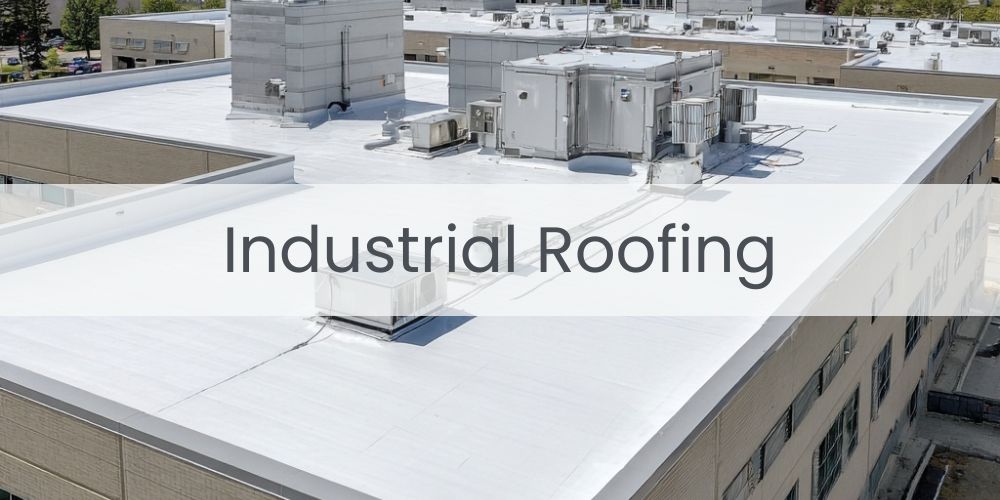
TPO roofing supports industrial roofing systems by maintaining thermal stability, moisture control, and envelope reliability under continuous production, storage, and logistics operations. Industrial buildings operate for extended hours or continuously, housing manufacturing processes, heavy equipment, inventory, and material handling systems that place sustained demands on roof assemblies. TPO roofing systems are used on industrial facilities where uncontrolled heat gain, moisture intrusion, or membrane failure would disrupt production continuity, damage assets, or compromise operational safety. Industrial roofing systems are subjected to sustained internal heat loads, large roof spans, rooftop mechanical congestion, frequent service access, and continuous environmental exposure typical of industrial operations. If industrial roof assemblies are not engineered to manage heat reflection, seam integrity, attachment performance, and drainage behavior, failures can propagate beneath the membrane surface. Once moisture enters an industrial roof assembly, it can migrate laterally through insulation layers, reduce thermal resistance, weaken structural attachments, and introduce risk to equipment, inventory, and occupied work zones below. TPO roofing for industrial buildings focuses on preventing these failure mechanisms, not merely improving surface efficiency. TPO industrial roofing is the process of installing a continuous, heat-welded thermoplastic membrane system with defined attachment methods, reflective surfaces, and engineered detailing to create a watertight and thermally controlled roof assembly. Unlike general commercial applications, industrial roofing systems must maintain consistent performance under high internal loads, frequent maintenance traffic, wide thermal variation, and zero-tolerance disruption thresholds tied to production and logistics. Without proper system design, minor deficiencies in seams, flashings, or drainage geometry can escalate into widespread operational downtime and asset loss. TPO Roofing Contractor installs TPO roofing systems for industrial facilities as operational control systems, engineered to regulate heat, block moisture intrusion, and preserve interior environmental stability across warehouses, manufacturing plants, distribution centers, and industrial campuses throughout the United States.
How Does TPO Industrial Roofing Control Heat, Moisture, and Downtime Risk?
Industrial roof failures occur when heat, moisture, and mechanical stress overwhelm roofing assemblies that are not designed for continuous industrial operation. Persistent internal heat generation from machinery and processes raises roof surface temperatures, daily thermal cycling stresses seams and attachments, and rooftop mechanical equipment concentrates vibration and load at penetrations and service zones. On industrial buildings, these forces act repeatedly and at scale, increasing the risk of seam fatigue, attachment loosening, and drainage restriction across large roof areas. TPO roofing systems control these risks by forming a monolithic, non-porous membrane barrier that resists thermal movement and prevents moisture migration beneath the roof surface. Heat-welded seams create continuous joints that do not separate under thermal cycling. Reflective membrane surfaces reduce roof surface temperatures, limiting heat transfer into production and storage spaces and supporting energy efficiency. Engineered attachment systems maintain secure connection to the roof deck, preventing uplift or movement that could compromise watertight integrity under wind and equipment vibration. Integrated flashing and drainage layouts prevent water from entering at penetrations, edges, and mechanical interfaces where industrial roofs are most vulnerable.
The industrial TPO roofing system creates the following system-level performance relationships:
- Heat-welded TPO seams → form continuous membrane joints → thermal cycling does not separate seams
- Reflective membrane surfaces → limit solar heat gain → internal temperature conditions remain stable
- Non-porous TPO structure → blocks moisture migration → water cannot spread beneath the roof
- Engineered attachment systems → secure membrane under load → mechanical movement does not loosen assemblies
- Integrated flashing at penetrations → seals equipment zones → moisture does not enter work areas
- Designed drainage geometry → evacuates water efficiently → ponding does not stress seams or insulation
Each of these outcomes results from coordinated system design decisions, ensuring that TPO roofing functions as a stability and risk-control layer rather than a passive surface covering in industrial environments.
What Conditions Require TPO Roofing on Industrial Buildings?
TPO roofing is required on industrial buildings when operating conditions impose sustained thermal, mechanical, and environmental stress that conventional roofing assemblies cannot reliably control. Industrial facilities differ from standard commercial buildings in both scale and intensity of use. Large roof spans, continuous or extended operating hours, internal heat generation from machinery, and high concentrations of rooftop mechanical equipment place combined demands on roof assemblies that amplify the consequences of failure. Under these conditions, roofing systems must function as load-bearing, moisture-controlling envelopes rather than simple weather barriers. Industrial buildings require TPO roofing when uncontrolled heat gain threatens internal temperature stability, energy efficiency, or process reliability. Manufacturing plants, warehouses, and distribution centers often generate significant internal heat while also being exposed to wide external temperature variation. Without reflective membrane surfaces and controlled thermal movement, roof assemblies experience accelerated seam fatigue, attachment stress, and insulation degradation. TPO roofing addresses this requirement by limiting solar heat absorption and maintaining seam integrity under repeated thermal cycling.
TPO roofing is also required when moisture intrusion poses operational or asset risk. Industrial roofs are commonly penetrated by vents, exhaust systems, conveyors, and mechanical supports, creating multiple potential leak paths. Once water enters an industrial roof assembly, it can migrate laterally through insulation layers across large areas, reducing thermal resistance, corroding attachments, and introducing risk to inventory, equipment, and occupied work zones below. TPO roofing systems are specified in these environments because heat-welded seams and non-porous membrane structure prevent subsurface moisture migration and allow failure zones to be isolated rather than propagated. Industrial conditions that include frequent maintenance traffic, rooftop equipment vibration, or wind exposure also necessitate TPO roofing. Forklift charging systems, HVAC units, dust collection equipment, and service walkways concentrate mechanical load and movement at roof penetrations and service zones. Roofing systems without engineered attachment strategies and reinforced detailing are prone to displacement, seam separation, and flashing failure under these forces. TPO roofing systems are engineered to maintain secure attachment and membrane continuity under repeated mechanical stress. Drainage behavior is another condition that drives the requirement for TPO roofing on industrial buildings. Large, low-slope industrial roofs must evacuate significant volumes of water efficiently to prevent ponding and hydrostatic pressure from stressing seams and insulation. Where drainage geometry is complex or roof spans are extensive, roofing systems must tolerate standing water without absorbing moisture or losing dimensional stability. TPO roofing is selected in these conditions because its welded seams, defined slope integration, and non-absorptive membrane structure maintain watertight integrity even when drainage performance is challenged.
The conditions that require TPO roofing on industrial buildings create the following system-level performance relationships:
- Sustained internal heat loads → elevate roof surface temperatures → reflective TPO membranes limit thermal stress
- Large roof spans and low slopes → increase water retention risk → welded seams resist hydrostatic pressure
- Dense rooftop mechanical equipment → concentrate vibration and load → engineered attachments prevent displacement
- Frequent service traffic → stresses seams and flashings → reinforced TPO detailing maintains continuity
- Multiple penetrations and interfaces → create leak pathways → monolithic membrane blocks moisture migration
- Continuous operation and downtime sensitivity → amplify failure impact → system reliability becomes mandatory
Each of these conditions represents a threshold where roofing performance directly affects operational continuity, asset protection, and safety. TPO roofing is required when industrial buildings cross these thresholds and demand a roofing system engineered to control heat, moisture, and mechanical stress as an integrated envelope rather than a surface covering.
Have a question about an upcoming project?
How Are TPO Roofing Systems Engineered for Large-Span Industrial Roofs?
TPO roofing systems are engineered for large-span industrial roofs by addressing structural scale, load distribution, thermal movement, and drainage behavior across expansive, low-slope roof assemblies. Industrial buildings often feature uninterrupted roof areas spanning tens or hundreds of thousands of square feet, supported by steel or concrete decks designed to accommodate heavy equipment, inventory storage, and mechanical systems. At this scale, roofing systems must manage cumulative stress rather than isolated load points. Engineering decisions for TPO industrial roofing focus on maintaining dimensional stability, watertight integrity, and attachment security across the entire roof field rather than relying on localized reinforcement. Large-span industrial roofs require TPO systems engineered to control thermal expansion and contraction across long membrane runs. Daily and seasonal temperature variation causes roof assemblies to expand and contract repeatedly, placing stress on seams, fasteners, and attachments. TPO roofing systems address this by using heat-welded seams that create continuous membrane joints capable of accommodating controlled movement without separation. Membrane layout, weld geometry, and attachment spacing are engineered to allow expansion to occur evenly across the roof surface rather than concentrating stress at isolated points.
Structural attachment strategy is another critical engineering factor on large industrial roofs. Wind uplift forces increase with roof size, exposure, and height, while rooftop equipment introduces vibration and dynamic loading. TPO roofing systems are engineered using mechanically fastened or fully adhered assemblies selected based on deck type, building geometry, and environmental exposure. Fastener density, attachment patterns, and perimeter securement are designed to distribute uplift and mechanical forces across the roof structure, preventing localized pull-out, membrane displacement, or progressive failure. Drainage engineering plays a central role in TPO roofing performance on large-span industrial roofs. Low-slope industrial roofs must evacuate significant volumes of water efficiently to prevent ponding, hydrostatic pressure, and seam stress. TPO systems are engineered with defined slope integration, internal drains, scuppers, and tapered insulation layouts to promote controlled water flow across expansive roof areas. Because the TPO membrane is non-porous and fully welded, the system maintains watertight integrity even when drainage performance is temporarily challenged, preventing moisture absorption and subsurface migration. Insulation specification and compressive strength selection are also engineered specifically for industrial roof conditions. Large roofs often support maintenance traffic, equipment platforms, and service routes that impose repeated point loads. TPO roofing systems are designed with insulation layers selected to resist compression and deformation under these loads, preserving surface flatness and preventing stress transfer into the membrane. Cover boards and reinforcement layers are integrated where required to protect the membrane from mechanical wear and extend service life.
The engineering decisions that allow TPO roofing systems to perform on large-span industrial roofs create the following system-level performance relationships:
- Large roof spans → increase cumulative thermal movement → heat-welded seams maintain continuity
- Extended membrane runs → amplify expansion forces → engineered layout distributes movement evenly
- High wind exposure → increases uplift pressure → attachment density resists displacement
- Rooftop equipment loads → concentrate vibration and weight → reinforced assemblies preserve stability
- Low-slope geometry → elevates ponding risk → integrated drainage evacuates water efficiently
- Frequent service traffic → stresses insulation layers → high compressive strength prevents deformation
Each of these outcomes results from coordinated engineering decisions that treat the roof as a unified structural and environmental control system. TPO roofing systems engineered for large-span industrial buildings are designed to maintain performance across scale, load, and time, ensuring that heat, moisture, and mechanical forces are controlled consistently rather than allowed to accumulate into system-level failure.
What Types of Industrial Facilities Use TPO Roofing Systems in the United States?
TPO roofing systems are used across a wide range of industrial facilities in the United States where roof performance must remain stable under continuous or extended operations, high internal loads, and varying environmental exposure. Industrial facilities include manufacturing plants, distribution centers, warehouses, logistics hubs, cold storage facilities, processing plants, and fabrication shops where heat generation, mechanical equipment, inventory loads, and frequent service access create sustained demands on roof assemblies. TPO roofing is specified on these facilities because uncontrolled heat gain, moisture intrusion, membrane failure, or drainage restriction can directly impact production continuity, asset protection, and operational safety. The scale, occupancy patterns, and functional diversity of industrial facilities require roofing systems that can manage thermal stress, moisture migration, mechanical load, and environmental exposure as integrated control systems rather than passive surface coverings. Large manufacturing plants use TPO roofing systems on expansive low-slope roof areas where internal process heat, rooftop equipment density, and thermal cycling can accelerate roof fatigue if not managed properly. Distribution centers and logistics hubs rely on TPO roofs to support high-clearance spaces and long-span geometry without creating localized stress points that compromise watertight integrity. Warehouses and storage facilities commonly adopt TPO roofing because its reflective properties and non-porous membrane structure limit heat absorption, protect stored goods, and reduce the risk of moisture migration into insulated storage zones. Cold storage and refrigerated facilities use TPO roofing where tight internal climate control is critical; these buildings demand membrane systems that resist thermal bridging and moisture ingress across large surface areas. Processing plants and fabrication shops, which may house welding, machining, or chemical systems, select TPO roofing to withstand localized thermal loads and protect against moisture-driven corrosion of structural elements. Across these industrial facility types, TPO roofing systems are engineered to preserve interior environmental stability, support operational continuity, and protect assets under continuous industrial use.
The industrial facility types that use TPO roofing systems create the following system-level performance relationships:
- Manufacturing plants → large heat loads and mechanical rooftop congestion → reflective TPO membranes control thermal stress
- Distribution centers → long-span low-slope geometry → welded seams maintain watertight continuity
- Warehouses and storage facilities → high internal storage risk → non-porous membrane blocks moisture migration
- Cold storage facilities → strict interior climate control → TPO limits thermal bridging and condensation
- Processing and fabrication shops → localized thermal spikes → engineered attachment resists fatigue
- Logistics hubs → frequent access and service traffic → reinforced detailing preserves membrane integrity
- Multi-building industrial campuses → integration across structures → TPO systems maintain consistent envelope performance
Each of these outcomes results from the industrial facility’s unique operating context requiring roofing systems that manage heat, moisture, and mechanical exposure as coordinated envelope control layers rather than surface finishes.
When Should an Industrial Facility Engage a TPO Roofing Specialist?
An industrial facility should engage a TPO roofing specialist when roof performance directly affects production continuity, asset protection, or operational safety. Facilities operating under continuous or extended hours, managing large inventories, or supporting heavy rooftop mechanical infrastructure require roofing systems that function as environmental control layers rather than passive coverings. Indicators such as recurring leaks, localized ponding, seam stress, flashing wear, unexplained insulation moisture, or rising internal heat levels often signal underlying roof system instability that escalates under industrial operating conditions. Industrial facilities also engage TPO roofing specialists during new construction, facility expansion, or major retrofit projects, where roofing decisions made at the design and tender stage directly influence long-term operational risk and lifecycle cost. At this stage, membrane selection, insulation density, attachment strategy, seam design, drainage layout, and penetration detailing must be engineered around roof span, equipment loading, thermal exposure, and maintenance access rather than minimum specification compliance. A TPO roofing system evaluation or design review assesses how the proposed or existing roof assembly will perform under real industrial operating conditions. This includes reviewing membrane and seam integrity, attachment performance, insulation specification, drainage behavior, and interface detailing around mechanical equipment and service zones. For new industrial buildings, this process provides technical validation of roofing specifications before construction begins. For existing facilities, it determines whether localized corrective work, system reinforcement, or full replacement is technically appropriate. Engaging a TPO roofing specialist at the evaluation or specification stage is a risk management decision that aligns roof performance with operational continuity, asset protection, and long-term facility reliability.