
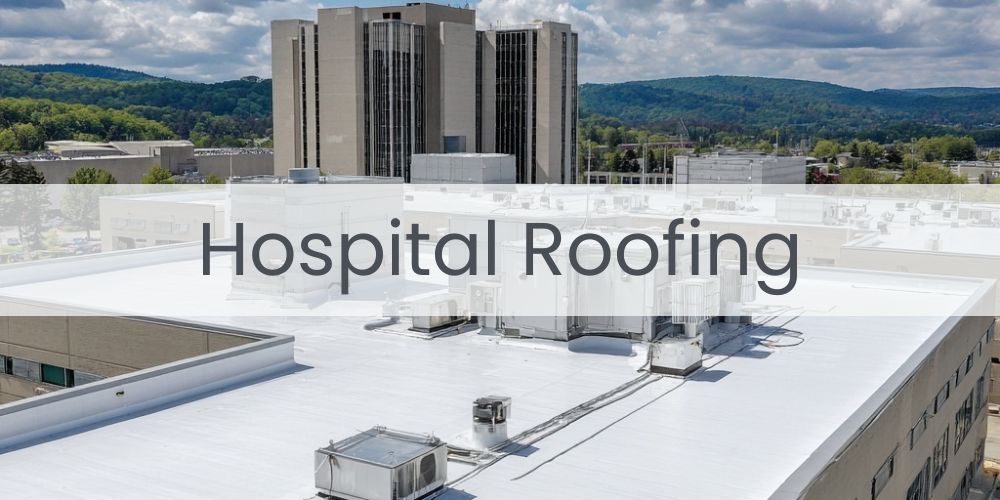
TPO roofing supports hospital roofing systems by maintaining thermal stability, moisture control, and envelope reliability under continuous occupancy and critical operating conditions. Hospitals operate 24/7 within healthcare environments that impose strict indoor climate tolerances, infection control requirements, and regulatory oversight, placing exceptional demands on roof assemblies. TPO roofing systems are used on hospitals where uncontrolled heat gain, moisture intrusion, or membrane failure would directly compromise patient safety, clinical operations, and healthcare compliance. Hospital roofing systems are subjected to sustained internal heat loads, rooftop mechanical congestion, frequent service access, and continuous environmental exposure common to healthcare operations. If hospital roof assemblies are not engineered to manage heat reflection, seam integrity, attachment performance, and drainage behavior, failures can propagate beneath the membrane surface. Once moisture enters a hospital roof assembly, it can migrate laterally through insulation layers, reduce thermal resistance, compromise environmental control systems, and introduce risk to occupied clinical spaces below. TPO roofing for hospitals focuses on preventing these failure mechanisms, not merely improving surface efficiency. TPO hospital roofing is the process of installing a continuous, heat-welded thermoplastic membrane system with defined attachment methods, reflective surfaces, and engineered detailing to create a watertight and thermally controlled roof assembly. Unlike general commercial applications, hospital roofing systems must maintain consistent performance under constant internal load, frequent maintenance traffic, and zero-tolerance disruption thresholds inherent to healthcare environments. Without proper system design, minor deficiencies in seams, flashings, or drainage geometry can escalate into widespread operational and clinical risk. TPO Roofing Contractor installs TPO roofing systems for hospitals as operational control systems, engineered to regulate heat, block moisture intrusion, and preserve interior environmental stability across hospitals, medical centers, and clinical campuses throughout the United States.
How Does TPO Hospital Roofing Control Heat, Moisture, and System Risk?
Hospital roof failures occur when heat, moisture, and mechanical stress overwhelm roofing assemblies that are not designed for continuous healthcare operation. Persistent internal heat generation raises roof surface temperatures, daily thermal cycling stresses seams and attachments, and rooftop medical and mechanical equipment concentrates vibration and load at penetrations and service zones. On hospitals, these forces act continuously, increasing the risk of seam fatigue, attachment loosening, and drainage restriction. TPO roofing systems control these risks by forming a monolithic, non-porous membrane barrier that resists thermal movement and prevents moisture migration beneath the roof surface. Heat-welded seams create continuous joints that do not separate under thermal cycling. Reflective membrane surfaces reduce roof surface temperatures, limiting heat transfer into conditioned hospital spaces and supporting HVAC performance. Engineered attachment systems maintain secure connection to the roof deck, preventing uplift or movement that could compromise watertight integrity. Integrated flashing and drainage layouts prevent water from entering at penetrations, edges, and mechanical interfaces where hospital roofs are most vulnerable.
The hospital TPO roofing system creates the following system-level performance relationships:
- Heat-welded TPO seams → form continuous membrane joints → thermal cycling does not separate seams
- Reflective membrane surfaces → limit solar heat gain → indoor temperature control remains stable
- Non-porous TPO structure → blocks moisture migration → water cannot spread beneath the roof
- Engineered attachment systems → secure membrane under load → mechanical movement does not loosen assemblies
- Integrated flashing at penetrations → seals service zones → moisture does not enter clinical spaces
- Designed drainage geometry → evacuates water efficiently → ponding does not stress seams or insulation
Each of these outcomes results from coordinated system design decisions, ensuring that TPO roofing functions as a stability and risk-control layer rather than a passive surface covering in hospital and healthcare environments.
What Conditions Require TPO Roofing Systems on Hospitals?
TPO roofing systems are required on hospitals when the roof assembly must maintain continuous thermal stability, moisture exclusion, and envelope reliability under 24/7 healthcare operating conditions. Hospitals operate with constant internal heat generation, strict indoor air quality control, infection prevention protocols, and zero-tolerance disruption thresholds that place exceptional demands on roofing systems. These conditions are intensified by rooftop mechanical congestion, frequent service access, and continuous environmental exposure. When hospital roof assemblies are not engineered to manage solar heat reflection, seam integrity, attachment performance, and drainage behavior, failures can propagate beneath the membrane surface without immediate visual indicators. Once moisture enters a hospital roof assembly, it can migrate laterally through insulation layers, reduce thermal resistance, compromise pressure-balanced ventilation systems, and introduce risk to occupied clinical environments below. Unlike general commercial buildings, hospitals cannot tolerate intermittent leaks, fluctuating interior conditions, or concealed moisture accumulation, as these directly affect patient safety, clinical operations, and regulatory compliance. TPO roofing systems are required when the roof must function as a controlled environmental barrier rather than a passive exterior surface, preserving interior stability under continuous operational load.
The conditions that require TPO roofing systems on hospitals create the following system-level performance relationships:
- Continuous internal heat load → elevates roof surface temperatures → reflective membranes reduce thermal gain
- Strict indoor climate tolerances → require stable envelope performance → heat-welded seams prevent air and moisture leakage
- Rooftop medical and mechanical equipment → concentrates load and vibration → engineered attachment systems maintain secure anchorage
- Frequent maintenance access → increases surface wear risk → reinforced membrane assemblies resist fatigue
- Healthcare infection control requirements → prohibit moisture intrusion → non-porous membranes block lateral migration
- Regulatory oversight and compliance → demand predictable performance → engineered drainage prevents ponding and system stress
Each of these conditions represents an operational requirement rather than a material preference. TPO roofing systems are specified on hospitals when roof performance must remain stable under continuous heat load, mechanical stress, and environmental exposure without allowing moisture migration or envelope instability. In healthcare environments, TPO roofing functions as a critical control layer that supports patient safety, clinical continuity, and regulatory compliance by maintaining predictable thermal and moisture behavior across the roof assembly.
Have a question about an upcoming project?
What Types of Hospital Buildings Use TPO Roofing Systems in the United States?
TPO roofing systems are used on hospital buildings where roof performance must remain stable under continuous occupancy, strict environmental control, and zero-tolerance operational disruption. In the United States, hospitals are not a single building type but a collection of specialized healthcare structures with different load profiles, equipment density, and risk exposure. Acute care hospitals, regional medical centers, teaching hospitals, outpatient campuses, specialty care facilities, and support buildings all impose sustained demands on roof assemblies due to constant internal heat generation, rooftop mechanical congestion, and frequent service access. TPO roofing is specified on hospital buildings where uncontrolled heat gain, moisture intrusion, or membrane failure would directly compromise patient safety, clinical workflows, infection control protocols, or regulatory compliance. The common requirement across hospital building types is not aesthetics or cost efficiency, but predictable envelope performance under continuous operational stress. TPO roofing systems are used where the roof must function as a controlled environmental barrier that preserves interior stability regardless of building size, clinical function, or geographic location.
The hospital building types that use TPO roofing systems create the following system-level performance relationships:
- Acute care hospitals → operate 24/7 with critical patient loads → continuous thermal and moisture control required
- Teaching and research hospitals → support dense mechanical infrastructure → reinforced attachment and seam integrity needed
- Outpatient and ambulatory care centers → require uninterrupted daily operation → watertight performance without service disruption
- Specialty hospitals (cardiac, oncology, pediatric) → house sensitive clinical environments → strict moisture exclusion essential
- Medical office and clinical support buildings → integrate with hospital campuses → consistent envelope performance across structures
- Hospital expansion and retrofit buildings → connect to existing systems → adaptable membrane detailing required
- Regional and rural hospitals → operate with limited redundancy → failure prevention prioritized over reactive repair
Each of these hospital building types imposes different operational and structural pressures, but all require roofing systems that maintain watertight integrity, thermal stability, and system reliability over long service cycles. TPO roofing systems are used across U.S. hospitals because they can be engineered to accommodate varying roof geometries, equipment densities, and service demands while delivering consistent environmental control. In hospital environments, TPO roofing is selected not based on building classification alone, but on whether the roof assembly must support continuous healthcare operations without introducing risk to patients, staff, or clinical infrastructure.
When Should a Hospital Engage a TPO Roofing Specialist?
If a hospital operates under continuous occupancy, relies on strict indoor climate control, or supports dense rooftop medical and mechanical infrastructure, the roof assembly must function as an environmental control system rather than a passive covering. Indicators such as localized ponding, recurring leaks, seam stress, flashing wear, unexplained humidity fluctuations, or increased HVAC load can signal underlying roofing system instability that escalates under 24/7 healthcare operation. Hospitals also engage TPO roofing specialists during new construction, campus expansion, or major refurbishment projects, where roofing decisions made at the design and tender stage directly affect long-term clinical risk, compliance exposure, and operational continuity. At this stage, membrane selection, insulation density, attachment strategy, seam design, drainage layout, and penetration detailing must be engineered around continuous internal load, infection control requirements, rooftop equipment density, and maintenance access rather than minimum specification compliance. A hospital TPO roofing system evaluation or design review examines how the proposed or existing roof assembly will perform under real healthcare operating conditions. This includes assessing membrane and seam integrity, attachment performance, insulation specification, drainage behavior, and interface detailing around critical medical and mechanical equipment. For new hospital builds, this process provides technical validation of roofing specifications before construction begins. For existing facilities, it determines whether localized corrective work, system reinforcement, or full replacement is technically required. Engaging a TPO roofing specialist at the evaluation or specification stage is a risk management decision that aligns roof performance with patient safety, regulatory compliance, environmental stability, and long-term asset protection across both existing and newly constructed hospital and healthcare facilities.