
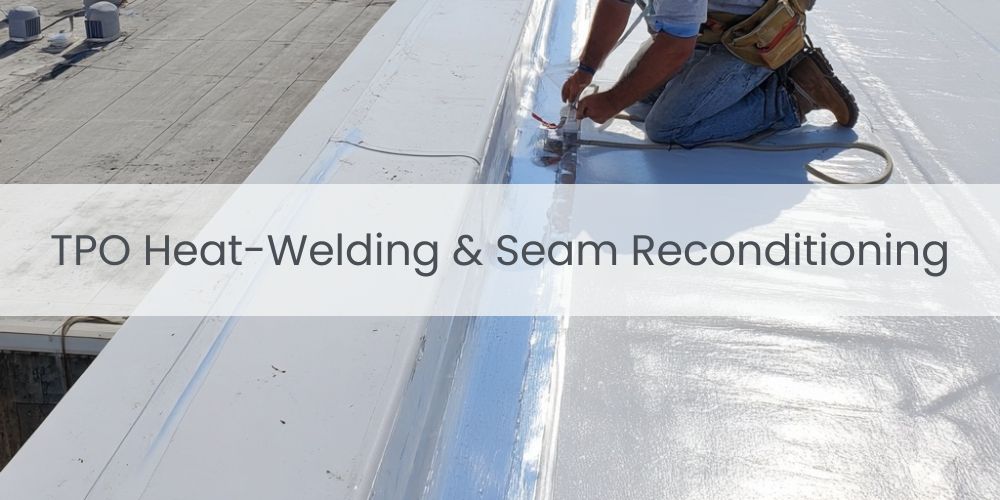
TPO heat-welding and seam reconditioning controls leak initiation by restoring membrane continuity at welded lap seams, where thermal movement, aging, and installation variance concentrate stress and water exposure. In TPO roofing systems, most long-term failures do not originate in intact membrane sheets. They originate at seam interfaces where adjacent membranes rely entirely on weld integrity to function as a continuous waterproofing layer. These seams govern whether a TPO roof assembly remains watertight under operating conditions or develops hidden failure pathways beneath an otherwise intact membrane field. Unlike field membrane surfaces, welded seams are constrained interfaces where differential movement, material aging, and construction tolerances converge. Thermal expansion and contraction repeatedly load seam welds as membrane sheets move independently. Wind uplift introduces cyclic peel forces along lap edges. Hydraulic pressure concentrates at seams during ponding or drainage events, forcing water against weld interfaces rather than across the membrane surface. Over time, these forces degrade marginal welds, reduce fusion depth, and allow micro-separations that become primary leak entry points. TPO heat-welding and seam reconditioning is used where original welds have aged, oxidized, been contaminated, or were inadequately fused at installation, creating latent failure risk across the roof field. When seam integrity degrades, water bypasses the membrane surface and migrates laterally along insulation layers and deck planes, often surfacing far from the original seam defect. Because seam failures propagate beneath the membrane before becoming visible, they frequently undermine roof performance without obvious surface indicators. For this reason, TPO Roofing Contractor treats heat-welding and seam reconditioning as system-critical remediation rather than surface repair. The process focuses on restoring molecular fusion at seam interfaces, not applying coatings or sealants that mask underlying weld failure. TPO heat-welding reactivates the thermoplastic membrane at controlled temperatures to re-establish homogeneous fusion between overlapping sheets, while seam reconditioning corrects contamination, oxidation, or weld geometry that prevents long-term bond integrity. Without restored seam fusion, even high-quality TPO membranes cannot maintain watertight performance across real thermal, wind, and hydraulic loading conditions.
How Does TPO Heat-Welding and Seam Reconditioning Prevent Seam Failure and Leaks?
TPO seam failures escalate because seams experience concentrated stress and water exposure that flat membrane fields do not. Thermal cycling causes adjacent membrane sheets to expand and contract independently, repeatedly loading the weld interface. Wind uplift introduces peel forces along lap edges that test fusion depth and continuity. Ponding water and drainage flow apply sustained hydraulic pressure directly against seam lines, exploiting even minor weld discontinuities. When seams are under-fused, contaminated, or aged, these forces open microscopic pathways that allow water to migrate beneath the membrane surface. TPO heat-welding and seam reconditioning controls this risk by restoring full thermoplastic fusion across the seam interface. Proper re-welding re-melts compatible membrane surfaces to form a single continuous material plane rather than a bonded joint. Reconditioned seams regain resistance to peel forces, accommodate thermal movement without splitting, and block water migration at the most failure-prone interfaces. By treating seams as engineered system joints rather than incidental overlaps, heat-welding preserves roof integrity under real operating stresses.
When TPO seam reconditioning is engineered around how stress and water act on welded interfaces, performance follows direct causal pathways:
- Restored weld fusion depth → absorbs thermal movement → seams do not split over time
- Continuous heat-welded laps → maintain membrane continuity → water cannot bypass the roof field
- Cleaned and reconditioned seam surfaces → eliminate contamination → weld strength is preserved
- Corrected weld geometry → resists peel forces → wind uplift does not open seams
- Reinforced seam interfaces → distribute hydraulic pressure → ponding water does not force entry
- Verified weld integrity → prevents subsurface migration → leaks do not spread undetected
These outcomes result from treating welded seams as primary structural interfaces within the TPO system, ensuring that localized seam degradation does not escalate into system-wide roof failure
What Conditions Trigger TPO Heat-Welding & Seam Reconditioning?
TPO heat-welding and seam reconditioning is triggered when welded lap seams lose membrane continuity and no longer prevent water entry under normal thermal, wind, and hydraulic loading. In TPO roofing systems, this condition does not originate in intact membrane sheets. It originates at lap seams where adjacent membranes rely entirely on weld fusion to function as a continuous waterproofing layer. These seam interfaces determine whether a TPO roof assembly remains watertight or develops subsurface failure pathways despite otherwise intact field membrane performance. Seam reconditioning is required where loss of weld fusion would allow water to bypass the membrane surface and migrate directly into insulation layers and deck assemblies beneath the roof field. Unlike the membrane field, welded seams are constrained interfaces exposed to operating forces that exceed those acting on flat membrane areas. These forces include thermal expansion and contraction between adjoining sheets, wind uplift that applies peel stress along lap edges, and hydraulic pressure from ponding or drainage events. Because these forces act directly on seam welds rather than across the membrane surface, seam integrity governs overall system reliability. When weld fusion has degraded due to aging, oxidation, contamination, or insufficient original fusion, seams can no longer absorb movement, resist peel forces, and block water simultaneously. Under these conditions, discontinuities form at the seam interface that permit subsurface water migration before visible leakage occurs. Once water enters through a compromised seam, it can spread laterally beneath the membrane, reduce thermal performance, corrode attachments, and cause interior damage far from the original defect. TPO heat-welding and seam reconditioning is required when restoring weld fusion is necessary to re-establish membrane continuity and prevent localized seam degradation from escalating into system-wide roof failure.
The failure conditions that trigger TPO heat-welding and seam reconditioning create the following system-level performance relationships:
- Loss of weld fusion at lap seams → membrane continuity is broken → water bypasses the roof field
- Thermal expansion between membrane sheets → differential seam movement → shear stress concentrates at welds
- Thermal contraction during cooling cycles → reverse seam movement → weld fatigue develops
- Wind uplift at lap edges → peel forces act on seams → weld separation initiates
- Hydraulic pressure from ponding water → sustained load at seam interfaces → water is forced through discontinuities
- Oxidation at exposed seam edges → thermoplastic properties change → fusion strength declines
- Surface contamination at seams → molecular bonding is inhibited → weld continuity is reduced
- Insufficient original fusion depth → limited structural weld capacity → seams fail under normal loading
- Seam discontinuity beneath membrane surface → lateral water migration → insulation becomes saturated
- Insulation saturation beneath seams → loss of thermal resistance → system performance degrades
Each of these conditions represents a loss of seam-level system control rather than a cosmetic defect. TPO heat-welding and seam reconditioning is required when these failure states are present to restore weld fusion, re-establish membrane continuity, and prevent localized seam degradation from escalating into full roofing system failure.
Have a question about an upcoming project?
How Is TPO Heat-Welding & Seam Reconditioning Performed?
TPO heat-welding and seam reconditioning restores membrane continuity by re-establishing homogeneous thermoplastic fusion at welded lap seams. In TPO roofing systems, seam performance depends on molecular fusion between overlapping membrane sheets, not on surface adhesion or mechanical bonding. Heat-welding reactivates the thermoplastic membrane at controlled temperatures so adjacent sheets fuse into a single continuous material plane capable of resisting water entry under operating conditions. Seam reconditioning is performed where existing welds have lost effective fusion due to aging, oxidation, contamination, or insufficient original weld depth. Unlike surface-applied sealants, heat-welding directly restores the structural interface that controls seam performance. The process begins by preparing seam interfaces to remove oxidation, dirt, and contaminants that inhibit molecular bonding. Once surfaces are conditioned, controlled heat is applied to both membrane layers to re-melt the thermoplastic material and achieve uniform fusion across the lap width. Proper heat-welding must accommodate the forces acting at seam interfaces. Weld temperatures, welding speed, and applied pressure are calibrated to achieve sufficient fusion depth without degrading membrane reinforcement. Correctly executed welds form continuous seams that absorb thermal expansion and contraction, resist peel forces from wind uplift, and block hydraulic pressure from ponding or drainage flow. Seam geometry and fusion consistency are verified to ensure that welds function as structural system joints rather than superficial overlaps. When seam reconditioning is performed correctly, restored welds eliminate discontinuities that allow subsurface water migration and return seam interfaces to full load-bearing performance. Heat-welded seams re-establish membrane continuity across the roof field, ensuring that localized seam degradation does not persist as a latent failure pathway under real operating stresses.
The seam restoration process produces the following system-level performance relationships:
- Conditioned seam surfaces → contaminants removed → molecular bonding is enabled
- Controlled heat application → thermoplastic membranes re-melt → homogeneous fusion forms
- Uniform fusion depth across lap → structural seam capacity restored → seams absorb thermal movement
- Proper weld geometry → stress distributed evenly → peel forces do not concentrate at edges
- Continuous welded seams → membrane continuity restored → water cannot bypass the roof field
- Verified weld integrity → resistance to hydraulic pressure → subsurface migration is prevented
Each of these outcomes reflects restoration of seam-level system control rather than cosmetic repair. TPO heat-welding and seam reconditioning is performed to re-establish weld fusion, restore membrane continuity, and ensure that lap seams function as durable, load-bearing interfaces within the TPO roofing system.
How Is Weld Integrity Verified After TPO Heat-Welding & Seam Reconditioning?
Weld integrity after TPO heat-welding and seam reconditioning is verified by confirming that restored lap seams maintain membrane continuity under mechanical stress without separation. In TPO roofing systems, verification does not rely on visual appearance alone. It relies on direct confirmation that welded seams function as continuous, load-bearing interfaces capable of resisting movement, peel forces, and water pressure. Verification is performed at seam interfaces because these locations govern whether restored welds can prevent water from bypassing the membrane surface. Unlike field membrane areas, welded seams must be tested for fusion depth, continuity, and resistance to mechanical stress. Proper verification focuses on whether the seam can absorb thermal movement, resist wind-induced peel forces, and block hydraulic pressure without loss of continuity. Mechanical probe testing is used to confirm that molecular fusion has been achieved across the full weld width. A properly fused seam resists probing without separation or tearing at the weld interface. Peel resistance testing evaluates whether seam edges remain bonded under applied force, indicating sufficient fusion depth and uniform weld geometry. Visual inspection supports these tests by identifying voids, burn-through, inconsistent weld width, or surface defects that may indicate compromised fusion beneath the membrane surface. Weld verification also accounts for operating conditions. Seams must maintain integrity across temperature variations, movement cycles, and localized stress zones rather than only at the time of installation. Verification confirms that restored seams function as structural system joints capable of maintaining membrane continuity under real service conditions.
The verification process establishes the following system-level performance relationships:
- Continuous probe resistance at seams → full fusion depth confirmed → membrane continuity is maintained
- Seam edge peel resistance → weld geometry and strength verified → wind uplift does not open seams
- Uniform weld width and texture → consistent heat application → fusion integrity is uniform
- Absence of voids or skips → uninterrupted weld interface → water cannot bypass the membrane
- Verified seam continuity → resistance to hydraulic pressure → subsurface migration is prevented
- Confirmed load-bearing seams → restored system control → seam failure pathways are eliminated
Each of these verification outcomes confirms restoration of seam-level system control rather than superficial repair. TPO heat-welding and seam reconditioning is considered complete only when welded lap seams are verified to function as continuous, load-resisting interfaces that preserve overall roof system integrity.
Why Do Sealants and Coatings Fail at TPO Seams?
Sealants and coatings fail at TPO seams because they do not restore membrane continuity or replace lost weld fusion at lap seam interfaces. In TPO roofing systems, seam performance depends on homogeneous thermoplastic fusion between overlapping membrane sheets. Sealants and coatings function as surface-applied barriers, not as structural interfaces, and therefore cannot convert adjacent membrane sheets into a single continuous waterproofing layer. TPO seams are used where loss of fusion would allow water to bypass the membrane surface and migrate directly into insulation layers and deck assemblies beneath the roof field. Unlike heat-welded seams, sealants and coatings rely on adhesion to the membrane surface rather than molecular bonding within the membrane material. These materials are unable to absorb differential movement between adjoining sheets, resist peel forces from wind uplift, and block hydraulic pressure simultaneously. Because operating forces act directly at seam interfaces, surface-applied materials are subjected to stress conditions they are not engineered to withstand.
Thermal expansion and contraction cause adjacent membrane sheets to move independently, shearing surface-applied sealants and breaking adhesion at the seam line. Wind uplift applies cyclic peel forces along lap edges, lifting coatings and sealant films away from the membrane surface. Hydraulic pressure from ponding water forces water laterally beneath failed sealant layers, allowing subsurface migration despite intact surface appearance. Over time, ultraviolet exposure, temperature cycling, and environmental contamination further degrade sealant elasticity and adhesion, accelerating loss of effectiveness. When sealants or coatings fail at seams, water entry is often concealed rather than prevented. Surface-applied materials can mask underlying seam discontinuities while allowing moisture to migrate beneath the membrane, delaying detection and expanding the failure zone. Because these materials do not re-establish weld fusion, they cannot restore seam-level system control once fusion integrity has been lost.
The failure mechanisms associated with sealants and coatings at TPO seams produce the following system-level performance relationships:
- Surface-applied sealant at lap seam → adhesion-based barrier only → membrane continuity is not restored
- Thermal movement between membrane sheets → shear stress on sealant layer → adhesion failure occurs
- Wind uplift at seam edges → peel forces on coatings → surface barrier lifts or fractures
- Hydraulic pressure at seam interfaces → water driven beneath sealant film → subsurface migration continues
- Ultraviolet exposure and aging → sealant elasticity loss → cracking and debonding accelerate
- Masked seam discontinuities → delayed leak detection → expanded system damage
Each of these outcomes represents an absence of seam-level structural control rather than a temporary surface defect. Sealants and coatings fail at TPO seams because they cannot restore weld fusion, cannot accommodate operating forces, and cannot prevent subsurface water migration. For this reason, TPO heat-welding and seam reconditioning remains the only method capable of re-establishing membrane continuity and long-term seam performance in TPO roofing systems.
When Should a Property Engage a TPO Roofing Contractor for Seam Reconditioning?
A property should engage a TPO roofing contractor for seam reconditioning when welded lap seams have lost functional weld fusion and membrane continuity can no longer be verified under operating conditions. This applies when seam degradation allows water to bypass the membrane surface and migrate beneath the roof assembly, even if visible leakage has not yet occurred. Engagement is appropriate once inspection or verification indicates that seam interfaces can no longer absorb thermal movement, resist wind uplift, or block hydraulic pressure without separation. At this decision point, seam failure represents a loss of system control rather than a localized defect. Delaying intervention increases the likelihood that subsurface moisture migration, insulation saturation, and attachment corrosion will expand beyond the original seam failure zone. Because seam degradation often propagates laterally beneath the membrane, corrective timing directly governs the scale of remediation required and the remaining service life of the roof system. TPO Roofing Contractor provides TPO heat-welding and seam reconditioning services focused on restoring weld fusion, re-establishing membrane continuity, and verifying seam performance under real operating stresses. This ensures that seam reconditioning functions as a system-level corrective measure rather than a surface repair that conceals ongoing failure. Engaging a TPO roofing contractor at the correct decision point aligns seam remediation with long-term roof system integrity, allowing properties to resolve seam-level failure based on verified weld performance rather than visible symptoms or temporary mitigation.