
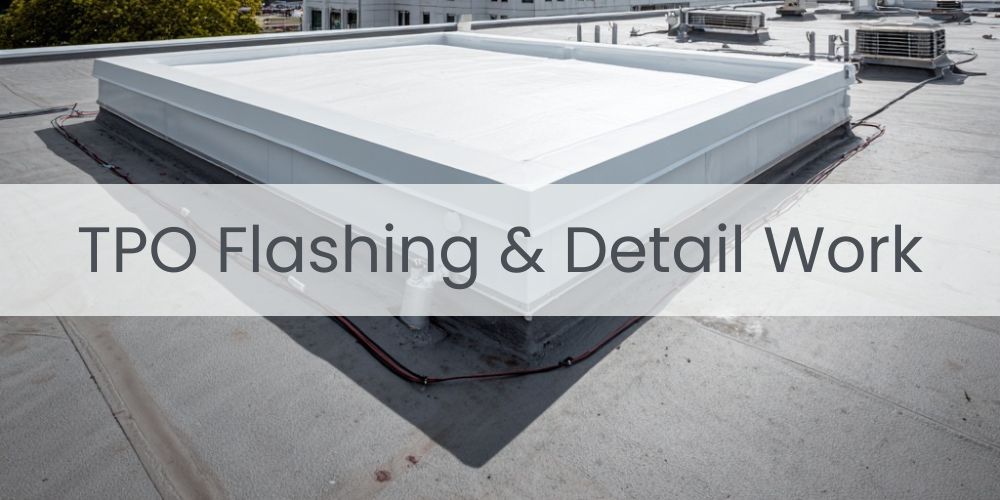
TPO flashing and detail work supports TPO roofing systems by controlling the highest-risk failure zones where membrane continuity is interrupted by penetrations, edges, transitions, and changes in plane. In TPO roof assemblies, most leaks do not originate in the open field of the membrane. They originate at flashings, terminations, equipment bases, parapet interfaces, drains, curbs, and expansion conditions where movement, stress, and water concentrate. These interfaces govern whether a TPO roof assembly maintains watertight integrity or fails despite otherwise intact field membrane performance. TPO flashing systems are used where uncontrolled moisture entry at details would bypass the primary membrane and migrate directly into insulation layers, deck assemblies, and occupied spaces below. These locations are subjected to combined forces that exceed those experienced in the roof field, including thermal expansion and contraction, wind uplift, vibration from rooftop equipment, differential movement between adjoining materials, and concentrated hydraulic pressure during rainfall events. Because these forces converge at details rather than across the membrane field, flashing performance determines overall system reliability. If TPO flashing and detail work is not engineered to accommodate movement, stress concentration, and water flow simultaneously, failure propagates rapidly beneath the membrane surface regardless of membrane quality elsewhere. Once water enters at a failed detail, it can migrate laterally, reduce thermal resistance, corrode attachments, and cause interior damage far from the original breach. For this reason, TPO Roofing Contractor treats TPO flashing and detail work as system-critical engineering, focused on controlling these interfaces rather than applying cosmetic edge treatments. TPO flashing is the process of forming continuous, heat-welded transitions between the primary membrane and all vertical, horizontal, and transitional elements using compatible materials, reinforced geometry, and defined attachment methods. Unlike field membrane installation, flashing and detail work must absorb movement, resist uplift, and manage water flow simultaneously. Without precise detailing, even properly installed TPO membranes cannot maintain long-term watertight performance across complex roof geometries and operating conditions.
How Does TPO Flashing and Detail Work Control Leak Risk and System Failure?
TPO roof failures escalate at details because these locations concentrate stress, movement, and water exposure beyond what flat membrane fields experience. Thermal cycling causes vertical and horizontal interfaces to move at different rates. Wind uplift intensifies pressure at edges, corners, and parapets. Rooftop equipment introduces vibration and repeated service traffic at curbs and penetrations. Drainage flow accelerates at scuppers, drains, and low points, increasing hydraulic pressure on flashing assemblies. When flashing geometry, attachment, or weld quality is insufficient, these forces open pathways that allow water to enter beneath the membrane surface. TPO flashing and detail work controls this risk by creating reinforced, heat-welded transitions that remain watertight under movement and stress. Properly executed TPO flashings maintain membrane continuity across changes in plane, resist pull-out and fatigue at attachment points, and prevent water from bypassing the primary roofing layer. By treating details as engineered system components rather than secondary accessories, TPO flashing preserves overall roof performance under real operating conditions.
When TPO flashing and detail work is engineered around how stress and water concentrate at roof interfaces, system performance can be expressed through direct cause-and-effect relationships.
- Reinforced TPO flashing geometry → absorbs differential movement → seams do not split at transitions
- Heat-welded flashing seams → maintain membrane continuity → water cannot bypass the roof field
- Engineered attachment at terminations → resists wind uplift → edges and parapets remain sealed
- Compatible flashing materials → prevent material incompatibility → weld integrity is preserved
- Detailed curb and penetration flashings → isolate vibration zones → leaks do not develop at equipment bases
- Controlled drainage detailing → manages hydraulic pressure → water does not force entry at drains
These outcomes result from coordinated flashing and detail design decisions, ensuring that TPO roofing systems remain watertight at their most vulnerable points and that localized stress does not escalate into system-wide failure.
What Conditions Require Specialized TPO Flashing and Detail Work?
Specialized TPO flashing and detail work is required when roof performance is governed by penetrations, transitions, and edge conditions rather than by the field membrane alone. In complex roofing environments, failures rarely originate in open membrane areas. They develop where movement, geometry change, mechanical loading, or material interfaces concentrate stress beyond the tolerance of standard detailing. TPO flashing becomes critical when roof assemblies are exposed to repeated thermal cycling, dense rooftop equipment, frequent service access, and uninterrupted occupancy below. Penetrations for HVAC units, conduits, vents, and structural supports introduce localized movement and vibration that stress membrane transitions. Parapet walls, expansion joints, inside and outside corners, curb interfaces, and drainage transitions experience compounded forces from heat expansion, wind uplift, and water flow. If these areas are not engineered with reinforced flashing, proper terminations, and compatible attachment methods, they become predictable failure points regardless of membrane quality. Conditions that necessitate advanced TPO flashing and detail work arise when water entry at a single interface can migrate laterally beneath the membrane and escalate into system-wide damage. This risk increases on roofs with shared insulation zones, long seam runs terminating at penetrations, stacked mechanical zones, or limited repair access during operation. In these scenarios, surface repairs or generic flashing methods cannot control moisture movement, differential expansion, or attachment stress at critical junctions. Specialized TPO flashing addresses these conditions by creating reinforced, heat-welded transitions that maintain continuity between the field membrane and all roof interfaces. Proper detailing controls membrane termination, seals vertical and horizontal plane changes, absorbs movement without separation, and prevents water from entering or migrating beneath the roof system. The objective is not cosmetic finish, but structural and environmental control at the most vulnerable points of the roof assembly.
The conditions that require specialized TPO flashing and detail work create the following system-level performance relationships:
- Thermal expansion at penetrations → concentrates movement stress → reinforced flashing absorbs movement without separation
- Rooftop equipment vibration → stresses membrane transitions → heat-welded details maintain seal integrity
- Parapet and edge conditions → amplify wind uplift forces → mechanically secured flashing resists displacement
- Drainage transitions and scuppers → concentrate water flow → engineered detailing prevents intrusion
- Plane changes and corners → create stress concentration zones → preformed or reinforced flashing maintains continuity
- Restricted repair access → increases consequence of failure → durable detailing reduces intervention frequency
Each of these conditions reflects a control requirement at the interface level, not a failure of the membrane field. Specialized TPO flashing and detail work is required when the roof must perform as a fully integrated system, ensuring that penetrations, edges, and transitions do not become the weak links that undermine overall roof stability.
Have a question about an upcoming project?
What Types of Roof Details Require TPO Flashing Systems?
Once the operating conditions that necessitate TPO flashing are established, the next distinction is where failure risk concentrates within the roof assembly and which interfaces require engineered system control rather than surface sealing. TPO flashing systems are required at roof details where membrane continuity is interrupted and where mechanical, thermal, or hydraulic forces concentrate stress beyond the tolerance of the field membrane.
TPO flashing systems are required at the following roof detail types:
- Roof penetrations: HVAC units, exhaust vents, conduits, gas lines, and structural supports introduce vertical transitions, vibration, and thermal movement. Heat-welded TPO flashing maintains membrane continuity and prevents moisture bypass at these interfaces.
- Parapet walls and perimeter edges: Horizontal-to-vertical transitions concentrate wind uplift, thermal expansion, and runoff. TPO flashing seals terminations and prevents moisture entry behind wall assemblies and edge metal systems.
- Equipment curbs and raised platforms: Concentrated loads, repeated service access, and vibration stress membrane transitions. Reinforced TPO flashing isolates movement and preserves watertight integrity at equipment interfaces.
- Expansion joints: Intentional structural movement zones require flexible TPO flashing assemblies. Without dedicated expansion detailing, cyclic movement causes membrane tearing and seam separation.
- Roof drains, scuppers, and overflow points: Accelerated water flow and hydraulic pressure increase intrusion risk. Integrated TPO flashing prevents backflow beneath the membrane plane and into insulation layers.
- Inside and outside corners: Multi-directional stress and water convergence occur at plane changes. Pre-formed or field-fabricated TPO flashing eliminates split risk at these high-stress locations.
When evaluated at the system level, these detail interfaces create predictable performance relationships:
- Roof penetrations → vertical movement and vibration → heat-welded TPO flashing maintains continuity
- Parapet transitions → wind uplift and runoff forces → welded vertical flashing blocks moisture entry
- Equipment curbs → repeated loading and access → reinforced flashing resists fatigue
- Expansion joints → structural movement → flexible TPO assemblies prevent membrane tearing
- Drainage points → hydraulic pressure concentration → integrated flashing prevents intrusion
- Corners and plane changes → multi-axis stress → formed flashing eliminates split risk
When Should a Building Engage a TPO Flashing Specialist?
A building should engage TPO Roofing Contractor when roof performance depends on the integrity of flashings, penetrations, terminations, and transitions rather than on membrane field condition alone. In TPO roof assemblies, these details experience the highest combined stress from thermal movement, wind uplift, mechanical vibration, differential material movement, and concentrated water flow, making them the most common origin point for leaks and system failure. Conditions that require specialist involvement include recurring leaks at penetrations or curbs, moisture intrusion at parapets or walls, seam separation at transitions, deteriorating edge conditions, or water infiltration that persists despite field membrane repairs. These indicators typically confirm flashing-level failure rather than generalized membrane fatigue. Buildings with dense rooftop equipment, complex geometry, frequent service access, shared roof assemblies, or multiple changes in plane are especially vulnerable when flashing systems are not engineered as integrated control interfaces. In these environments, localized detail failure allows moisture to bypass intact membranes and migrate laterally into insulation, deck assemblies, and occupied spaces. TPO Roofing Contractor designs, engineers, and executes TPO flashing and detail systems specifically to control these failure mechanisms. Flashing performance is evaluated under real operating conditions to determine whether localized corrective work, reinforcement, or system-level reengineering is required. Engaging TPO Roofing Contractor at the design, assessment, or corrective stage ensures that flashing details function as engineered system interfaces, preventing localized defects from escalating into widespread moisture intrusion, operational disruption, or premature roof system failure.