
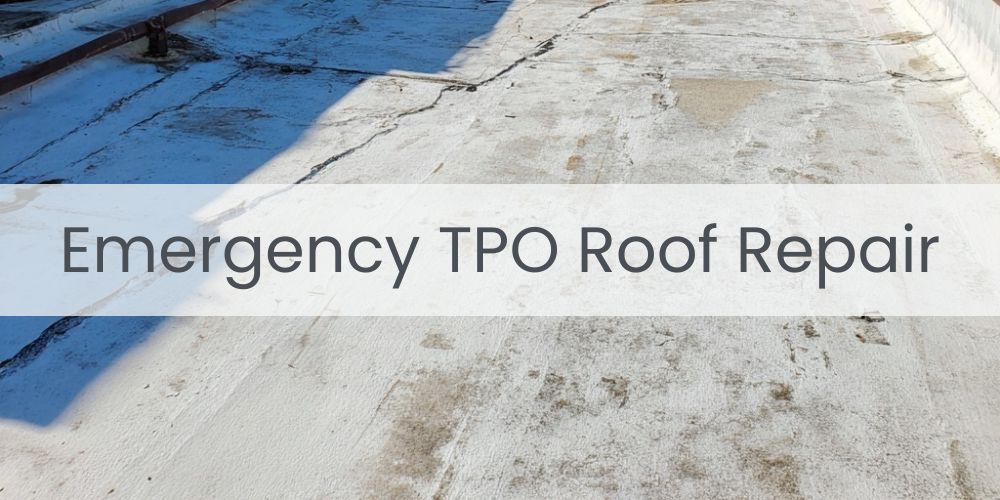
Emergency TPO roof repair stabilizes commercial roofing systems when active membrane failure is allowing uncontrolled water intrusion into the building envelope. Emergency conditions occur when TPO membranes, seams, flashings, or attachment zones are compromised by storms, mechanical damage, thermal stress, or drainage overload, allowing water to penetrate beneath the roof surface. Once water enters a TPO roof assembly, it can migrate laterally through insulation layers, reduce thermal resistance, weaken structural attachments, and cause interior damage far from the original failure point. Emergency TPO roof repair focuses on immediate containment of active failure rather than permanent restoration, with the objective of stopping moisture migration and preventing escalation into system-wide damage. Emergency TPO roof repair is the process of locating active failure points, isolating damaged membrane areas, and restoring temporary watertight integrity under live conditions. Unlike planned repairs, emergency work is performed while environmental stress is ongoing, such as during rainfall, high winds, or freeze–thaw cycles. Under these conditions, roof systems experience combined hydraulic pressure, wind uplift, and thermal movement that can rapidly expand small defects into large failure zones. Without immediate stabilization, water infiltration accelerates insulation saturation, deck deterioration, electrical risk, and operational disruption inside the building. TPO Roofing Contractor performs emergency TPO roof repair as a failure-containment service, designed to interrupt moisture entry, limit subsurface migration, and preserve the integrity of the remaining roof system until permanent corrective work can be engineered and scheduled.
How Does Emergency TPO Roof Repair Control Active Failure?
Emergency TPO roof failures escalate because water, movement, and pressure exploit weakened areas of the roofing system. Wind-driven rain forces water laterally across the membrane surface, thermal movement stresses seams and attachments, and saturated insulation reduces load resistance beneath the membrane. On large commercial roofs, these forces act simultaneously, allowing leaks to spread rapidly once the membrane is breached. Emergency TPO roof repair stops this escalation by sealing active leak paths, isolating damaged zones, and restoring short-term waterproofing so environmental forces can no longer propagate failure beneath the roof surface. Emergency stabilization measures are selected based on how the TPO system is failing under live conditions, not on cosmetic surface appearance. The goal is to regain control of moisture movement and membrane behavior until permanent repairs or replacement can be executed safely.
The emergency TPO roof repair process creates the following system-level performance relationships:
- Active membrane breaches → allow water entry → emergency sealing blocks moisture intrusion
- Compromised TPO seams → separate under movement → temporary welds or patches restore continuity
- Flashing failures at penetrations → concentrate leak paths → localized containment prevents lateral spread
- Saturated insulation zones → lose thermal resistance → moisture isolation limits internal damage
- Wind-driven rainfall → forces water beneath membranes → surface stabilization halts migration
- Uncontrolled drainage flow → increases hydraulic pressure → temporary diversion reduces stress on seams
Each of these outcomes results from short-term system stabilization decisions, which are designed to stop failure progression rather than deliver final restoration.
What Conditions Trigger an Emergency TPO Roof Repair?
Emergency TPO roof repair is triggered when a TPO roofing system experiences active loss of watertight integrity that allows uncontrolled water intrusion into the roof assembly. Unlike planned repairs, emergency conditions occur when membrane breaches, seam separations, flashing failures, or drainage overload are already permitting water to enter beneath the TPO surface while environmental stress is ongoing. These situations typically arise during or immediately after storms, periods of sustained rainfall, rapid freeze–thaw cycles, or mechanical impact events that compromise the membrane system under live operating conditions. Emergency conditions are defined not by the presence of surface damage alone, but by the risk of moisture migration and escalation within the roof assembly. Once water penetrates a TPO roof, it can spread laterally through insulation layers, reduce thermal resistance, weaken attachment points, and introduce electrical and operational risk inside the building. On large commercial roofs, failure rarely remains localized. Wind-driven rain, thermal movement, and hydraulic pressure can expand small defects into multiple active leak paths in a short period of time. Emergency TPO roof repair is required when stabilization is necessary to stop this progression and preserve the integrity of the remaining roof system until permanent corrective work can be engineered.
The failure conditions that trigger emergency TPO roof repair create the following system-level performance relationships:
- Active membrane breaches → allow direct water entry → moisture migrates beneath the TPO surface
- Seam separation under thermal movement → opens continuous leak paths → water spreads laterally through insulation
- Flashing failure at penetrations or edges → concentrates hydraulic pressure → leaks develop at equipment bases and perimeters
- Drainage overload or blocked flow paths → increase standing water depth → hydrostatic pressure forces water into weak points
- Storm-driven wind uplift → stresses attachments and seams → membrane displacement accelerates failure
- Insulation saturation → reduces compressive strength and thermal resistance → structural and interior damage risk escalates
Each of these conditions represents a loss of system control, not a cosmetic defect. Emergency TPO roof repair is required when these failure states are present to contain moisture intrusion, prevent subsurface migration, and stop short-term damage from escalating into full roofing system failure.
Have a question about an upcoming project?
What Happens During an Emergency TPO Roof Repair Response?
An emergency TPO roof repair response is a system stabilization sequence initiated to stop active water intrusion and prevent failure escalation while environmental stress is ongoing. The objective is not permanent restoration, but rapid containment of moisture entry and isolation of compromised areas so the remaining roof system can continue to function without additional damage. Emergency responses are performed under live conditions, often during rainfall, high winds, or freezing temperatures, when roof assemblies are under maximum hydraulic, thermal, and mechanical stress. During an emergency response, the roofing system is evaluated in terms of failure behavior, not surface appearance. Active leak paths, seam separation zones, flashing failures, and drainage overload areas are identified based on how water is entering and moving through the roof assembly. Stabilization measures are selected to immediately interrupt moisture migration, relieve pressure on weakened components, and restore short-term watertight integrity. These measures are designed to perform under continued exposure until permanent corrective work can be planned and executed safely. TPO Roofing Contractor performs emergency TPO roof repair responses as controlled failure-containment operations, prioritizing moisture control, insulation protection, and preservation of the remaining membrane system rather than cosmetic surface repair.
The emergency TPO roof repair response creates the following system-level performance relationships:
- Active leak paths identified → failure zones isolated → uncontrolled water entry is stopped
- Temporary membrane stabilization → restores surface continuity → moisture migration beneath the roof is interrupted
- Localized seam or flashing containment → reduces hydraulic pressure → leak propagation is limited
- Drainage diversion or clearance → lowers standing water depth → stress on compromised areas is reduced
- Protection of saturated zones → limits insulation degradation → thermal and structural performance is preserved
- Short-term watertight integrity restored → system stabilized → permanent repair planning becomes possible
Each stage of the emergency response is designed to regain control of the roofing system under live conditions, preventing short-term damage from escalating while maintaining building safety and operational continuity.
When Does Emergency TPO Roof Repair Require Escalation to Permanent Resolution?
Emergency TPO roof repair restores short-term control of active failure, but it does not resolve the underlying condition of the roofing system. Once rainfall, wind loading, or freeze–thaw pressure has subsided and the roof assembly is no longer under live environmental stress, the critical question becomes whether the stabilized TPO system can continue to perform reliably under normal operating conditions. Escalation is required when the extent, location, or recurrence of failure indicates that temporary containment alone cannot preserve long-term watertight integrity. The need to escalate beyond emergency repair is governed by roof system condition, not by the apparent success of temporary sealing. Insulation saturation, seam fatigue, attachment degradation, recurring failure at identical locations, or compromised drainage geometry indicate that the TPO roof assembly has lost its ability to resist moisture migration during routine exposure. In these conditions, maintaining short-term stability without corrective intervention increases the risk of concealed damage spreading beneath the membrane and re-emerging later as larger, more disruptive failures. TPO Roofing Contractor determines escalation requirements by evaluating how the stabilized TPO roof performs once active stress is removed. If moisture remains trapped within insulation layers, thermal resistance has been reduced, or membrane stress patterns indicate continued fatigue, permanent repair or full system replacement is required. If emergency containment successfully isolates damage and the remaining roof assembly retains secure attachment, intact seams, and functional drainage, permanent work may be limited to localized corrective intervention.
The transition from emergency TPO roof repair to permanent resolution creates the following system-level decision relationships:
- Emergency stabilization completed → roof performance assessed under normal conditions → long-term intervention determined
- Isolated membrane damage with dry insulation → structural integrity preserved → localized permanent repair sufficient
- Widespread insulation saturation → thermal and attachment performance degraded → system-level correction required
- Recurring seam or flashing failure → fatigue mechanisms remain active → reinforcement or replacement necessary
- Persistent drainage deficiencies → hydraulic stress unresolved → elevated future failure risk
Escalation decisions ensure that emergency TPO roof repair functions as a failure-control step, not a substitute for engineering resolution. The objective is to align permanent corrective action with verified system condition so temporary containment does not conceal long-term vulnerability.
When Should a Property Engage an Emergency TPO Roofing Specialist?
A property should engage an emergency TPO roofing specialist when a TPO roof has experienced active membrane failure and requires immediate stabilization to prevent moisture intrusion from escalating into insulation damage, structural degradation, or operational disruption. This applies when emergency containment has been performed, or when conditions indicate that uncontrolled water entry is occurring under live environmental stress. Emergency engagement is also appropriate immediately after stabilization, when the roof assembly must be evaluated to determine whether temporary containment is sufficient or whether permanent corrective work is required. Decisions made at this stage govern long-term roof performance, risk exposure, and capital planning. Delaying evaluation after an emergency event increases the likelihood that concealed moisture, insulation saturation, or attachment fatigue will remain undetected until larger system failure occurs. TPO Roofing Contractor provides emergency TPO roof evaluations and response services focused on failure containment, system condition assessment, and escalation planning. This ensures that emergency repairs function as a control step rather than a temporary fix that masks underlying system instability. Engaging an emergency TPO roofing specialist at the correct decision point aligns immediate response with long-term system integrity, allowing property owners and facility managers to move from crisis control to verified resolution based on actual roof condition rather than surface appearance or assumption.