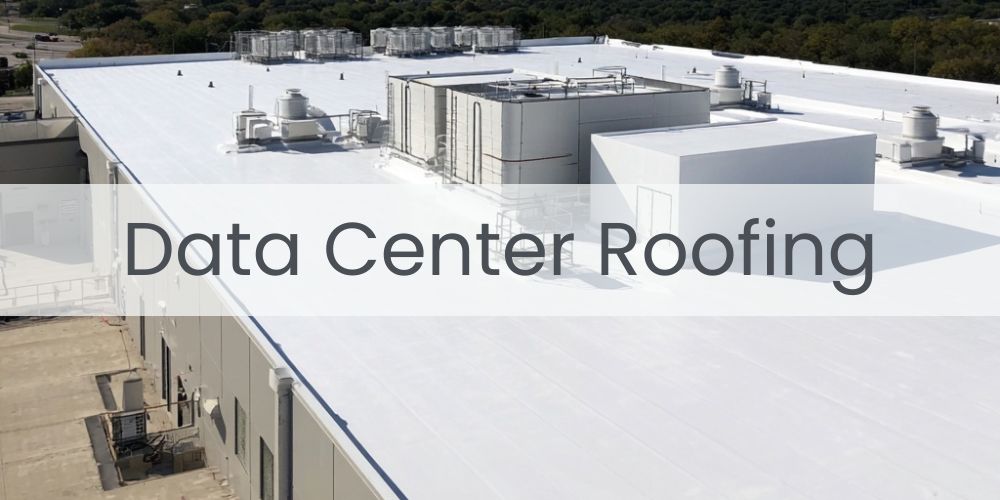
Data center roofing with TPO supports stable data center operations by controlling heat gain, preventing moisture intrusion, and protecting mission-critical facilities from system failure. TPO data center roofing is the process of installing an engineered thermoplastic polyolefin membrane system with heat-welded seams, defined attachment methods, and reflective surfaces to create a continuous, waterproof, and thermally controlled roof assembly. This system allows TPO data center roofing to regulate solar heat, block water penetration, and prevent seam separation and membrane fatigue that destabilize roofing systems under continuous 24/7 operating conditions. TPO roofing is used on data centers where constant internal heat loads, rooftop mechanical equipment, and thermal cycling have degraded traditional roof assemblies and allowed moisture to enter insulation and structural deck layers. By forming a monolithic, non-absorptive membrane surface, TPO roofing prevents heat-driven expansion, water migration, and environmental stress from compromising the building envelope. TPO data center roofing systems are installed to keep data centers thermally stable, watertight, and operationally protected under sustained heat load, weather exposure, and continuous uptime requirements.
How Does TPO Data Center Roofing Control Heat, Moisture, and Uptime Risk?
Data center roofs fail because heat, moisture, and movement overwhelm weak roofing systems. Continuous internal heat generation raises roof surface temperatures, daily thermal cycling forces roof assemblies to expand and contract, and rooftop mechanical equipment concentrates load and vibration at penetrations and service zones. On data centers, this combination causes membrane seams to stress, attachment points to loosen, and drainage paths to restrict, creating pathways that allow water to enter insulation and migrate laterally beneath the roof surface. Once moisture infiltrates a data center roof assembly, thermal resistance is reduced, cooling efficiency declines, and leaks can appear far from their original entry point, placing equipment, power systems, and uptime at risk. TPO data center roofing systems stop this failure process by forming a continuous, heat-welded membrane barrier that seals the roof surface and resists environmental attack. Heat-welded seams create monolithic joints that do not separate under thermal movement, while defined mechanical or adhered attachment systems maintain secure connection to the roof deck. Reflective TPO membranes reduce roof surface temperatures, limiting thermal expansion and lowering cooling demand inside the facility. Integrated flashing systems and engineered drainage layouts prevent water from entering at penetrations, edges, and equipment bases. Because data center risk is driven by failure at seams, penetrations, attachment zones, and drainage low points, TPO systems control uptime risk by verifying continuity at those interfaces and preventing the conditions that allow moisture to spread unseen. Seam integrity is confirmed through probing and weld checks so under-fused segments are corrected before wind-driven rain can force water into laps. Penetration and curb interfaces are treated as the highest-frequency leak origins, so flashing packages are welded and detailed as movement-tolerant transitions around RTUs, conduits, pipe clusters, and equipment bases. Attachment strategy is matched to deck type and uplift exposure so membrane flutter does not fatigue seams or peel terminations under cyclic loading. Drain bowls, scuppers, and low points are validated for evacuation capacity so ponding duration does not increase hydraulic pressure and wetting time at the same locations where leaks initiate. Where moisture risk is suspected, targeted moisture assessment (IR scanning and/or core cuts) defines whether insulation is wet and how far migration has spread, so repairs isolate the actual wet zone rather than chasing interior symptoms. The outcome is not a generic “watertight roof”; it is a roof assembly kept inside controlled limits for seam fusion, interface detailing, securement, and drainage so moisture does not become a hidden uptime threat.
The TPO data center roof control system creates the following system-level performance relationships:
- Heat-welded seam fusion (verified by probing/testing) → prevents seam micro-gaps under thermal cycling → wind-driven water does not enter at field laps
- Attachment method matched to deck + uplift zone → limits flutter and displacement → seam fatigue and termination peel forces decrease
- Penetration/curb flashing packages (RTUs, conduits, pipe clusters) → standardize high-movement interfaces → leaks do not initiate at equipment bases
- Drain bowl/scupper control + tapered design validation → reduces ponding duration → hydraulic loading does not overstress low-point seams
- Moisture detection (IR scan/core cuts where indicated) → confirms wet insulation boundaries → repairs target the actual migration zone, not symptoms
- Defined service routes + walkway pads → reduce puncture probability near mechanical zones → breach frequency declines in high-traffic areas
When these controls are executed and verified, the roof stays dry, seams stay fused, and drainage stays functional, so thermal performance and uptime risk remain predictable under 24/7 operating loads.
What Is TPO Data Center Roofing And How Is It Used in the United States?
TPO data center roofing is a single-ply membrane roofing system constructed from thermoplastic polyolefin sheets that are mechanically fastened or fully adhered to data center roof decks and joined using heat-welded seams. The system is defined by a continuous, non-porous membrane surface, welded seam geometry, and engineered attachment methods that form a watertight and thermally controlled roof assembly over insulation and structural substrates. Unlike conventional commercial roofing applications, TPO data center roofing is engineered as a mission-critical envelope system designed to operate continuously under elevated internal heat loads, strict cooling tolerances, and zero-downtime expectations. In the United States, TPO data center roofing is installed on hyperscale data centers, colocation facilities, enterprise computing campuses, and network infrastructure buildings where roof failure directly threatens operational continuity. These facilities are exposed to sustained solar radiation, wide geographic climate variation, rooftop mechanical congestion, and constant thermal cycling driven by 24/7 equipment operation. TPO roofing is selected for U.S. data centers because it provides a lightweight, weldable membrane system that can be engineered to maintain seam integrity, control heat gain, and prevent moisture intrusion across large, low-slope roof areas with dense penetrations and complex drainage layouts. TPO data center roofing assemblies are engineered to accommodate roof geometry, structural deck movement, drainage requirements, and equipment loading common to U.S. data center construction. The system’s performance is determined not by the membrane alone, but by how insulation density, attachment strategy, seam welding, flashing design, and drainage integration work together to preserve thermal stability and waterproofing over the life of the facility.
The TPO material properties that support data center roof performance create the following performance relationships:
- High-reflectivity white TPO surface → reduces solar absorption → roof-surface temperature and heat gain decrease
- Thermoplastic weldable polymer structure → enables heat fusion → seams can become continuous membrane zones
- Low water absorption / non-porous sheet → resists moisture uptake → the membrane does not become a water-holding layer
- UV-stabilized formulation → slows oxidation and embrittlement → flexibility and weldability persist longer under exposure
- Reinforced sheet architecture (where specified) → improves dimensional stability → thermal cycling causes less distortion and stress concentration
- Thicker membrane gauges (where specified) → increase puncture and wear margin → breach probability decreases in high-activity zones
These properties define the membrane’s baseline capability to resist heat loading, remain weldable, and tolerate long-term exposure without rapid stiffness or dimensional drift. In data centers, that baseline matters because even small losses in reflectivity, flexibility, or seam-forming behavior can translate into higher thermal stress and a higher probability that defects initiate at the roof’s most loaded interfaces. Material capability alone does not guarantee outcomes, but it determines whether the roof system can be built and maintained as a stable, continuous, repairable membrane assembly over the facility’s service life.
Have a question about an upcoming project?
Where Does Stress Accumulate On Data Center Roofs In the United States And How Does TPO Control It?
Data center roofs in the United States experience concentrated structural, thermal, and environmental stress at specific failure-prone zones rather than uniformly across the roof field. Continuous internal heat generation, dense rooftop mechanical equipment, and 24/7 operating cycles create persistent thermal pressure on roof assemblies, while external environmental exposure introduces moisture, wind, and ultraviolet stress. These forces concentrate at seams, penetrations, attachment points, drainage transitions, and areas of repeated service access, where small defects can escalate into system-wide instability. Sustained internal heat loads raise roof surface temperatures and drive constant expansion and contraction of roofing materials. On low-slope data center roofs, this thermal cycling places repeated stress on membrane seams and attachment interfaces. If seams are not monolithic or attachments are not engineered to accommodate movement, stress accumulates until seams fatigue, attachments loosen, or membrane distortion creates pathways for moisture intrusion. Once water enters insulation layers, it spreads laterally beneath the roof surface, reducing thermal resistance and degrading cooling efficiency critical to data center operations. Rooftop equipment density further concentrates stress. HVAC units, cooling towers, conduits, cable trays, and service walkways introduce point loads, vibration, and repeated foot traffic. These forces are absorbed at penetration flashings, curb interfaces, and localized attachment zones. Without reinforced detailing and controlled load distribution, movement and vibration cause flashing fatigue, joint separation, and membrane wear at equipment bases—areas where leaks often originate but remain hidden until operational disruption occurs. Drainage transitions represent another critical stress concentration point. Large data center roofs must evacuate significant volumes of water efficiently. Blocked drains, inadequate slope, or ponding water increase hydraulic pressure on seams and insulation, accelerating membrane degradation and increasing the likelihood of moisture migration. In data center environments, even minor ponding can elevate roof temperatures, increase membrane stress, and compound cooling demand inside the facility.
TPO data center roofing systems are engineered to control how and where these stresses are absorbed. Heat-welded seams form continuous, monolithic joints that move with the membrane rather than separating under thermal cycling. Engineered attachment systems secure the membrane to the structural deck while allowing controlled movement, preventing stress transfer into insulation layers or fasteners. Reinforced flashing details and welded penetration assemblies protect high-risk zones around equipment and service routes, while defined drainage geometry directs water away from vulnerable areas before hydraulic pressure can develop. By controlling stress concentration at seams, penetrations, attachments, and drainage points, TPO roofing systems prevent localized failure from propagating across the roof assembly. This preserves waterproofing integrity, maintains thermal performance, and protects the operational stability of data centers under continuous heat load, environmental exposure, and mission-critical uptime requirements.
Data center roofing performance in the United States can be reduced to direct cause-and-effect relationships between stress concentration zones, system controls, and operational outcomes:
- Heat-welded TPO seams → continuous thermal cycling → seams do not separate
- Engineered attachment systems → membrane expansion and contraction → stress is absorbed without fastener failure
- Reinforced penetration detailing → rooftop equipment vibration → leaks do not initiate at service points
- Non-porous TPO membrane → moisture exposure → water does not migrate beneath insulation
- Defined drainage geometry → heavy rainfall and ponding risk → hydraulic pressure does not degrade seams
- Reflective membrane surfaces → sustained solar load → roof surface temperatures remain controlled
- Controlled service access detailing → repeated maintenance traffic → membrane wear does not become failure paths
How Are TPO Roofing Systems Engineered To Prevent Data Center Roof Failure?
TPO roofing systems for data centers are engineered as integrated envelope control systems, not surface coverings. Preventing roof failure in data center environments requires coordinated control of thermal movement, moisture exclusion, structural attachment, drainage behavior, and long-term service interaction. Each design decision is made to interrupt known failure pathways before they can compromise cooling efficiency, electrical redundancy, or operational uptime. Engineering begins at the structural interface. TPO data center roofing systems are designed around the roof deck type, load capacity, and movement characteristics of the building. Attachment strategies—mechanically fastened, fully adhered, or hybrid assemblies—are selected to maintain secure membrane connection while allowing controlled expansion and contraction under continuous thermal cycling. This prevents stress transfer into fasteners, insulation, or deck interfaces that would otherwise loosen attachments and open leak paths. Seam integrity is engineered as a primary failure-control mechanism. Heat-welded TPO seams are formed under controlled conditions to create monolithic joints that behave as a continuous membrane rather than discrete overlaps. Unlike bonded or taped seams, welded seams retain strength under temperature fluctuation, vibration, and sustained heat load. Seam layout, welding parameters, and quality testing are coordinated to ensure that movement is absorbed uniformly across the membrane field rather than concentrated at isolated joints. Insulation design is treated as a structural component, not a thermal afterthought. High-density insulation boards and cover boards are specified to resist compressive deformation from rooftop equipment, maintenance traffic, and long-term loading. By maintaining insulation thickness and rigidity, the roof assembly preserves consistent thermal resistance and prevents localized deflection that can stress membranes and disrupt drainage planes. Drainage engineering is integrated into the roofing system from the outset. Tapered insulation layouts, drain placement, and overflow provisions are designed to evacuate water efficiently across large roof expanses typical of U.S. data centers. By eliminating standing water and hydraulic loading at seams and penetrations, drainage design prevents ponding-related degradation and limits heat accumulation caused by solar-heated water retention. Penetrations, curbs, and service routes are engineered as controlled interfaces rather than weak points. Equipment bases are flashed using reinforced membrane assemblies and welded transitions that move with the roof system instead of resisting it. Designated service paths, walk pads, and protection zones distribute foot traffic and maintenance loads, preventing abrasion and fatigue at high-activity areas. Through coordinated control of attachment, seams, insulation, drainage, and service interaction, TPO roofing systems prevent localized stress from evolving into systemic roof failure. The result is a roofing assembly that maintains watertight integrity, thermal stability, and structural performance under the continuous operating demands of U.S. data centers.
Engineered TPO data center roofing decisions create the following failure-prevention relationships:
- Engineered attachment strategy → continuous thermal movement → membrane remains securely anchored
- Heat-welded seam construction → cyclic expansion and contraction → seams retain monolithic integrity
- High-density insulation systems → rooftop equipment loading → thermal resistance and drainage planes remain intact
- Tapered drainage design → rainfall and ponding risk → water does not stress seams or insulation
- Reinforced flashing assemblies → equipment vibration and movement → penetrations do not become leak origins
- Defined service pathways → repeated maintenance access → membrane wear does not escalate into failure
When Should a Data Center Engage a TPO Roofing Specialist?
If a data center is operating under continuous internal heat load, relies on tight cooling tolerances, or supports dense rooftop mechanical infrastructure, the roof assembly must function as a stable control system rather than a passive covering. Indicators such as localized ponding, recurring leaks, seam stress, flashing wear, rising cooling demand, or unexplained humidity changes can signal underlying roofing system instability that escalates under 24/7 operation. Data centers also engage TPO roofing specialists during new construction, campus expansion, or major retrofit projects, where roofing decisions made at the design and tender stage directly affect long-term operational risk. At this stage, membrane selection, insulation density, attachment strategy, seam design, drainage layout, and penetration detailing must be engineered around future heat load, equipment density, and maintenance access rather than minimum specification compliance. A TPO roofing system evaluation or design review examines how the proposed or existing roof assembly will perform under real data center operating conditions. This includes assessing membrane and seam performance, attachment strategy, insulation specification, drainage behavior, and interface details around critical equipment. For new builds, this process provides technical validation of roofing specifications before construction begins. For existing facilities, it identifies whether targeted corrective work, system reinforcement, or full replacement is technically appropriate. Engaging a TPO roofing specialist at the evaluation or specification stage is a risk management decision that aligns roof performance with operational continuity, thermal stability, and long-term asset protection across both existing and newly constructed data center facilities.