
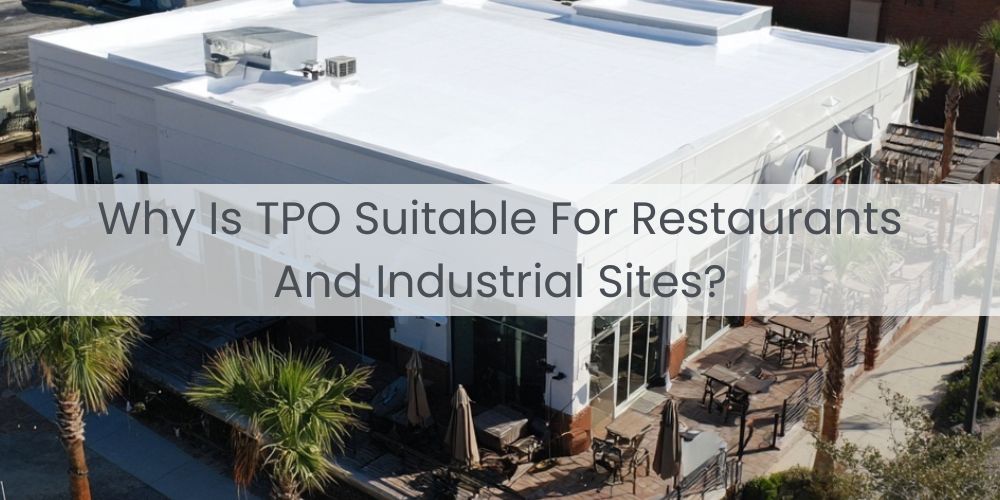
TPO roofing supports restaurant and industrial site roof systems by maintaining watertight continuity, exposure resistance, and controllable thermal loading where grease, chemical discharge, and high-duty operations create elevated risk at seams, penetrations, and rooftop service zones. Restaurants and industrial sites operate with continuous or extended-hour occupancy, process heat generation, equipment-driven exhaust and discharge, and disruption-intolerant workflows that make roof failure a direct operational and safety problem rather than a routine maintenance inconvenience. TPO is selected for restaurants where kitchen exhaust, grease-laden residues, and frequent rooftop HVAC service concentrate contamination and puncture risk at penetrations and service routes, and for industrial sites where chemical exposure, emissions, and mechanical activity increase degradation and leak initiation risk. These facilities are typically low-slope, large-area roof environments subjected to sustained solar irradiance, daily thermal cycling, wind uplift forces, rooftop mechanical congestion, and repeated maintenance access that repeatedly load seams, flashings, terminations, and drainage low points. If roof assemblies are not engineered to control heat-welded seam continuity, protect high-exposure zones, preserve insulation continuity, and maintain drainage function, localized contamination and small defects can propagate beneath the membrane surface and become recurring intrusion pathways. Once moisture enters a restaurant or industrial roof assembly, it can migrate laterally through insulation layers, reduce thermal resistance, weaken attachment performance, and cause interior damage far from the original defect location, increasing downtime risk and repair scope while amplifying operational disruption. TPO selection in these environments focuses on controlling exposure-driven degradation and seam-driven water entry under live operating conditions, not merely choosing a reflective membrane for generalized energy claims. Restaurant and industrial TPO roofing is the process of installing a heat-welded thermoplastic membrane system with defined attachment methods, compatible insulation and cover-board detailing, and engineered penetrations, perimeters, and drainage interfaces to create a watertight roof assembly that also limits solar-driven heat input while tolerating grease- and chemical-adjacent exposure conditions. Unlike general commercial roofs with lower contamination intensity, restaurant and industrial sites demand tighter control of penetration detailing, service-route protection, and exposure-zone maintenance because kitchen exhaust terminations, rooftop equipment curbs, and discharge pathways concentrate the highest failure probability. Without proper system design, grease accumulation at curbs and ducts, chemical exposure at discharge points, seam-quality variability, insulation discontinuities, and drainage restriction can preserve water-entry and degradation pathways even when the membrane material is nominally durable. TPO Roofing Contractor installs and maintains TPO systems for restaurants and industrial sites as exposure-aware roof control systems, engineered to preserve welded membrane continuity, resist contamination-driven deterioration, and stabilize roof performance with minimal disruption across facilities throughout the United States.
How Does TPO Control Grease- and Chemical-Driven Roof Risk While Preserving Watertight Performance?
Failures escalate in restaurant and industrial roofs when contaminants, movement, and water loads exploit weak interfaces at penetrations, seams, and low points. Grease-laden exhaust residues can collect around duct penetrations and equipment curbs, increasing surface contamination and complicating adhesion-dependent repairs; industrial discharges and airborne pollutants can attack vulnerable details if exposure alignment is not controlled. Thermal cycling drives membrane movement and seam stress, wind uplift loads perimeter zones, and frequent rooftop service activity increases puncture probability along access routes and around mechanical equipment. On these roofs, small seam defects or poorly integrated flashing transitions can become repeat leak initiation points because contamination, movement, and ponding repeatedly load the same interfaces. TPO controls this risk by forming a monolithic thermoplastic membrane barrier with heat-welded seams that maintain continuity under thermal movement, and by using engineered flashing and termination methods that seal penetrations and perimeters where contaminants and stress concentrate. Surface reflectivity reduces roof-surface heat loading, lowering membrane temperature rise and reducing thermal stress that can accelerate seam fatigue in high-heat operating contexts. Continuous insulation and controlled transitions maintain thermal resistance and reduce bypass pathways that would otherwise amplify condensation risk and interior temperature instability. The goal is to keep seam integrity, penetration interfaces, exposure zones, and drainage behavior within stable bounds so contamination does not translate into leak recurrence or premature system failure.
The restaurant and industrial TPO roofing system creates the following system-level performance relationships:
- Heat-welded TPO seams → form continuous thermoplastic joints → contamination does not cause seam debonding under thermal cycling
- Grease-laden exhaust zones → concentrate residue at penetrations → engineered flashing prevents leak initiation at duct interfaces
- Chemical discharge and pollutant exposure → stress membrane details → exposure-aware detailing reduces localized degradation risk
- Rooftop service access and foot traffic → increases puncture probability → defined walk paths and localized reinforcement reduce breach frequency
- Reflective membrane surface → limits roof-surface heat loading → thermal stress on seams and details decreases during peak operation
- Drainage performance control → reduces ponding duration → hydraulic stress does not accelerate seam fatigue or insulation saturation
Each of these outcomes results from coordinated exposure and system-control decisions, ensuring that TPO functions as a watertight, contamination-tolerant roof assembly rather than a membrane whose most exposed penetrations and weakest seams govern performance in restaurant and industrial environments.
What Details and Maintenance Controls Keep TPO Reliable in Grease Exhaust Zones and Chemical Exposure Areas?
TPO performance on restaurants and industrial sites is determined less by the membrane label and more by whether the roof is engineered and maintained as an exposure-controlled system at the exact locations where contamination, traffic, and discharge repeatedly attack continuity. These buildings concentrate risk into predictable interfaces: kitchen exhaust curbs and duct penetrations, RTU service zones, pipe stands, discharge points, parapet transitions, and drainage low points where residues and standing water persist. In those zones, the roof fails when contamination accumulates, cleaning is deferred, traffic routes remain unprotected, and detailing is not standardized to tolerate vibration, thermal movement, and repeated service access. The purpose of this section is to define the operational controls that keep the roof inside stable limits: clean and weldable membrane surfaces at repairs, reinforced and consistently flashed penetrations, protected walk paths that reduce puncture probability, and drainage behavior that prevents ponding from magnifying chemical contact time and seam stress. When these controls are applied, TPO remains a fused, watertight barrier under real restaurant and industrial loading rather than a membrane that gradually becomes unrepairable due to residue, abrasion, and recurring low-point saturation.
The restaurant and industrial exposure-control program creates the following system-level performance relationships:
- Grease and residue deposition at exhaust curbs → reduces surface weldability and traps moisture → scheduled cleaning preserves weldable conditions and prevents contamination-driven leak initiation
- High-traffic service routes near equipment → concentrate puncture and abrasion risk → designated walk paths and protection pads reduce breach probability
- Vibration and repeated access at curb and penetration interfaces → amplifies movement stress at flashings → standardized curb flashing packages maintain continuity under movement
- Chemical discharge contact time at low points → accelerates localized degradation and seam stress → discharge management and drainage correction reduce exposure duration and ponding load
- Ad hoc repairs using non-compatible methods → create discontinuities and recurrent leak edges → heat-welded repairs with correct overlap restore fused continuity and reduce recurrence
- Restricted drainage and debris loading → increases ponding duration and hydraulic pressure → routine drain and scupper servicing prevents seam overloading and insulation wetting
- Unverified seams at prior repairs and transitions → allow micro-gaps to persist → seam probing and verification closes latent leak paths before storms load the roof
Each of these outcomes results from controlling the specific exposure and wear mechanisms that dominate restaurants and industrial sites, ensuring TPO remains a maintainable, watertight system in the highest-risk zones rather than a roof whose contaminated penetrations and traffic corridors govern failure timing.
Have a question about an upcoming project?
When Should a Restaurant or Industrial Site Engage TPO Roofing Contractor to Keep a TPO Roof Reliable Under Grease and Chemical Exposure?
A restaurant or industrial site should engage TPO Roofing Contractor before contamination and traffic turn small roof defects into recurring leak corridors that are hard to localize and disruptive to operations. The trigger is not roof age. The trigger is exposure reality. If the building has grease-laden kitchen exhaust, frequent rooftop HVAC service, discharge points that wet the membrane, or equipment density that concentrates penetrations and foot traffic, the roof is operating in a higher-risk regime where seam continuity and penetration detailing must be treated as operational controls, not occasional repair items. For restaurants, engagement is warranted when grease residue is accumulating around exhaust curbs or duct penetrations, when service routes repeatedly cross the same membrane areas, when punctures and scuffs keep appearing near RTUs, or when drains and low points hold water long enough to keep residue and moisture in contact with details. For industrial sites, engagement is warranted when rooftop deposition, chemical exposure, or process exhaust is present, when discharge patterns create localized wetting and accelerated aging at low points, or when recurring minor leaks begin presenting as multiple interior symptoms that suggest lateral moisture migration under the membrane. Facilities should also engage TPO Roofing Contractor ahead of predictable operational events that raise roof risk. That includes planned equipment replacements, new penetrations, exhaust rerouting, production changes that increase rooftop deposition, seasonal maintenance surges, insurance renewals, and any period where downtime tolerance is low. In these environments, the wrong sequence is to wait for a live leak, because once water enters and insulation begins to wet, the problem expands. It stops being a small breach and becomes an operating incident with containment, cleanup, and interruption risk. A proper exposure-focused evaluation looks like an operational risk map, not a generic roof walk. It identifies and ranks the zones that fail first in restaurants and industrial sites: exhaust curb interfaces, duct and pipe penetrations, curb corners, service corridors, parapet transitions, discharge contact zones, and drainage basins. Then it verifies the variables that keep TPO controllable in those zones: heat-welded seam fusion integrity through probing and targeted verification, flashing geometry and termination stability at penetrations where movement and vibration concentrate, surface condition and clean-to-weld readiness where residue can compromise repairs, traffic-route protection to reduce puncture frequency, and drainage performance so ponding does not extend wetting duration and magnify exposure time at details. Engaging TPO Roofing Contractor early is a risk-management decision that keeps the roof maintainable. It preserves weldable conditions, standardizes and reinforces the interfaces that see grease and chemical stress, reduces repeat puncture generation along service routes, keeps drainage functional so low points do not become exposure accelerants, and prevents moisture migration from turning a manageable roof system into a recurring disruption problem.