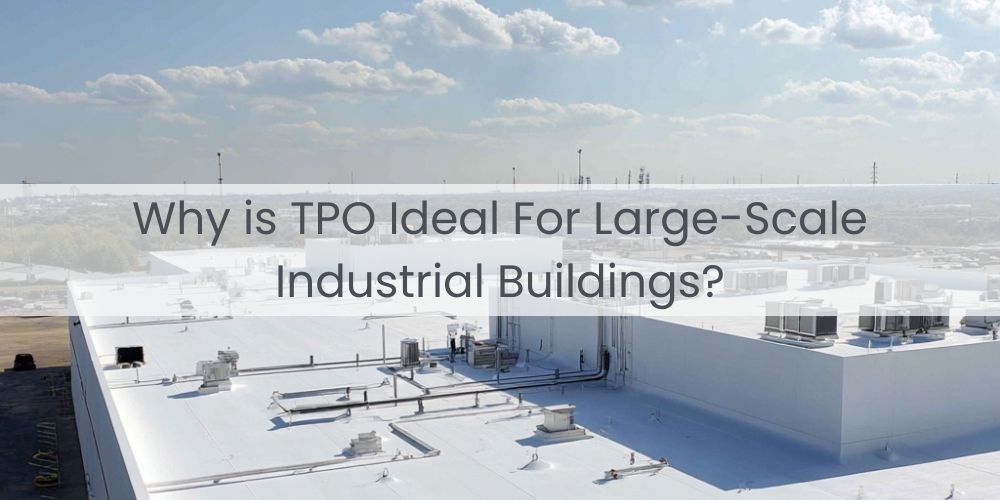
TPO roofing supports large industrial building roof systems by maintaining watertight continuity, chemical-resistance stability, and controllable thermal loading across expansive low-slope roof fields where seam reliability and downtime avoidance govern operational risk. Industrial facilities operate with continuous or high-duty production schedules, equipment-driven internal loads, inventory and process sensitivity, and strict maintenance windows that make roof failure a direct operational disruption rather than a simple repair event. TPO is selected for large industrial buildings where uncontrolled moisture intrusion would threaten production lines, stored materials, electrical distribution, and safety compliance, and where roof-surface solar heat gain would increase cooling load or amplify temperature drift in upper zones and process-adjacent spaces. Industrial roofs are subjected to sustained solar irradiance, daily and seasonal thermal cycling, wind uplift forces, rooftop mechanical congestion, service traffic, and site-specific chemical and pollutant exposure that concentrate stress at seams, penetrations, perimeters, and drainage low points. If industrial roof assemblies are not engineered to maintain heat-welded seam continuity, resist chemical attack at exposure zones, preserve insulation continuity, and sustain drainage function, defects can propagate beneath the membrane surface and create system-wide wet insulation and recurring leak pathways. Once moisture enters an industrial roof assembly, it can migrate laterally through insulation layers, reduce thermal resistance, weaken attachment performance, and cause interior damage far from the original breach location, compounding risk to operations and increasing unplanned downtime. Industrial TPO selection focuses on controlling seam-driven water entry and environment-driven degradation mechanisms at scale, not merely choosing a “durable” membrane based on generic commercial criteria. Industrial TPO roofing is the process of installing a heat-welded thermoplastic membrane system with defined attachment methods, compatible insulation and cover-board detailing, and engineered penetrations, perimeters, and drainage interfaces to create a watertight roof assembly that also limits solar-driven heat input and withstands industrial exposure conditions. Unlike smaller roofs where localized detailing dominates, large industrial roofs demand consistent weld quality and verified seam fusion across long runs, because the seam network becomes the governing pathway for moisture entry if workmanship variability exists. Without correct system design, chemical-exposure misalignment, seam-quality variability, insufficient perimeter securement, insulation discontinuities, and drainage restriction can preserve water-entry and heat-transfer pathways even when the membrane material is otherwise suitable, reducing reliability across the roof field. TPO Roofing Contractor installs and maintains TPO systems for large industrial buildings as operational control roof systems, engineered to preserve welded membrane continuity, resist industrial exposure conditions, and stabilize roof performance with minimal disruption across industrial facilities throughout the United States.
How Does Industrial TPO Roofing Control Moisture Intrusion, Chemical Exposure, and Downtime Risk?
Industrial roof failures escalate when water, movement, and exposure loads exploit weak seams and high-stress interfaces across a large membrane field where defects can remain hidden while moisture migrates. Thermal cycling drives membrane movement and seam stress, wind uplift loads corners and perimeters, rooftop servicing increases puncture risk, and chemical or pollutant exposure can degrade surfaces and details if compatibility is not controlled; together, these forces concentrate failure risk at seams, penetrations, and low points. TPO controls this risk by forming a monolithic thermoplastic membrane barrier with heat-welded seams that resist separation under thermal movement and maintain continuity across long sheet runs when properly fused and verified. Chemical-resistance alignment reduces the likelihood that localized exposures undermine membrane stability, while engineered flashing and termination methods protect penetrations and perimeters where industrial roofs are most vulnerable to movement and uplift. Continuous insulation and controlled transitions preserve thermal resistance and reduce pathways for condensation and heat transfer that can destabilize interior conditions and increase HVAC or process cooling demand. Drainage servicing and low-point control reduce ponding duration and hydraulic stress that accelerate seam fatigue and insulation saturation. The goal is to keep the seam network, exposure zones, and drainage geometry within stable performance bounds so the roof remains watertight and predictable without emergency-driven interventions that disrupt industrial operations.
The industrial TPO roofing system creates the following system-level performance relationships:
- Heat-welded TPO seams → form continuous membrane joints → moisture does not enter through seam separation under thermal cycling
- Exposure-zone compatibility planning → aligns membrane with chemical/pollutant conditions → localized degradation does not initiate premature failure
- Engineered penetrations and terminations → seal high-stress interfaces → leaks do not initiate at equipment curbs and edge conditions
- Continuous insulation and transition control → preserves thermal resistance → heat and moisture do not bypass control layers into the building
- Drainage function and low-point control → reduces ponding and hydraulic stress → seams and insulation are not overstressed at wet zones
- Planned inspection and targeted repairs → detect early defects before migration → unplanned downtime risk decreases
Each of these outcomes results from coordinated industrial roof-system design and maintenance decisions, ensuring that TPO functions as a watertight, exposure-resilient, and operationally stable roof assembly rather than a membrane whose weakest seam or incompatible exposure zone governs performance across an industrial roof field.
How Do You Specify and Detail TPO for Industrial Roof Exposure Zones, Equipment Density, and Service Traffic?
Industrial TPO performance is not determined only by “choosing TPO”; it is determined by whether the roof is specified and detailed to control industrial-specific stressors that do not exist at the same intensity on typical commercial buildings. Large industrial roofs concentrate risk into predictable zones: high RTU and process-exhaust density, frequent contractor access routes, curb and pipe-stand penetrations, grease and chemical residue deposition, vibration at equipment bases, and long-span drainage runs that magnify ponding duration when low points develop. In that environment, the roof must be designed as a controlled field system with exposure-aware membrane selection, traffic and puncture protection, penetration standardization, perimeter securement matched to uplift demand, and drainage geometry that does not allow repeated hydraulic loading to fatigue seams and saturate insulation. The purpose of this section is to convert “industrial suitability” into industrial controllability, so the seam network stays stable, exposure zones do not become degradation initiators, and maintenance can be executed predictably without disruptive emergency events.
The industrial TPO specification and detailing pathway creates the following system-level performance relationships:
- Exposure mapping of rooftop zones → classifies chemical, exhaust, and residue conditions → membrane and accessory compatibility is selected for actual site exposure
- High equipment density → increases penetration count and vibration interfaces → standardized curbs, pipe supports, and flashing packages reduce leak initiation points
- Repeated service access routes → concentrate puncture and abrasion risk → designated walk paths and protection layers reduce breach probability
- Perimeter and corner uplift demand → imposes cyclic tension at terminations → enhanced edge securement prevents flutter-driven seam fatigue
- Long-span drainage runs and low points → increase ponding duration and hydrostatic stress → corrected slope/drain capacity reduces seam overloading and insulation wetting
- Detailing at transitions and term bars → controls movement concentration zones → thermal cycling does not open micro-gaps into active intrusion paths
- Documented detailing standards across the roof field → reduces workmanship variability → defect frequency and rework cycles decline across large areas
Each of these outcomes results from converting industrial roof “exposure reality” into defined design controls, ensuring TPO performs as a predictable, maintainable industrial roof system rather than a membrane whose most stressed zones dictate failure timing.
Have a question about an upcoming project?
When Should an Industrial Facility Engage TPO Roofing Contractor to Keep a Large TPO Roof Operationally Predictable?
If an industrial building cannot tolerate unplanned downtime, has process-sensitive interiors, or runs a roof so large that a small defect can become a migrating moisture event before anyone sees interior symptoms, it should engage TPO Roofing Contractor before roof risk turns into production risk. The practical trigger is not roof age. It is any sign that the roof is drifting out of “controlled performance” and into “hidden propagation.” Indicators include recurring leaks that present in different interior locations, repeated repairs in the same seam corridors, ponding that persists after rain, high penetration density around equipment curbs and pipe stands, perimeter flutter in wind events, frequent contractor access creating puncture patterns, or any evidence that insulation has been wet in more than a localized, clearly bounded area. Facilities should also engage TPO Roofing Contractor ahead of known operational inflection points: planned shutdown windows, equipment additions or relocations, process exhaust changes that alter rooftop deposition, electrical or controls upgrades, insurance renewals, audit or compliance cycles, and annual capital planning. On large industrial roofs, outcomes are decided upstream by controls that must be engineered and standardized: heat-weld seam quality and verification across long runs, exposure-zone compatibility at pollutant or chemical deposition areas, penetration standardization so details are repeatable and inspectable, perimeter securement matched to uplift demand, traffic-route protection to prevent repeat punctures, and drainage basin performance so ponding does not become a hydraulic stress multiplier. A proper industrial evaluation is built around operational containment and recoverability. That means mapping the roof into exposure and stress zones (exhaust discharge areas, high-traffic service corridors, high-penetration equipment fields, perimeter and corner uplift zones, drainage basins and long-run low points), then verifying the control variables that determine whether defects stay localized: seam fusion integrity through probing and targeted verification, flashing and termination stability at vibration and movement interfaces, drainage function and low-point behavior that governs wetting duration, and insulation condition where moisture migration would create thermal drift and attachment instability. It also includes checking whether prior repairs restored true heat-welded continuity or simply covered symptoms in a way that will re-open under thermal cycling and uplift. Engaging TPO Roofing Contractor at the specification, evaluation, and program-management stage is a risk-management decision that keeps industrial roofs predictable at scale. It prevents seam-network variability, stops exposure zones from becoming degradation initiators, keeps insulation dry and thermally stable, maintains drainage so ponding does not accelerate fatigue, and preserves the facility’s ability to diagnose and correct issues without emergency-driven interventions that disrupt production.