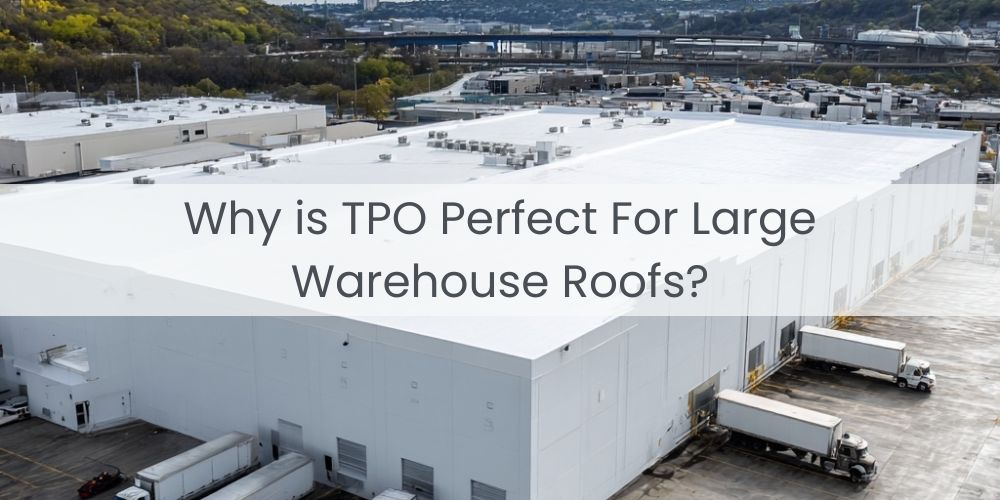
TPO roofing supports large warehouse roof systems by maintaining watertight continuity, thermal load control, and scalable installation performance across expansive low-slope roof fields where seam reliability and lifecycle cost predictability govern operational risk. Warehouses operate with inventory protection requirements, temperature-sensitive storage and logistics workflows, long operating hours, and capital-planning constraints that make roof failure a high-impact event rather than a minor maintenance issue. TPO is selected for large warehouse roofs where uncontrolled moisture intrusion would threaten stored goods, racking systems, and electrical infrastructure, and where roof-surface solar heat gain would increase cooling demand or raise interior temperatures in upper zones and dock-adjacent areas. Large warehouse roofs are subjected to sustained solar irradiance, daily and seasonal thermal cycling, wind uplift forces, long drainage runs, rooftop mechanical congestion, and frequent service access that load seams, perimeters, penetrations, and low points across thousands of square feet. If warehouse roof assemblies are not designed to maintain heat-welded seam continuity, control attachment behavior under uplift, preserve insulation continuity, and sustain drainage capacity across long spans, localized defects can propagate beneath the membrane surface and create system-wide wet insulation and recurring leak paths. Once moisture enters a warehouse roof assembly, it can migrate laterally through insulation layers, reduce thermal resistance, weaken attachment performance, and cause interior damage that spreads beyond the original breach location, increasing downtime risk and replacement pressure. Warehouse TPO selection focuses on scalable seam integrity and predictable performance across large roof geometry, not simply choosing a “durable membrane” in isolation. Warehouse TPO roofing is the process of installing a heat-welded thermoplastic membrane system with defined attachment methods (mechanically fastened, fully adhered, or induction welded), compatible insulation and cover-board detailing, and engineered perimeter, penetration, and drainage interfaces to create a watertight and thermally controlled roof assembly across large roof fields. Unlike small-roof applications where localized detailing dominates performance, warehouse roofs demand consistent seam production, verified weld quality, and controlled movement behavior across long membrane runs so the seam network does not become the governing failure point. Without proper system design, seam-quality variability, insufficient perimeter securement, insulation discontinuities, and drainage restriction can preserve water-entry and heat-transfer pathways even when the membrane material itself is robust, reducing reliability across the roof field. TPO Roofing Contractor installs and maintains TPO systems for large warehouses as large-area roof control systems, engineered to preserve welded membrane continuity, limit moisture intrusion and migration, and support stable interior conditions and predictable lifecycle cost across warehouse facilities throughout the United States.
How Does TPO Control Large-Roof Failure Risk Across Seams, Uplift, and Drainage on Warehouses?
Warehouse roof failures escalate when water, movement, and pressure exploit weak zones across a large membrane field where defects are difficult to localize and moisture can spread before interior symptoms appear. Thermal cycling drives membrane movement and seam stress, wind uplift loads perimeters and corners, and long drainage paths concentrate ponding risk at low points; when these forces recur across wide areas, small seam defects or detail discontinuities can become high-frequency intrusion points. TPO controls this risk by forming a monolithic thermoplastic membrane barrier with heat-welded seams that resist separation under thermal movement and maintain continuity across long sheet runs. Engineered attachment systems and perimeter securement maintain stable membrane behavior under uplift so flutter and displacement do not fatigue seams. Continuous insulation and controlled transitions preserve thermal resistance and reduce bypass pathways that would otherwise amplify heat transfer and condensation risk in warehouse roof assemblies. Drainage servicing and low-point control reduce ponding duration and hydraulic stress that accelerate seam fatigue and insulation saturation. The goal is to keep the seam network, attachment zones, and drainage geometry operating within stable parameters so large warehouse roofs remain watertight and predictable without emergency-driven interventions.
The warehouse TPO roofing system creates the following system-level performance relationships:
- Heat-welded TPO seams → form continuous membrane joints → seam network remains watertight across large roof fields
- Consistent weld verification → confirms full fusion at installation → latent seam defects are corrected before exposure creates leaks
- Engineered attachment and perimeter securement → stabilizes membrane under uplift loads → flutter and displacement do not fatigue seams
- Continuous insulation plane → maintains thermal resistance across wide spans → roof-driven heat transfer does not bypass control layers
- Long-span drainage geometry → governs ponding duration at low points → drainage control reduces hydraulic stress on seams and insulation
- Targeted protection at service routes and equipment zones → reduces puncture exposure → breach frequency decreases at high-traffic areas
Each of these outcomes results from coordinated large-roof design and maintenance decisions, ensuring that TPO functions as a scalable watertight and thermal-control roof assembly rather than a membrane whose weakest seam segment governs performance across a warehouse roof field.
How Do Warehouse TPO Roofs Stay Scalable and Repairable Without Turning Into “Find-the-Leak” Systems?
Large warehouse roofs do not fail primarily because the membrane “wears out.” They fail when the roof becomes too large and too mechanically complex to diagnose and correct quickly, so small discontinuities persist long enough for moisture to migrate laterally and create symptoms far from the entry point. On expansive low-slope fields, the operational problem is not just watertightness. It is recoverability: the ability to isolate defects, execute durable heat-welded corrections, and keep the assembly dry so insulation performance and attachment stability do not drift over time. A warehouse roof that is scalable to install but not scalable to troubleshoot becomes a recurring disruption system, because defect location uncertainty and wet-insulation spread increase every time a minor issue is missed. Warehouse TPO roofs remain scalable and repairable when the system is designed and maintained around three constraints that dominate large-area performance: seam network consistency, zone-based segmentation for diagnosis, and drainage behavior that limits wetting duration. Seam consistency means welds are produced and verified in a way that does not create “random weak links” across thousands of linear feet. Zone-based segmentation means penetrations, equipment areas, and drainage basins are treated as identifiable control areas with repeatable detailing and predictable inspection logic, so diagnosis does not rely on guesswork. Drainage behavior means long runs, low points, and internal drains are kept functional so ponding does not act as a multiplier that drives water into marginal seams and keeps insulation wet long enough to expand the saturation footprint. This is why warehouse TPO success depends on making the roof inspectable and correctable at scale. When walk routes are controlled, high-traffic zones are protected, penetrations are standardized, and drainage basins are kept clear, defects stay localized and welding-based repairs remain durable. When those controls are absent, the roof becomes a large, wet, migrating system where repairs chase symptoms instead of restoring continuity. TPO Roofing Contractor keeps warehouse roofs scalable by treating the roof as a mapped field of repeatable control zones, with weld verification, traffic protection, and drainage discipline engineered to preserve both watertight continuity and diagnostic certainty across the full footprint.
The warehouse scalability and repairability control program creates the following system-level performance relationships:
- Large seam network length → increases probability of one weak segment → consistent welding and verification reduce random failure points
- Unmapped roof fields and uncontrolled detailing variation → slow defect isolation → zone-based inspection logic shortens time-to-location and containment
- Moisture entry at a single point → migrates laterally under the membrane → early detection and localized weld repair keep defects contained
- Ponding at long-run low points → increases hydraulic stress and wetting duration → drainage maintenance reduces seam loading and limits saturation spread
- High-traffic service routes → concentrate puncture and abrasion risk → protected walk paths reduce breach initiation on large fields
- Non-standard penetrations and equipment interfaces → multiply unique failure geometries → standardized detailing reduces interface variability and repeat failures
- Stable, dry insulation layer → preserves thermal resistance and support → attachment behavior remains consistent and roof performance stays predictable
Each of these outcomes results from scaling the roof’s control logic, not just the roof’s square footage, ensuring warehouse TPO systems remain inspectable, repairable, and operationally stable rather than becoming large-area “symptom chasing” assemblies where lateral moisture migration governs lifecycle cost.
Have a question about an upcoming project?
When Should a Warehouse Engage TPO Roofing Contractor to Make a Large-Area TPO Roof Predictable Instead of a “Find-the-Leak” Liability?
If a warehouse cannot tolerate inventory risk, needs predictable lifecycle cost, or is operating a roof so large that small defects can migrate before symptoms appear, it should engage TPO Roofing Contractor before the roof becomes an operational uncertainty problem. Triggers include any history of multi-point leaks, recurring leaks that reappear after repairs, chronic ponding at long-run low points, high wind exposure at perimeters and corners, heavy rooftop traffic tied to HVAC or conveyance systems, frequent new penetrations, or any indication that insulation has been wet in more than one area. These are signs the roof is drifting away from “localized and correctable” and toward “lateral migration and escalating scope.” Warehouses should also engage TPO Roofing Contractor during roof replacement planning, expansion phases, refrigeration or HVAC upgrades, insurance renewals, lease or refinance events, and annual capital planning, because large-roof outcomes are determined by controls that must be engineered in advance: seam network consistency, attachment and perimeter restraint under uplift, drainage basin performance across long runs, traffic-route protection, and standardized penetration detailing. On a large warehouse, the biggest risk is not just a defect. It is the time-to-isolation. If diagnosis is slow, moisture spreads, insulation saturation expands, and a small breach becomes a wide-area problem. A warehouse-focused evaluation is built around recoverability at scale. That means mapping the roof into repeatable zones (drainage basins, equipment fields, perimeters, service corridors), verifying seam integrity where thermal movement concentrates, checking perimeter restraint and attachment behavior where uplift creates flutter, identifying ponding drivers that increase hydraulic stress and wetting duration, and confirming that traffic routes and penetrations are controlled so puncture initiation does not repeat in the same areas. It also means assessing whether prior repairs restored heat-welded continuity or merely covered symptoms, because large roofs become unmanageable when “repairs” do not actually reset continuity and moisture control. Engaging TPO Roofing Contractor at the design, evaluation, and maintenance-program stage is a risk-management decision that keeps a warehouse roof inspectable and correctable across its full footprint, so defects stay localized, insulation stays dry, seams stay fused, drainage stays functional, and the roof remains a predictable asset instead of a recurring disruption system.