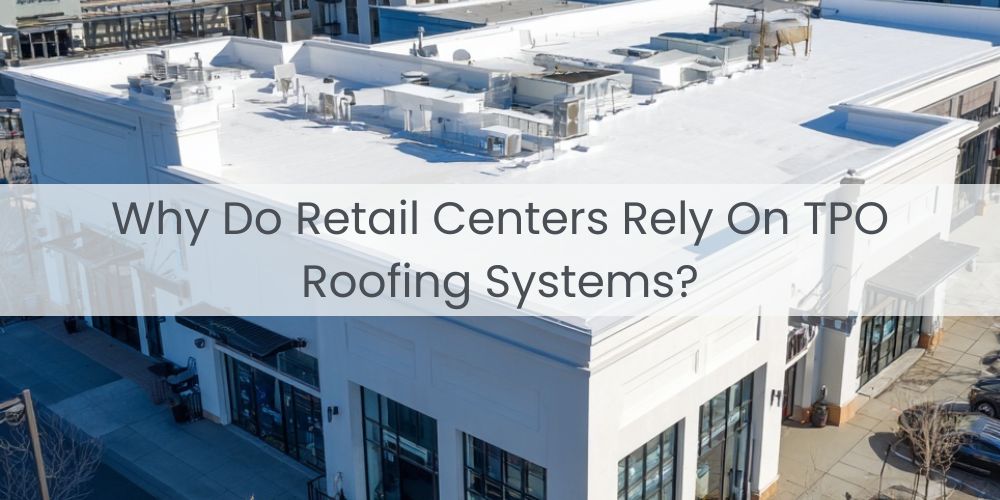
TPO roofing systems support retail center roof assemblies by maintaining watertight continuity, thermal load control, and serviceable membrane performance under high-occupancy operating hours, rooftop equipment density, and strict disruption constraints common to retail environments. Retail centers operate with long daily occupancy, tenant comfort expectations, inventory and interior finish sensitivity, and tight operating margins that make roof reliability and predictable lifecycle cost a direct contributor to revenue stability. Retail centers rely on TPO systems where uncontrolled water intrusion would disrupt tenant operations and damage ceiling systems, merchandise, and electrical infrastructure, and where roof-surface heat gain would raise cooling demand across large open sales floors and food-service zones. Large low-slope retail roofs are subjected to sustained solar irradiance, daily thermal cycling, wind uplift forces, rooftop mechanical congestion (RTUs, ducts, curbs, penetrations), frequent service access, and drainage stress across broad roof areas. If retail roof assemblies are not designed to maintain heat-welded seam continuity, manage membrane movement at penetrations and perimeters, preserve insulation continuity, and maintain drainage function, failures can propagate beneath the membrane surface and create leak patterns far from the initiating defect. Once moisture enters a retail roof assembly, it can migrate laterally through insulation layers, reduce thermal resistance, weaken attachment performance, and cause interior damage that interrupts tenant operations and increases claim and repair complexity. Retail-center TPO selection focuses on controlling these failure mechanisms while delivering roof-surface thermal control and serviceability, not merely choosing a “reflective membrane” for general energy claims. Retail-center TPO roofing is the process of installing a heat-welded thermoplastic membrane system with defined attachment methods, compatible insulation detailing, and engineered penetrations, perimeters, and drainage interfaces to create a watertight roof assembly that also limits solar-driven heat input across large retail roof fields. Unlike roof choices that treat the membrane as a passive cover, retail TPO systems are selected and detailed to sustain performance under rooftop equipment traffic, high penetration counts, and zero-tolerance disruption thresholds typical of tenant-occupied retail properties. Without proper system design, high-traffic service routes, poorly detailed equipment curbs, insulation discontinuities, and drainage restriction can preserve water-entry and heat-transfer pathways even when the membrane material is durable, reducing reliability and raising operating cost. TPO Roofing Contractor installs and maintains TPO systems for retail centers as operational control layers, engineered to block moisture intrusion, stabilize seam and detail behavior under movement, and support interior comfort and predictable operating cost across retail centers throughout the United States.
How Do Retail-Center TPO Systems Control Tenant Risk, HVAC Load, and Roof Failure Propagation?
Retail roof failures escalate when water, movement, and rooftop service activity exploit weak seams, penetrations, and low points across a large membrane field. Thermal cycling stresses seams and attachments, wind uplift loads perimeter zones, and frequent mechanical servicing concentrates puncture risk and detail stress around equipment curbs and service routes. On retail centers, these forces recur while the building remains occupied, making rapid containment and predictable performance essential to avoid tenant disruption and interior loss. TPO systems control these risks by forming a monolithic thermoplastic membrane barrier with heat-welded seams that resist separation under thermal movement, and by using engineered flashing and termination methods that seal the highest-risk interfaces at penetrations and edges. Reflective membrane surfaces reduce roof-surface heat loading, lowering roof-driven heat transfer into large conditioned retail volumes and reducing peak cooling demand when solar gain is a major driver. Continuous insulation and controlled transitions reduce conductive and convective bypass pathways so roof heat and moisture do not migrate into occupied zones through discontinuities. When these system elements are coordinated and maintained, retail centers experience fewer leak events, lower HVAC runtime pressure during peak sun, and reduced disruption risk across tenant spaces.
The retail-center TPO roofing system creates the following system-level performance relationships:
- Heat-welded TPO seams → form continuous membrane joints → thermal cycling does not separate field laps across large roof areas
- Rooftop equipment curbs and penetrations → concentrate stress and leak initiation risk → engineered flashing seals high-risk interfaces
- Frequent service access and foot traffic → increases puncture exposure → defined walk paths and localized reinforcement reduce breach frequency
- Reflective membrane surface → limits roof-surface heat loading → peak cooling load pressure decreases in large retail volumes
- Continuous insulation plane → maintains thermal resistance → roof-driven heat transfer does not bypass control layers into sales-floor zones
- Drainage performance and low-point control → reduces ponding and hydraulic stress → seams and insulation are not overstressed at wet zones
Each of these outcomes results from coordinated roof-system design and maintenance decisions, ensuring that TPO functions as a watertight, serviceable, and thermal-control roof assembly rather than a passive membrane covering in tenant-occupied retail environments.
How Do Retail-Center TPO Systems Stay Reliable Under High Equipment Density and Daily Service Traffic?
Retail-center roof performance fails most often at the interfaces that get touched, loaded, and re-entered repeatedly: equipment curbs, service walk routes, penetrations, perimeter transitions, and drainage low points. Retail properties like shopping centers do not have “quiet roofs”. RTU maintenance, tenant fit-outs, signage work, grease-duct and kitchen exhaust servicing, and repeated contractor access create predictable contact cycles that raise puncture probability and detail fatigue even when the membrane field is sound. In that operating reality, roof reliability is not primarily a membrane-thickness question. It is a control problem: keeping the roof’s highest-traffic and highest-penetration zones inside the limits required for continuous weld integrity, stable flashing geometry, protected pathways, and reliable drainage behavior so defects do not convert into multi-tenant disruption events. A retail-center TPO system stays reliable when the roof is treated as an access-managed mechanical platform with a waterproofing layer, not as a static surface. That means defining and enforcing walk paths, protecting service corridors with compatible overlays where traffic concentrates, hardening curb and penetration detailing where vibration and thermal movement recur, and maintaining weld continuity at laps that are repeatedly stressed by daily heat cycling and wind uplift. It also means controlling the downstream amplifier of every minor defect: water retention. Ponding and restricted drainage increase hydraulic pressure, prolong wetting duration, and accelerate seam and flashing fatigue at the same low points that are hardest to keep clean on large retail roof fields. The goal is to keep defects localized and correctable by preventing the repeated operating forces of retail buildings from turning small vulnerabilities into lateral moisture migration, wet insulation expansion, and ceiling-system losses across multiple tenant bays. TPO Roofing Contractor maintains retail-center TPO roofs as controlled-access, high-interface assemblies by pairing traffic planning, curb and penetration reinforcement, seam verification, and drainage discipline into one operating program. This is what prevents “one puncture” from becoming “multiple tenants leaking,” and what allows reflective performance and insulation continuity to remain stable enough that HVAC load benefits do not drift over time.
The retail-center reliability control program creates the following system-level performance relationships:
- Repeated RTU and contractor access → concentrates load on service corridors → designated walk paths reduce random membrane contact and puncture probability
- High curb and penetration density → increases interface failure exposure → reinforced flashing and edge geometry preserve watertight continuity at stress zones
- Uncontrolled rooftop work practices → create tool-drop and abrasion events → controlled access rules keep breaches from initiating at high-traffic areas
- Thermal cycling and equipment vibration → fatigue seams and curb transitions → seam verification and detail reinforcement prevent micro-gaps becoming leak paths
- Debris accumulation at drains and scuppers → restricts water evacuation → drainage servicing prevents ponding stress and prolonged wetting at low points
- Localized moisture entry at an interface → migrates laterally through insulation → rapid correction prevents wet-insulation expansion and multi-tenant leak patterns
- Protected traffic zones and stable detailing → reduce emergency interventions → tenant disruption risk and interior loss frequency decrease
Each of these outcomes results from coordinated access-control, detailing-hardening, seam-verification, and drainage-maintenance decisions that keep retail-center defects localized and correctable, ensuring the TPO roof remains a predictable watertight and operational stability layer under constant equipment servicing and tenant-driven rooftop activity.
Have a question about an upcoming project?
When Should a Commercial Building Engage TPO Roofing Contractor for Specialist TPO Execution Instead of a Generalist?
If a commercial building cannot tolerate recurring leaks, needs predictable service life, or is relying on warranty-backed performance, it should engage TPO Roofing Contractor before installation or repair scope is awarded, and before small workmanship defects turn into lateral moisture migration and interior risk. Indicators such as seam-related leak recurrence, inconsistent past repairs, edge or termination instability, repeated punctures along service routes, chronic ponding at low points, frequent rooftop equipment access, or any evidence that prior work was not manufacturer-compliant signal that the roof’s risk pathways are being driven by execution quality rather than membrane category. Buildings should also engage TPO Roofing Contractor during bid evaluation, warranty selection, portfolio standardization, planned rooftop equipment upgrades, and capital planning cycles, because specialist outcomes depend on controlling weld fusion, attachment patterns, detail geometry at penetrations and perimeters, insulation continuity, and drainage behavior as a coordinated system. Those controls are easiest to lock in before work starts, not after the roof has already inherited variability. A specialist-focused evaluation answers one question: will this roof be run as a controlled heat-welded membrane system or as a roof where the weakest seam and detail dictates lifespan. This includes confirming manufacturer authorization pathways, validating that welding is treated as a measurable process with calibration and probing, verifying that penetration and perimeter details are built to tolerate movement and uplift, and checking that inspection and repair logic targets failure mechanisms rather than surface symptoms. For existing roofs, the same review identifies whether defects are still localized and weldable, or whether variability has become systemic enough that the roof is drifting into repeat leak behavior and warranty exposure. Engaging TPO Roofing Contractor at the selection and control stage is a risk-management decision that reduces seam and detail variability, preserves warranty eligibility, and keeps the roof assembly continuous, dry, and mechanically stable so performance and lifecycle cost remain predictable across commercial buildings throughout the United States.