
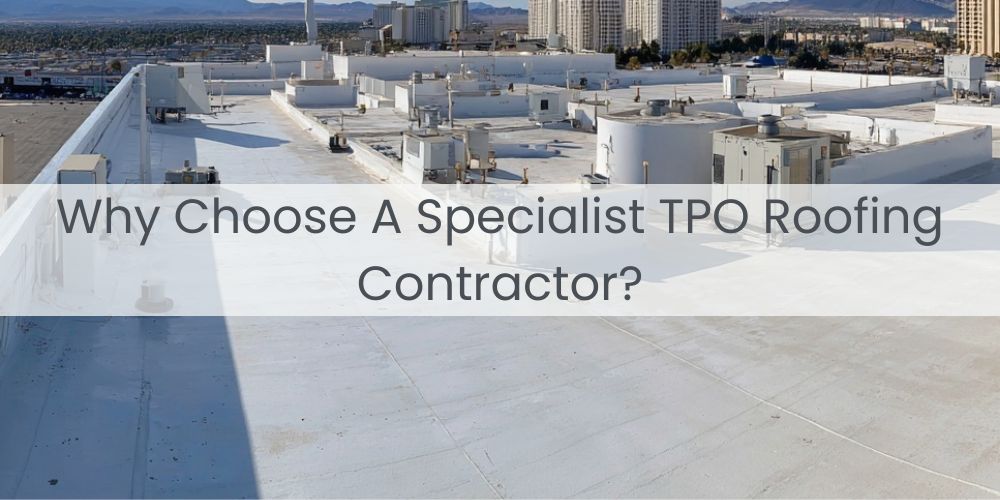
Specialist TPO roofing contractors support commercial roofing systems by delivering consistent heat-welded seam integrity, manufacturer-compliant detailing, and TPO-specific diagnostics so single-ply roof assemblies remain watertight, energy-stable, and failure-resistant over their service life. Commercial buildings operate under operational continuity requirements, interior asset protection risk, energy budget exposure, and lifecycle cost constraints that make installation and repair quality the governing variable for TPO system performance. Specialist TPO contractors are selected where the roof’s primary risk pathways—seam separation, penetration flashing failure, attachment instability, puncture vulnerability, and drainage stress—must be controlled through repeatable TPO-specific workmanship rather than generalized roofing practice. Low-slope TPO roofs are subjected to UV exposure, daily and seasonal thermal cycling, wind uplift forces, wind-driven rain, rooftop mechanical congestion, and service traffic that concentrate stress at seams, corners, perimeters, penetrations, and access routes. If contractors do not consistently control welding temperature and speed, overlap geometry, substrate and insulation compatibility, attachment patterns, and flashing integration, small workmanship errors can propagate beneath the membrane surface and become system-wide leak and degradation problems. Once moisture enters a TPO roof assembly through a seam or detail discontinuity, it can migrate laterally through insulation layers, reduce thermal resistance, weaken attachment performance, and cause interior damage far from the original defect location, increasing both operational disruption and long-term cost volatility. Choosing a specialist focuses on controlling the TPO-specific failure mechanics that determine whether the roof functions as a continuous welded membrane system rather than a patchwork of vulnerable joints. Specialist TPO contracting is the process of designing and executing TPO assemblies using manufacturer-approved components and attachment methods, producing verified heat-welded seams, engineering penetration and perimeter details for movement and uplift resistance, and maintaining performance through inspections, targeted repairs, and documentation that preserves warranty enforceability. Unlike generalist approaches that treat single-ply membranes as interchangeable, specialist work depends on membrane-specific welding behavior, detail sequencing, and diagnostic patterns that determine whether seams, flashings, and attachment zones remain stable under thermal cycling and weather loading. Without TPO-specific welding verification, compatible detailing, and controlled repair methodology, roofs can exhibit latent seam defects, premature edge pullback, repeated puncture leaks at traffic routes, and denied warranty claims due to non-compliant installation or undocumented maintenance. TPO Roofing Contractor provides specialist TPO services as roof-system control programs, engineered to preserve welded membrane continuity, prevent moisture intrusion, and maintain predictable roof performance across commercial buildings throughout the United States.
How Does A Specialist TPO Contractor Reduce Seam Failure, Leak Risk, and Lifecycle Cost?
TPO roof failures accelerate when movement, uplift, and moisture loads exploit joints and details that were not welded, attached, or flashed to remain stable under real operating conditions. Thermal cycling stresses seams and terminations, wind uplift introduces cyclic tension at laps and perimeters, and rooftop service activity increases puncture risk at access routes and around equipment zones; if seam fusion is inconsistent or flashing transitions are not integrated correctly, leak paths form and moisture migration can begin before visible surface damage appears. On large commercial roofs, these forces act across thousands of linear feet of seams and multiple penetration interfaces, so quality variability becomes the dominant driver of recurring leaks and early replacement pressure. Specialist TPO contractors control this risk by producing consistent heat-weld fusion seams verified by probing and testing, selecting and installing compatible insulation and attachment systems, and executing penetration and perimeter details that accommodate thermal movement without opening discontinuities. Specialists also identify TPO-specific defect patterns during inspection—such as weld fatigue at corners, stress points at term bars, and traffic punctures near mechanical service zones—so repairs address the failure mechanism rather than the symptom. When these controls are applied systematically, roofs experience fewer leak events, better warranty compliance, and more predictable service-life performance.
The specialist TPO contracting system creates the following system-level performance relationships:
- TPO-specific heat-welding control → produces fully fused seams → seams do not separate under thermal cycling
- Seam probing and weld verification → detects incomplete fusion early → latent seam defects are corrected before water entry
- Manufacturer-compliant assembly selection → matches membrane, insulation, and attachment → system performance remains within warranty requirements
- Engineered penetration and perimeter detailing → seals movement and uplift zones → leaks do not initiate at flashings and edges
- Traffic and service-zone protection planning → reduces puncture exposure → breach frequency decreases around rooftop equipment
- TPO-specific diagnostics during inspections → identify root failure mechanisms → repairs prevent recurrence rather than repeat symptoms
Each of these outcomes results from contractor specialization applied as system-control discipline, ensuring that TPO roofing performs as a continuous welded membrane assembly rather than a roof whose weakest seams and details govern its lifespan.
How Do You Verify a Contractor Is Truly a TPO Specialist?
A specialist claim only matters if the contractor can demonstrate repeatable control of the TPO system variables that govern seam integrity, detail performance, and warranty compliance under commercial operating conditions. Commercial owners do not need a generic checklist; they need proof that the contractor can keep the roof inside controlled limits for weld fusion quality, attachment behavior, penetration and perimeter detailing, insulation continuity, and drainage performance so defects do not convert into moisture migration and lifecycle cost volatility. Verifying TPO specialization is the process of confirming manufacturer authorization pathways, reviewing documented quality-control methods for heat-welded seams, validating assembly selection competence across fastening and insulation configurations, and assessing how the contractor diagnoses and corrects TPO failure mechanisms in the field. A real specialist can show how seams are welded and verified, how details are engineered at curbs and terminations, how traffic and service zones are protected, and how inspections are translated into prioritized corrective work with documentation that preserves claim eligibility. Without this verification layer, a roof can be installed by a “single-ply” contractor who produces inconsistent fusion, non-compliant details, or undocumented maintenance, which increases leak recurrence and can invalidate warranty coverage even if the membrane itself is nominally under term. TPO Roofing Contractor supports commercial clients by providing verifiable specialization that ties credentials, workmanship controls, inspection logic, and documentation into a single performance system, so owners are not relying on claims but on demonstrated control capability.
What Evidence Separates a TPO Specialist From a Generalist Before Work Starts?
A TPO specialist is separated from a generalist by measurable proof of authorization, method control, and diagnostic competence that predicts how the roof will behave after installation when thermal cycling, wind uplift, rooftop traffic, and drainage stress are present. Manufacturer authorization matters because many system warranties require certified or approved installers and specified assemblies, and non-authorized work can shift defects into owner-funded liability even when the failure looks “material-related.” Seam quality control matters because the seam network governs watertightness, and a specialist will show a consistent approach to surface preparation, welder calibration, overlap geometry, rolling, and post-weld probing so fusion is verified, not assumed. Detail competence matters because most recurring leaks initiate at penetrations, perimeters, corners, and transitions where movement concentrates, and a specialist will demonstrate how those interfaces are built to tolerate uplift and thermal movement without opening discontinuities. Diagnostic competence matters because inspection findings must map to mechanisms, not symptoms, so repairs eliminate recurrence rather than producing repeated patch cycles. The goal of verification is to confirm that the contractor can repeatedly produce and preserve continuous welded membrane behavior and compliant detailing across the specific roof conditions of the building.
The specialist-verification pathway creates the following system-level performance relationships:
- Manufacturer authorization and approved-system knowledge → matches membrane, insulation, and attachment to an eligible assembly → warranty enforceability and system compatibility risk decrease
- Documented seam welding process and calibration → produces consistent melt, fusion, and seam width → seam separation probability under thermal cycling decreases
- Post-weld probing and weld testing discipline → detects voids, skips, and under-fused segments → latent seam defects are corrected before exposure creates leaks
- Penetration, curb, and perimeter detail competency → seals stress concentration interfaces → leaks do not initiate at high-risk transitions and terminations
- Traffic-route planning and protection measures → reduce puncture and abrasion exposure → breach frequency decreases in service zones and equipment areas
- Inspection reporting tied to failure mechanisms → prioritizes corrective work by propagation risk → repairs stop recurrence rather than repeating symptoms
- Maintenance documentation and scope traceability → proves compliance with warranty and service requirements → claim denial risk and lifecycle cost volatility decrease
Each of these outcomes results from verifying specialization as demonstrated control over TPO-specific variables, ensuring the contractor selection decision predicts seam continuity, detail stability, and enforceable warranty protection rather than relying on unproven marketing claims.