
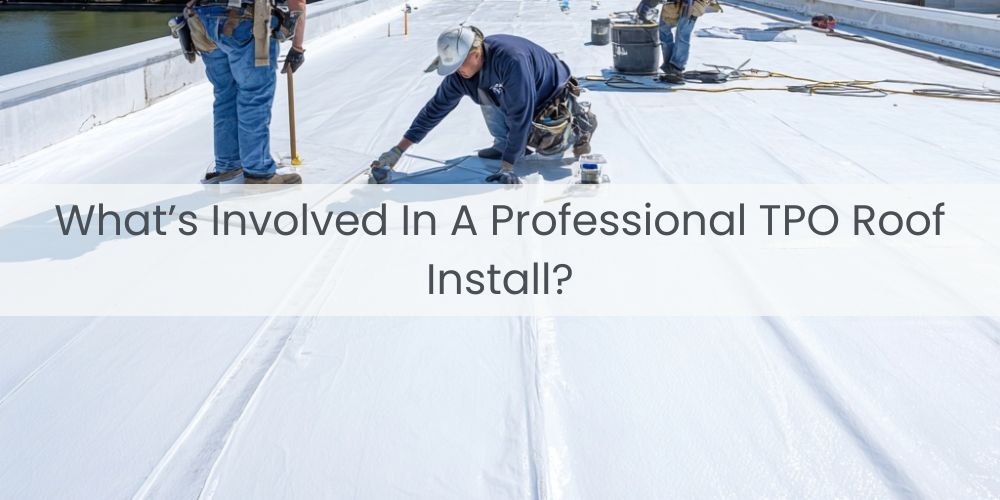
Professional TPO roof installation stabilizes commercial roof assemblies by creating continuous membrane watertightness, controlled thermal performance, and secure attachment behavior that prevents moisture intrusion and premature system failure over the roof’s service life. Commercial buildings operate under occupancy continuity requirements, interior asset protection risk, energy budget exposure, and warranty/compliance constraints that make installation quality the primary determinant of long-term roof reliability. Professional TPO roof installs are executed where seam failure, poor attachment, insulation discontinuity, or inadequate penetration detailing would otherwise create early leak pathways, insulation saturation, and escalating maintenance across large low-slope roof areas. Low-slope commercial roofs are subjected to UV exposure, daily and seasonal thermal cycling, wind uplift forces, rooftop mechanical congestion, service traffic, and drainage stress that concentrate loading at seams, perimeters, penetrations, and low points. If installation does not control substrate preparation, insulation layout, fastening patterns, seam welding quality, flashing geometry, and drainage continuity, defects can propagate beneath the membrane surface and convert minor workmanship errors into system-wide performance problems. Once moisture enters a TPO roof assembly, it can migrate laterally through insulation layers, reduce thermal resistance, weaken attachment performance, and cause interior damage far from the original defect location, while also compromising warranty position and lifecycle cost predictability. Professional TPO installation focuses on engineering a complete roof system—deck interface, insulation plane, membrane continuity, and detailing—rather than simply placing membrane sheets on a roof. Professional TPO roof installation is the process of preparing the roof substrate, installing compatible insulation and cover board (where required), applying the TPO membrane using the specified attachment method (mechanically fastened, fully adhered, or induction welded), heat-welding seams into continuous joints, and executing code- and manufacturer-compliant detailing at edges, penetrations, transitions, and drainage components to create a watertight and thermally stable roof assembly. Unlike non-professional installs that rely on inconsistent welding, improvised detailing, or incomplete documentation, professional work follows defined specifications, verified seam integrity, and traceable quality control that preserves both performance and warranty compliance. Without disciplined installation sequencing, correct fastening patterns, verified weld strength, and engineered flashing and drainage details, roofs can exhibit seam openings, membrane flutter, edge pullback, ponding stress, and early leaks that shorten service life and increase emergency repair frequency. TPO Roofing Contractor performs professional TPO roof installation as a system-control service, engineered to deliver continuous watertight integrity, preserve insulation performance, resist wind uplift and thermal movement, and maintain long-term roof reliability across commercial buildings throughout the United States.
How Does A Professional TPO Install Prevent Early Failure and Deliver Long-Term Performance?
TPO roof failures begin when movement, uplift, and moisture loads exploit discontinuities created during installation. Thermal cycling stresses seams and terminations, wind uplift loads challenge securement, and rooftop service activity concentrates stress at penetrations and traffic paths; if seams are under-welded, attachments are mis-specified, or flashings are not integrated correctly, water entry can begin even when the membrane appears intact. On large commercial roofs, these forces act across wide areas, allowing small workmanship defects to become recurring leak sources and creating wet-insulation zones that spread beyond the original defect location. A professional TPO install prevents this escalation by controlling the system interface from deck to membrane: substrate preparation provides a stable base, insulation and cover boards maintain a continuous thermal plane, attachment methods are chosen and executed to resist uplift and movement, and heat-welded seams create continuous joints that do not separate under thermal cycling. Engineered flashing at penetrations and perimeters seals the highest-risk interfaces, and drainage detailing reduces ponding that increases hydraulic stress on seams and accelerates aging. The goal is to produce a roof assembly whose seams, details, and attachment behavior remain stable under real operating loads so watertightness, energy performance, and service life are predictable.
The professional TPO installation system creates the following system-level performance relationships:
- Substrate preparation → creates stable installation base → membrane and insulation do not shift and create stress points
- Continuous insulation layout → maintains thermal resistance plane → roof-driven heat transfer does not bypass control layers
- Specified attachment method → secures membrane under uplift and movement → flutter and displacement do not fatigue seams
- Heat-welded TPO seams → form continuous membrane joints → thermal cycling does not separate field seams
- Engineered flashing at penetrations and perimeters → seals high-risk interfaces → water entry does not initiate at transitions and service zones
- Drainage detailing and water-control geometry → reduces ponding and hydraulic stress → seams and insulation are not overstressed at low points
Each of these outcomes results from coordinated installation decisions verified against specification and manufacturer requirements, ensuring the TPO system functions as a controlled roof assembly rather than a membrane applied without system engineering.
What Quality-Control Checks Confirm a Professional TPO Install Is Watertight, Compliant, and Ready for Warranty Closeout?
A professional TPO install is only complete when the roof assembly has been verified as a controlled system across the failure initiation zones that determine early-life performance: field seams, corners and angle changes, penetrations and curbs, perimeter terminations, attachment restraint, insulation continuity, and drainage low points. Commercial owners do not need a summary that the roof was installed. They need proof that the system variables that govern TPO performance have been checked, corrected where required, and documented so the roof remains predictable under wind uplift, thermal cycling, rooftop service activity, and live rainfall. In that context, quality control is not a preference layer. It is the installation phase that prevents hidden discontinuities from becoming active water entry paths during the first storm cycle. TPO systems fail early when one of five controllable conditions is left unverified. First, seam fusion is incomplete or inconsistent, leaving micro voids that admit wind driven water under live loading. Second, flashing and termination geometry allows water to route behind details at curbs, parapets, and penetrations even when the membrane field appears intact. Third, attachment restraint is misapplied or inconsistent, creating membrane flutter that concentrates fatigue at seams and edges. Fourth, insulation continuity is compromised by gaps, compression, or wet materials, creating thermal bypass and stress zones that accelerate movement and degradation. Fifth, drainage function is not validated, allowing ponding duration to increase hydraulic stress, wetting time, and freeze cycle loading at low points. A professional closeout phase verifies that these conditions are controlled before the roof is placed into service. Professional TPO installation verification is the process of performing systematic seam probing and weld continuity checks, confirming detail geometry and water shedding at penetrations and perimeters, verifying securement patterns and restraint behavior, confirming insulation and cover board continuity at transitions, and validating drainage evacuation so ponding drivers are identified and corrected. Unlike a visual walk only, closeout quality control is designed to convert install actions into verified system state. That is what protects both watertight integrity and warranty position because most warranty disputes trace back to the same measurable variables that drive leaks: seam continuity, termination execution, attachment compliance, and maintained drainage behavior. TPO Roofing Contractor performs TPO installation verification as a closeout control step that confirms the roof assembly is continuous, restrained, drainable, and documentation ready across commercial buildings throughout the United States.
How Do Closeout Inspections and Documentation Prevent Hidden Defects From Becoming Early Leaks?
Early leaks do not appear because TPO is unpredictable. They appear because a defect that existed at turnover was not detected at the locations where roof stress concentrates. Under peak sun, thermal cycling drives expansion and contraction that tests seam edges and termination restraint. Under wind events, uplift loading tests securement patterns and membrane flutter behavior. Under rainfall, hydraulic pressure tests low points, drain bowls, scuppers, and any detailing that can route water behind the membrane. When these loads hit a roof that has not been verified, micro gaps become leak paths, ponding becomes a stress multiplier, and minor detailing weaknesses become recurring intrusion points. Closeout verification prevents that transition by converting uncertainty into confirmed continuity. Seam probing identifies voids before water can be driven under laps. Detail review confirms that penetrations, corners, and perimeters are sealed as water shedding interfaces, not water collecting geometries. Securement verification prevents flutter that fatigues seams into separation. Drainage validation reduces wetting duration that accelerates seam stress and insulation saturation. Documentation closes the loop by creating a roof system record that aligns installed conditions with manufacturer requirements so future maintenance and any warranty review references controlled evidence rather than assumptions. The goal is not to produce paperwork. The goal is to ensure the roof begins its service life in a verified stable state so performance does not drift immediately after handover.
The professional TPO installation closeout system creates the following system level performance relationships:
- Completed seam welds → require continuity confirmation → seam probing identifies voids and weak segments before they become leak paths
- Inconsistent weld temperature or speed → produces partial fusion → re weld and edge consolidation restore fused joint continuity
- Penetrations and curbs → concentrate vibration and service traffic → flashing verification prevents micro gaps becoming active intrusion points
- Perimeter terminations and parapets → experience uplift peel forces → termination checks prevent edge lifting and storm driven water routing
- Attachment patterns and fastener placement → govern restraint under uplift → securement verification prevents flutter that fatigues seams
- Insulation gaps, compression, or wet boards → reduce thermal resistance and support → continuity checks prevent thermal bypass and stress concentration
- Drain bowls, scuppers, and low points → control wetting duration → drainage validation reduces ponding stress and limits saturation risk
- Walk paths and service routes → drive puncture probability → protection verification reduces breach formation after turnover
- Closeout records and photo evidence → preserve installed system state → future maintenance targets the right zones before defects escalate
- Verified watertight continuity at turnover → prevents moisture entry → insulation remains dry and service life remains predictable
Each of these outcomes results from verification decisions that confirm continuity, restraint, and drainage behavior, ensuring a professional TPO install is delivered as a controlled roof assembly rather than a membrane application that leaves latent defects to emerge under the first operating loads.
Have a question about an upcoming project?
When Should a Commercial Building Engage TPO Roofing Contractor for a Professional TPO Roof Install?
If a commercial building needs predictable watertight performance, stable energy behavior, and warranty-safe execution on a low-slope roof, it should engage TPO Roofing Contractor before design assumptions and field realities diverge at the exact points where TPO systems fail first: seams, penetrations, perimeters, attachment restraint, insulation continuity, and drainage low points. Indicators such as repeated leak history on the existing roof, wet-insulation concerns, chronic ponding, high rooftop equipment density, frequent service access, known wind-uplift exposure, top-floor comfort complaints during peak sun, or upcoming tenant and operational constraints signal that the install must be treated as a controlled system build rather than a membrane swap. Buildings should also engage TPO Roofing Contractor during design and tender, pre-construction planning, value-engineering reviews, and before rooftop equipment work or curb modifications, because attachment method, insulation build-up, penetration detailing, traffic routing, and drainage geometry must be coordinated at the same decision point if long-term performance is expected to be predictable instead of dependent on luck. A professional-install review focuses on whether the roof will be built as a continuous assembly from deck to membrane with verifiable controls. This includes confirming the substrate condition and prep requirements, establishing the insulation and cover-board layout so the thermal plane is continuous and stable, selecting an attachment strategy that matches uplift exposure and roof geometry, defining seam layout and welding approach so continuity is maintained through thermal cycling, and engineering penetrations, curbs, edges, and transitions as water-shedding interfaces rather than stress concentrators. It also includes planning for rooftop traffic realities by defining service routes and protection so puncture probability is reduced from day one, and validating drainage behavior so ponding duration does not become a stress multiplier that accelerates seam fatigue and insulation wetting. For projects in design or tender, this process validates that the specified system is installable, code- and manufacturer-aligned, and detailed to avoid early-life defects. For replacement work on occupied buildings, it clarifies sequencing and controls that protect operations while ensuring the finished system is continuous, restrained, and drainable. Engaging TPO Roofing Contractor before installation begins is a risk-management decision that aligns specification, workmanship controls, and closeout verification so the roof enters service in a verified stable state with fused seam continuity, secure attachment restraint, continuous insulation performance, reliable drainage behavior, and documentation that supports long-term maintenance and warranty compliance across commercial buildings.