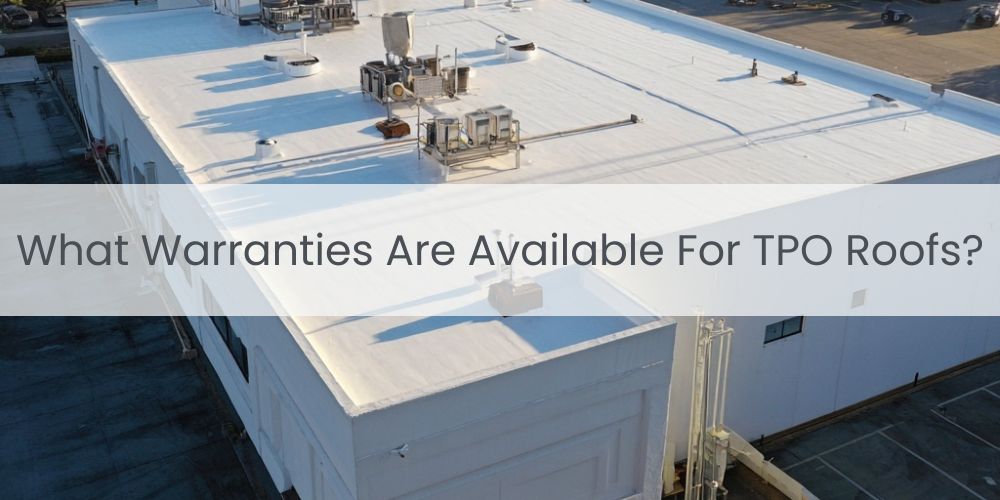
TPO roof warranties support commercial risk management by defining enforceable coverage terms for membrane performance, system integrity, and installation responsibility so building owners can control lifecycle exposure and avoid unmanaged repair liability. Commercial properties operate under capital-planning constraints, tenant and operational continuity requirements, and interior asset protection risk that make roof warranty scope a material financial control rather than a brochure feature. TPO roof warranties are used where a defined coverage period, covered failure modes, and documented compliance requirements determine whether future defects are treated as warrantable claims or as owner-funded repairs and replacements. Commercial roof systems are subjected to UV exposure, daily and seasonal thermal cycling, wind uplift forces, rooftop mechanical congestion, service traffic, and drainage stress that concentrate failure risk at seams, perimeters, penetrations, and low points. If warranty selection and compliance planning do not align with roof design, attachment method, climate exposure, and maintenance requirements, claim eligibility can fail even when a roof defect appears to be a “material problem.” Once a roof defect becomes non-warrantable, the owner assumes full cost for diagnosis, repair, and potential replacement, and water intrusion can still migrate laterally through insulation layers, reduce thermal resistance, and cause interior damage far from the original defect location. TPO roof warranty selection focuses on matching system risk to coverage scope and preserving claim eligibility through documented compliance, not simply choosing the longest stated term. TPO roof warranty selection is the process of choosing a warranty type and term (material-only, labor, full-system, or enhanced weather coverage), confirming the manufacturer’s required installation pathway and detailing standards, and implementing the inspection and maintenance documentation needed to keep the warranty enforceable over the roof’s intended service life. Unlike generic assurances that imply “the roof is covered,” real warranty protection depends on defined exclusions, authorized contractor requirements, wind-speed or hail limitations, puncture and traffic exclusions, and maintenance documentation that links roof condition to compliance obligations. Without correct system selection, authorized installation, and documented maintenance, owners can lose coverage for seams, flashings, wind damage, or labor costs even when the membrane itself is under warranty, increasing lifecycle cost volatility. TPO Roofing Contractor supports TPO warranty-backed installations and service programs as compliance-aligned roof systems, engineered to meet manufacturer requirements, preserve weld integrity, and maintain the documentation trail needed to keep warranty coverage enforceable across commercial buildings throughout the United States.
How Do TPO Roof Warranties Work and What Determines Whether A Claim Is Approved?
Warranty claims fail when the covered event, the roof’s installed configuration, and the documentation requirements do not align with the warranty’s defined terms. Manufacturers typically distinguish between material defects (manufacturing-related issues), system performance coverage (including seams and details when installed to specification), and labor or workmanship responsibilities (often provided by the installer, sometimes wrapped into a system warranty when installed by an authorized contractor). Many warranties require that the roof be installed by certified contractors, that the assembly components match an approved system, and that periodic inspections and maintenance be documented to demonstrate ongoing compliance. If exclusions apply—such as punctures from foot traffic, unauthorized modifications, poor drainage conditions, or lack of maintenance records—coverage can be reduced or denied even when the roof has a long stated term. Effective warranty strategy controls this risk by selecting a warranty structure that matches building exposure (wind, hail, traffic, equipment density), installing the system through the required authorization pathway, and maintaining inspection and service records that preserve eligibility. The goal is to convert a warranty term into an enforceable protection mechanism that reliably transfers defined failure costs away from the owner when covered conditions occur.
The TPO warranty protection pathway creates the following system-level performance relationships:
- Manufacturer system warranty → covers membrane, seams, and approved components → system-level failures can be transferred to warranty responsibility
- Authorized installation pathway → satisfies manufacturer eligibility requirements → claim approval probability increases
- Documented maintenance and inspections → demonstrate compliance with warranty conditions → exclusions are less likely to invalidate coverage
- Defined exclusions (traffic punctures, unapproved modifications, poor drainage) → remove coverage for certain failures → owner-funded repairs increase if exclusions are triggered
- Enhanced weather coverage options → expand defined storm-related protection limits → wind/hail claim exposure is reduced where applicable
- Installer workmanship warranty → covers installation-related defects → early-life failure risk is transferred to installer responsibility
Each of these outcomes results from coordinated warranty selection and compliance decisions, ensuring that “available warranties” function as enforceable risk transfer mechanisms rather than assumed protection based on term length alone.
What Warranty Compliance Requirements Must Be Maintained So TPO Coverage Remains Enforceable Over the Roof’s Service Life?
A TPO warranty only functions as risk transfer if the roof remains inside the warranty’s compliance boundary after turnover. Commercial owners do not lose coverage because the membrane “aged.” They lose coverage because a later condition triggers an exclusion or breaks a documented requirement that the warranty treats as a condition precedent to coverage. In practice, the enforceability of a TPO warranty is governed by controllable variables: whether the roof is inspected on the required cadence, whether drainage is kept functional, whether rooftop access and traffic damage are controlled, whether repairs and modifications follow the manufacturer pathway, and whether records exist to prove compliance when a claim is filed. That is the difference between a stated term and an enforceable protection mechanism. Warranty compliance fails most often in predictable ways. Maintenance is not documented, so the roof cannot be shown to have been kept in warrantable condition. Drains are allowed to clog or ponding persists, so the manufacturer classifies the failure as drainage neglect rather than a covered system defect. Third parties penetrate the membrane or add equipment without approved detailing, creating an unapproved modification that voids coverage in the affected area and sometimes beyond it. Repairs are performed with incompatible materials or non-welded methods, so seam integrity and system continuity no longer match the warranted assembly. Even when the initiating defect looks like a material issue, the claim outcome is determined by whether the roof remained compliant at the time of loss and whether the owner can prove it with records. TPO warranty compliance management is the process of operating the roof as a warrantable system: scheduling inspections that verify seam and detail continuity, maintaining drainage behavior so ponding and wet insulation do not develop, controlling access and traffic so puncture risk remains managed, executing repairs through heat-welded, compatible restoration methods, and documenting each action so the roof’s condition and interventions are traceable. Unlike warranty selection, which is decided once, compliance management is an ongoing control loop that preserves claim eligibility. TPO Roofing Contractor supports this as a warranty-preservation program that keeps the roof assembly dry, continuous, and documentation-ready so coverage remains enforceable across commercial buildings throughout the United States.
How Do Post-Install Activities Trigger Warranty Exclusions, and What Controls Prevent Claim Denial?
Claim denial typically occurs when a covered failure mode is reclassified as an excluded cause due to post-install conditions. A leak at a seam can be treated as a system defect when the assembly remains as specified and inspections demonstrate continuity was maintained. The same leak can be denied when records show no inspections, when ponding persisted at the location, or when an unapproved modification changed the load path or detailing at that zone. The warranty is not adjudicating whether the roof leaked. It is adjudicating whether the roof remained within the warranted configuration and conditions. Compliance controls prevent this reclassification by removing the common exclusion triggers before a loss occurs and by preserving evidence when a loss does occur. Documented inspections establish that the roof was maintained in a condition consistent with warranty requirements. Drainage servicing prevents ponding duration from becoming a neglect argument and reduces wetting that accelerates seam stress and insulation saturation. Approved repair pathways ensure that any restoration preserves weld continuity and system integrity rather than introducing incompatible patches that invalidate the assembly. Access controls and walk-path protection reduce punctures that warranties frequently exclude. Modification controls ensure new equipment, penetrations, and curbs are detailed using manufacturer-approved methods, preserving the warranted system boundary. The goal is to keep every later intervention compatible with the originally warranted system so the warranty remains an enforceable mechanism instead of a term on paper.
The TPO warranty compliance control system creates the following system-level performance relationships:
- Required inspection cadence → produces condition evidence at defined intervals → warranty compliance can be demonstrated during claim review
- Unrecorded maintenance history → removes proof of compliance → claim denial probability increases even when defects appear material
- Drainage servicing and ponding control → prevents prolonged wetting and hydraulic stress → drainage-related exclusions are less likely to be triggered
- Persistent ponding or blocked drains → reclassify failures as maintenance neglect → owner-funded repairs increase when exclusions apply
- Controlled rooftop access and walk paths → reduce puncture probability → traffic-damage exclusions are triggered less often
- Unmanaged third-party traffic and tool drops → increase puncture events → excluded damage expands owner liability exposure
- Manufacturer-approved repair methods → preserve heat-welded continuity → repairs remain within warranted system requirements
- Incompatible repair materials or adhesive-only patches → break system compatibility → affected zones become non-warrantable
- Approved modification process for new penetrations → maintains warranted detailing geometry → claims are not invalidated by unapproved work
- Unapproved equipment additions or penetrations → create non-compliant conditions → coverage can be voided at the modified area
- Maintained dry insulation condition → preserves thermal resistance and structural support → system performance remains stable and defect propagation is limited
- Compliance records retained and organized → enable fast claim substantiation → claim handling is accelerated and dispute risk decreases
Each of these outcomes results from compliance-focused operating decisions that keep the roof within the warranty’s enforceable boundary, ensuring a TPO warranty functions as a reliable risk-transfer instrument rather than an assumed benefit based on stated term length alone.
Have a question about an upcoming project?
When Should a Commercial Building Engage TPO Roofing Contractor to Secure Enforceable TPO Roof Warranty Coverage?
If a commercial property is relying on the roof warranty as a real risk-transfer instrument, not a marketing line, it should engage TPO Roofing Contractor before the warranty type, specification pathway, and post-install obligations are locked in. Indicators such as a planned roof replacement tied to capital planning, insurance renewal or claim sensitivity, tenant occupancy risk, rooftop equipment density, high wind or hail exposure, prior leak history, or portfolio standardization requirements signal that warranty scope and eligibility must be engineered into the project rather than assumed. Buildings should also engage TPO Roofing Contractor during design and tender, pre-construction review, and before any rooftop equipment changes, because warranty enforceability is determined by system selection, authorized installation pathway, and the compliance controls that prevent exclusions from being triggered later. A warranty-aligned review focuses on whether the roof will stay inside the warranty’s enforceable boundary for the full term. This includes selecting the correct warranty structure for the building’s risk profile (material-only versus system coverage, labor/workmanship responsibility, and any enhanced weather limits), confirming the approved assembly components and attachment method, and aligning details at seams, penetrations, perimeters, and drainage interfaces with the manufacturer’s required pathway. It also includes defining the post-install operating controls that preserve eligibility, such as inspection cadence, drainage servicing to prevent ponding-based exclusions, access and traffic protection to reduce puncture-driven denials, and a clear process for future repairs and modifications so third-party work does not create non-compliant conditions. For new installs, this process validates that the warranty being pursued is realistically claimable under the building’s exposure and that closeout documentation will support it. For existing roofs, it identifies whether documentation gaps, unapproved repairs, persistent ponding, or prior modifications are already undermining coverage and what corrective steps restore the roof to a warrantable state. Engaging TPO Roofing Contractor at the warranty selection and compliance-planning stage is a risk-management decision that aligns system design, authorized execution, and ongoing documentation so coverage remains enforceable, claim denial risk is reduced, and roof liability does not silently revert back to the owner after turnover across commercial buildings throughout the United States.