
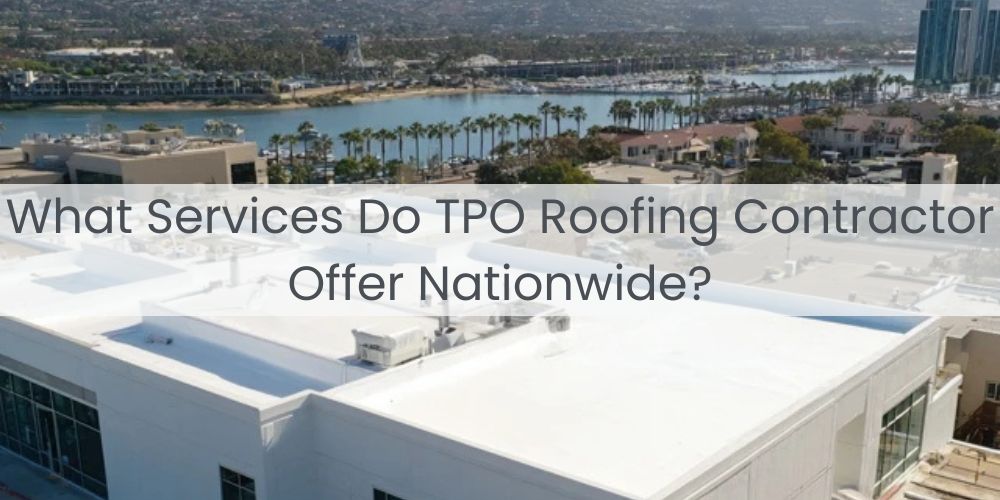
TPO Roofing Contractor supports commercial roofing systems nationwide by delivering end-to-end membrane lifecycle control across installation, inspection, repair, maintenance, and replacement so low-slope roof assemblies remain watertight, energy-stable, and operationally reliable across diverse U.S. climates. Commercial property owners and facility managers operate under continuity requirements, interior asset protection risk, and capital-planning constraints that make roofing work a systems-management function rather than a one-time construction event. TPO Roofing Contractor provides nationwide coverage where building portfolios require consistent membrane standards, repeatable detailing, and fast response capability to prevent localized defects from escalating into insulation saturation, interior damage, and premature replacement. Low-slope commercial roofs are subjected to UV exposure, daily and seasonal thermal cycling, wind uplift forces, rooftop mechanical congestion, service traffic, and drainage stress that concentrate failure risk at seams, penetrations, perimeters, and low points. If TPO systems are not installed and serviced with controlled seam welding, engineered attachment, penetration detailing, and drainage maintenance, defects can propagate beneath the membrane surface and become system-wide failures. Once moisture enters a TPO roof assembly, it can migrate laterally through insulation layers, reduce thermal resistance, weaken attachment performance, and cause interior damage far from the original defect location, increasing operational disruption and cost volatility. Nationwide services from TPO Roofing Contractor focus on preventing and containing these failure mechanisms through standardized workmanship, documented scope control, and planned maintenance, not simply reacting to leaks after interior impacts occur. Nationwide TPO Roofing Contractor service delivery is the process of assessing roof condition and system type, designing or confirming compatible TPO assembly details, executing heat-welded membrane installation or corrective work, and maintaining roof performance through inspections, targeted repairs, drainage servicing, emergency stabilization, and lifecycle planning. Unlike fragmented vendor coverage that treats each roof as an isolated event, TPO Roofing Contractor applies repeatable quality standards and consistent corrective logic across multiple buildings and regions so performance remains predictable across a portfolio. Without routine inspections, timely seam and flashing corrections, traffic protection practices, and drainage control, punctures, seam fatigue, edge pullback, and ponding stress can compound into recurring leak events and shortened service life even on otherwise well-specified TPO systems. TPO Roofing Contractor provides nationwide services as roof-system control programs engineered to preserve welded membrane continuity, prevent moisture intrusion, and stabilize long-term roof performance across commercial buildings throughout the United States.
How Do Nationwide Services From TPO Roofing Contractor Control Risk Across Installation, Repair, and Maintenance?
Commercial TPO roof risk escalates when installation variability, deferred maintenance, and slow response allow small discontinuities to become active intrusion pathways under live weather loading. Thermal cycling stresses seams and terminations, wind uplift challenges securement, rooftop service activity increases puncture and abrasion risk, and drainage restriction increases hydraulic pressure at low points where leaks initiate and insulation saturation spreads. Across a national building portfolio, these forces recur in different climates and seasons, so consistent inspection, standardized repair methods, and predictable maintenance cycles determine whether roof performance remains stable or degrades unevenly across sites. TPO Roofing Contractor controls these risks by standardizing heat-weld seam quality, validating attachment and flashing details, and maintaining drainage performance so water cannot enter and migrate beneath the membrane. Inspections identify early seam separation, puncture initiation, edge pullback, and ponding drivers before they produce wet-insulation zones. TPO repairs restore membrane continuity using compatible heat-welded patches, seam re-welding, localized flashing correction, or localized section replacement when damage exceeds patchable limits. Maintenance programs preserve roof-surface condition and detailing integrity so energy performance and watertightness do not degrade over time. The goal is to keep each roof within controlled performance parameters so failure probability, emergency spend, and disruption risk remain predictable across regions.
The nationwide service system delivered by TPO Roofing Contractor creates the following system-level performance relationships:
- Standardized TPO installation scope → creates heat-welded membrane continuity → field seams become watertight joints that resist separation under movement
- Routine roof inspections → detect early seam, puncture, flashing, and drainage defects → small issues are corrected before water entry escalates
- Targeted TPO repairs → restore membrane and detail continuity → active leak paths are eliminated and subsurface migration is contained
- Preventive maintenance cycles → preserve drainage and surface condition → ponding and degradation do not accelerate seam failure or insulation wetting
- Emergency stabilization capability → contains active failure under live conditions → interior damage and wet-insulation expansion are limited
- Portfolio-level lifecycle planning → schedules renewal before system-wide degradation → unplanned failures, disruption risk, and cost volatility decrease
Each of these outcomes results from coordinated service decisions that treat TPO roofing as a managed membrane system over time, ensuring TPO Roofing Contractor’s nationwide services function as performance control and risk control rather than episodic repair work.
How Does TPO Roofing Contractor Deliver Consistent Quality Nationwide Across Different Roofs, Climates, and Crews?
Nationwide TPO service only works when the same roof-control variables are executed the same way on every building, regardless of region, crew, or season. Commercial TPO performance does not drift because a roof is “different” in a vague sense. It drifts when repeatable controls are not enforced at the points where TPO systems actually succeed or fail: heat-weld seam continuity, perimeter restraint, penetration and curb detailing, attachment pattern integrity, drainage function, and traffic-zone protection. Those variables behave differently under Florida heat, Midwest hail, coastal wind, and freeze–thaw cycles, but the control logic stays constant: keep the assembly continuous, dry, mechanically restrained, and drainable so small defects remain isolated and do not become lateral moisture migration events. TPO Roofing Contractor maintains nationwide consistency by treating every scope as a standardized field process built around measurable checkpoints. Roof condition is not “inspected” as a general activity. It is mapped into defect classes that directly correspond to failure pathways: underweld segments that will open under thermal cycling, puncture initiation points along RTU service paths, edge pullback zones that will peel under uplift, curb and pipe penetration interfaces that will gap under vibration, and ponding zones that will keep seams wet long enough to accelerate fatigue and insulation wetting. When those conditions are identified, corrective work is not improvised. It is executed using the same compatibility rules and geometry rules that make TPO reliable: clean-to-weld surface prep, correct patch overlap, edge rounding, controlled hot-air weld parameters, perimeter probe verification, and detail correction at the termination plane so the assembly returns to continuous behavior. Consistency also depends on controlling the “portfolio accelerants” that make roofs fail faster across multiple sites: high RTU density, frequent service access, unprotected traffic routes, and drainage restriction from debris loading. If these are not managed, seam fatigue and puncture frequency increase and every site becomes a leak lottery during the next storm. The nationwide consistency outcome is therefore operational: the roof remains within controlled limits so energy performance, watertightness, and service-life planning remain predictable from building to building.
How Does TPO Roofing Contractor Prevent Performance Drift From Site to Site?
Performance drift occurs when the same roof system is allowed to behave differently because execution is not anchored to verifiable controls. A heat-welded membrane system is only “heat-welded” in a useful sense when the welds are continuous, consolidated, and verified at the locations that actually open first: field seams at thermal movement zones, corners and angle changes, pipe boots and pitch pans where movement concentrates, curb flashings around RTUs where vibration and service traffic recur, and perimeter terminations where uplift creates peel forces. If seam verification is inconsistent, one site develops seam-edge separation during summer cycling while another site stays intact, even if the membrane is nominally the same. TPO Roofing Contractor prevents that drift by enforcing repeatable practices that keep the roof assembly operating as a continuous membrane barrier. Seam continuity is validated through probing and repair work that restores fused joints rather than relying on surface sealing that cannot tolerate movement. Penetration and curb detailing is treated as the highest-frequency leak origin category, so it is checked for compression gaps, membrane bridging, termination integrity, and the presence of stress risers that will split under cycling. Drainage is treated as a structural load factor, not a housekeeping item, because ponding increases hydraulic stress at seams and extends wetting duration that accelerates insulation saturation and adhesive breakdown in non-fused interfaces. Traffic is treated as a defect generator, not a background condition, because punctures and scuffs start where people walk and where tools drop. When those controls are applied uniformly, outcomes converge: fewer emergency events, lower wet-insulation incidence, stable thermal resistance, and predictable replacement planning across the portfolio.
The nationwide consistency system delivered by TPO Roofing Contractor creates the following system-level performance relationships:
- Standardized scope templates and detail rules → constrain field variability → installation outcomes remain consistent across regions
- Controlled hot-air welding parameters and technician technique → create fused seam continuity → seams resist separation under thermal cycling and uplift
- Seam probing and weld verification at field seams and corners → detect underweld and voids → latent seam defects are corrected before water entry occurs
- Penetration and curb detailing verification at RTUs, pipes, conduits, skylights → seals high-movement interfaces → recurring service-zone leaks do not initiate
- Perimeter and termination control at parapets and roof edges → resists peel forces under uplift → edge lifting does not open storm-driven water entry paths
- Attachment pattern validation and securement checks → prevent membrane flutter → movement stress does not fatigue seams and terminations over time
- Traffic-route designation and walkway protection → reduces puncture frequency → direct membrane breaches do not form at service access paths
- Drain, scupper, and gutter servicing → restores water evacuation capacity → ponding does not increase hydraulic stress or wet insulation duration
- Moisture-risk mapping and prioritized corrective repairs → interrupt lateral migration pathways → wet-insulation zones do not expand beyond the initiating defect
- Consistent documentation of findings and repairs per site → preserves continuity of decisions → roof performance does not drift between visits or crews
Each of these outcomes results from repeatable field controls that keep TPO roofs operating as dry, continuous, mechanically restrained, and drainable assemblies, ensuring nationwide service produces consistent watertight performance and predictable lifecycle behavior across a commercial building portfolio.
Have a question about an upcoming project?
When Should a Commercial Building Engage TPO Roofing Contractor for Nationwide TPO Roofing Services?
If a commercial owner is managing multiple buildings, needs consistent roof performance across regions, or wants to prevent small site-level defects from turning into portfolio-wide cost volatility, it should engage TPO Roofing Contractor before inconsistencies in inspection cadence, repair quality, and response speed create repeat leak cycles and wet-insulation expansion. Indicators such as recurring leaks that “move” from area to area, uneven repair history between sites, rising emergency call volume, chronic ponding at certain buildings, frequent rooftop service access, high RTU density, seam fatigue at movement zones, edge or termination instability, or any history of insulation wetting signal that the portfolio needs standardized membrane control rather than isolated reactive fixes. Buildings should also engage TPO Roofing Contractor during acquisition and due diligence, annual budgeting, insurance renewal, planned rooftop equipment work, or scheduled roof replacement cycles, because these are the decision points where inspection findings, lifecycle timing, and scope standardization can be coordinated before failures force rushed, expensive interventions. A nationwide service evaluation focuses on whether each roof is operating as a dry, continuous, mechanically stable system and whether the same control variables are being enforced everywhere. This includes establishing consistent inspection protocols (seam probing, penetration and perimeter checks, drainage evaluation, traffic-zone review), defining standardized repair rules (clean-to-weld prep, correct patch overlap and geometry, controlled hot-air welding, perimeter verification), and setting maintenance cycles that keep drainage functional and high-risk interfaces stable before storms expose weaknesses. It also includes creating portfolio-level reporting that classifies defects by failure mechanism and consequence, so direct breach conditions are stabilized first, progression defects are corrected before they become leak paths, and enabling conditions like drainage restriction and uncontrolled traffic are removed so repairs do not re-fail. For projects in design or replacement planning, this process validates that membrane selection, attachment strategy, and detailing standards remain consistent across regions while still accounting for local stress drivers like wind, hail, or freeze–thaw exposure. For existing portfolios, it identifies whether targeted restoration, standardized preventive maintenance, localized reinforcement at recurring failure zones, or phased replacement is the technically appropriate path to restore predictability. Engaging TPO Roofing Contractor as a nationwide provider is a risk-management decision that reduces performance drift from site to site by enforcing repeatable seam, detail, drainage, and traffic controls, improving response speed during live failures, and stabilizing lifecycle planning so watertightness, energy performance, and replacement timing remain predictable across a commercial building portfolio.