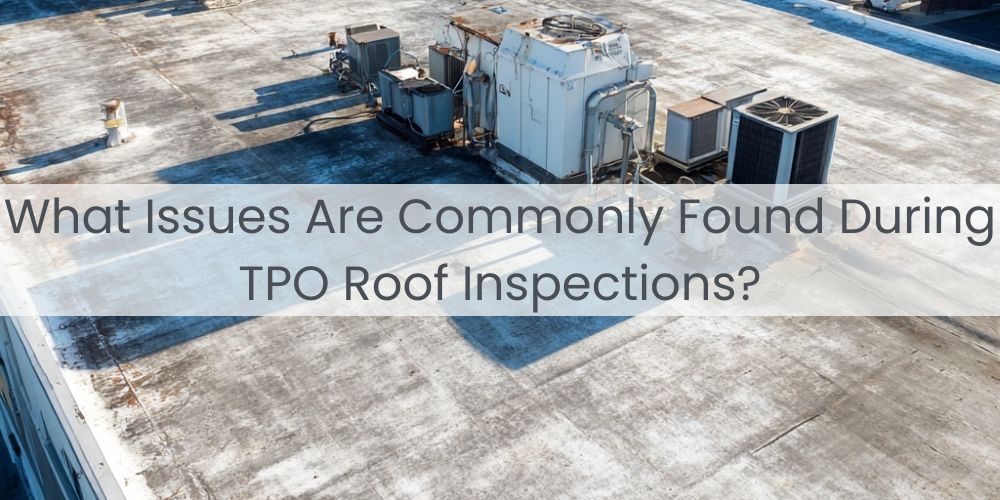
TPO roof inspections support commercial roofing systems by identifying early-stage defects in seams, membrane surface condition, penetrations, perimeters, and drainage behavior before those defects become active water-entry paths and subsurface migration zones. Commercial buildings operate under operational continuity requirements, interior asset protection risk, and maintenance budget constraints that make early detection of roof defects a cost-control and failure-prevention function. TPO roof inspections are performed where small discontinuities—such as seam separation, punctures, edge pullback, or flashing weaknesses—would otherwise allow moisture intrusion that saturates insulation and expands damage beyond the visible defect area. TPO roof assemblies are subjected to UV exposure, daily and seasonal thermal cycling, wind uplift forces, rooftop mechanical congestion, and repeated service access that concentrate stress at seams, corners, termination bars, penetrations, and traffic paths. If inspection programs are not structured to evaluate weld integrity, membrane aging indicators, attachment performance, detailing geometry, and drainage function, minor issues can propagate beneath the membrane surface and evolve into recurring leaks and premature system failure. Once moisture enters a TPO roof assembly, it can migrate laterally through insulation layers, reduce thermal resistance, weaken attachment performance, and cause interior damage far from the original defect location. TPO roof inspections focus on locating defect mechanisms and their propagation pathways, not merely documenting surface appearance. TPO roof inspection is the process of systematically assessing seam continuity, membrane condition, penetrations and perimeter details, attachment behavior, and drainage performance, then classifying findings by risk so repairs can be executed before water entry and system-wide deterioration occur. Unlike reactive leak response that begins after interior damage is visible, inspection-driven maintenance targets the earliest observable signals of seam failure, puncture initiation, UV fatigue, shrinkage stress, and drainage overload that precede active intrusion. Without routine inspection, small seam gaps, traffic punctures, edge pullback, and ponding conditions can compound into saturated insulation zones, uplift vulnerability, and repeated leak events that shorten service life and increase replacement pressure. TPO Roofing Contractor performs TPO roof inspections as failure-prevention services, engineered to detect seam and detail vulnerabilities, identify moisture-risk conditions, and preserve roof-system integrity across commercial buildings throughout the United States.
How Do TPO Roof Inspections Detect Seam, Surface, and Drainage Defects Before Failure Escalates?
TPO roof failures escalate when water, movement, and degradation exploit discontinuities that are small enough to go unnoticed but large enough to admit moisture under real weather loading. Thermal cycling stresses heat-welded seams and terminations, UV exposure reduces surface flexibility and weldability at aging edges, and service access and rooftop equipment increase puncture and abrasion risk along traffic routes. On large commercial roofs, wind-driven rain and hydraulic pressure from ponding can force water laterally across the membrane surface and into seam openings, corners, and penetration flashings, creating wet-insulation zones that expand beyond the original defect location. TPO roof inspections prevent this escalation by verifying seam continuity, identifying puncture initiation points, detecting shrinkage-related pullback at edges and penetrations, and evaluating drainage behavior that amplifies stress at low points. Seam probing and detail review locate early weld separation before it becomes an active leak path. Surface condition assessment identifies oxidation, chalking, and brittleness that reduce weld reliability and increase crack and puncture susceptibility. Drainage evaluation identifies ponding drivers such as blocked drains, deflected deck areas, or crushed insulation that increase seam stress and accelerate membrane aging. The goal is to identify the specific defect mechanism and its likely propagation path so corrective work can be prioritized before moisture entry, insulation saturation, and system instability occur.
The TPO roof inspection process creates the following system-level performance relationships:
- Seam separation at welds or corners → creates discontinuities in membrane continuity → seam probing identifies separation before water entry escalates
- Traffic punctures and tool drops → create direct breach points → localized repair planning eliminates active intrusion pathways
- UV oxidation and surface chalking → reduce flexibility and weldability → condition assessment flags edges that will not weld reliably without prep
- Shrinkage and edge pullback → stress terminations and openings → perimeter inspection identifies uplift and leak vulnerability zones
- Improper flashing at penetrations → concentrates leak paths at service zones → detail inspection isolates high-risk interfaces for correction
- Ponding water and restricted drainage → increase hydraulic stress at low points → drainage inspection identifies conditions that accelerate seam failure
Each of these outcomes results from structured inspection decisions that map defects to failure mechanisms, ensuring that inspections function as early detection and risk-control rather than documentation after damage has already propagated.
What Defects Are Prioritized After a TPO Roof Inspection, and How Are Findings Converted Into Corrective Work?
A TPO roof inspection is only valuable if it converts observations into controlled interventions. The logical next section is the post inspection decision layer. It explains how inspection findings are triaged, how the highest risk defects are identified, and how corrective work is sequenced so minor discontinuities do not become active water entry paths. Commercial owners do not need a long list of issues. They need an operating method that turns inspection data into reliable next actions under budget, access, and scheduling constraints. TPO inspection findings fall into categories that behave differently under live loading. Some defects represent direct breach conditions, such as punctures, open seams, or failed penetration flashings. These can become immediate leak paths during the next rainfall event. Others represent progression conditions, such as seam edge irregularities, early shrinkage pullback, UV aged weld zones, or ponding drivers that raise hydraulic stress and accelerate seam fatigue. A third class represents enabling conditions, such as restricted drainage, uncontrolled traffic routes, rooftop work practices, or perimeter securement weakness. These are not always leaks today, but they create the environment where seams and details fail on schedule. A correct post inspection framework ranks findings by two variables: probability of near term water entry and consequence of subsurface migration if water enters. That is the core distinction between a defect that can be scheduled and a defect that must be controlled immediately. The same puncture has different consequence depending on whether the assembly is recoverable, whether insulation is already wet, and whether drainage and wind exposure will force water laterally under the membrane. The same seam deficiency has different escalation speed depending on thermal movement, wind uplift, and ponding exposure. The inspection therefore needs to produce an actionable risk map that ties each defect to its failure mechanism and its propagation pathway. Corrective work is then sequenced to keep the roof inside controlled limits. Direct breach conditions are stabilized first because they represent active entry paths. Progression conditions are corrected next because they are the defects that will become the next entry paths under cyclic stress. Enabling conditions are addressed in parallel because they determine whether repaired areas remain stable or re fail. Without this conversion step, inspection becomes documentation rather than risk control. With it, inspection becomes a system management routine that preserves watertight continuity, keeps insulation dry, and stabilizes service life.
The TPO post inspection triage and correction plan creates the following system level performance relationships:
- Open seams, punctures, and failed flashings → represent direct water entry paths -> immediate corrective work restores watertight continuity before the next load event
- Wet insulation indicators and recurring leak signatures → signal subsurface migration potential → moisture mapping and targeted opening confirm extent so repair scope matches the actual wet zone
- Seam edge irregularities and early weld weakness → separate under thermal cycling and uplift → reinforcement and re welding prevent progression into repeat leak paths
- Shrinkage pullback and perimeter stress → concentrate peel forces at edges and terminations → termination correction and securement upgrades prevent edge lift water entry during storms
- Ponding drivers and restricted drainage → increase hydraulic pressure and wetting duration -> drainage correction reduces seam loading and limits accelerated aging at low points
- UV aged and contaminated weld zones → reduce weld reliability → controlled surface preparation restores weldable condition so repairs fuse instead of failing prematurely
- High traffic routes and rooftop service practices → increase puncture and detailing damage → walk path control and protection reduce repeat defects in the same zones
- Unprioritized defect lists -> delay action until failure occurs → risk ranked repair sequencing converts inspection into prevention and stabilizes service life planning
Each of these outcomes results from translating inspection findings into ranked failure mechanisms and then executing the minimum corrective actions needed to keep the membrane dry, continuous, and mechanically supported so inspection functions as control, not record keeping.
Have a question about an upcoming project?
When Should a Commercial Building Engage TPO Roofing Contractor After a TPO Roof Inspection?
If a commercial building is relying on inspections to prevent leaks, control life-cycle cost, or keep the roof inside a predictable “maintained range,” it should engage TPO Roofing Contractor as soon as inspection findings show defect mechanisms that can transition from minor discontinuity to active water entry under the next weather cycle. Indicators such as any open or suspect seam segments identified by probing, punctures or abrasion in traffic and service routes, flashing weakness at penetrations, edge pullback or termination instability, recurring ponding or restricted drains, UV-aged areas that are losing weldability, or any signs consistent with wet insulation and lateral migration signal that the roof is no longer operating as a fully controlled barrier and needs corrective work prioritized by failure risk rather than scheduled by convenience. Buildings should also engage TPO Roofing Contractor when inspection results include “progression conditions” that are not leaking today but are structurally on-path to failure, such as seam edge irregularities, early shrinkage stress at perimeters, concentrated uplift exposure at edges, or ponding drivers that increase hydraulic pressure and wetting duration at low points. A post-inspection response should not be a generic repair list; it should be a risk-ranked correction plan that stabilizes the roof before live loading converts small defects into wet-insulation zones. This includes converting the inspection into an actionable map: stabilizing direct breach conditions first (open seams, punctures, failed flashings), confirming and bounding any suspected wet areas so scope matches the actual migration footprint, then correcting the progression mechanisms next (targeted seam reinforcement and re-welding, perimeter securement upgrades, penetration detail corrections) while addressing enabling conditions that cause repeat failure (drainage correction, traffic routing and protection, surface cleaning and preparation where weldability is degraded). For roofs that are still fundamentally sound, this process identifies the minimum interventions needed to preserve seam continuity, keep insulation dry, and reduce defect recurrence so service life remains predictable. For roofs showing repeated leak signatures, widespread seam fatigue, chronic ponding, or evidence of moisture migration, it clarifies whether targeted restoration, partial reinforcement, or full replacement is the technically appropriate path to regain control. Engaging TPO Roofing Contractor immediately after inspection is a risk-management decision that turns inspection findings into prevention, reduces the probability of near-term water entry, and protects the roof system from escalation into insulation saturation, interior damage, and failure-driven capital spend.