
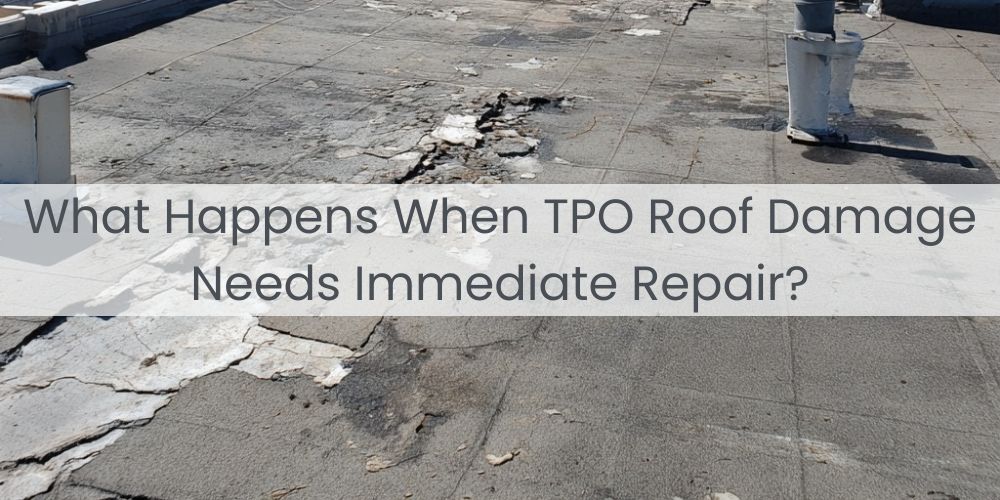
Emergency TPO roof repair stabilizes commercial roofing systems when active membrane damage is allowing uncontrolled water intrusion into the building envelope. Emergency conditions occur when TPO membranes, seams, flashings, or attachment zones are compromised by storms, mechanical damage, service traffic punctures, thermal stress, or drainage overload, allowing water to penetrate beneath the roof surface. Once water enters a TPO roof assembly, it can migrate laterally through insulation layers, reduce thermal resistance, weaken structural attachments, and cause interior damage far from the original failure point. Immediate TPO roof repair focuses on containment of active failure rather than permanent restoration, with the objective of stopping moisture migration and preventing escalation into system-wide damage. Immediate TPO roof repair is the process of locating the active breach, isolating the affected membrane zone, and restoring temporary or permanent watertight continuity using compatible heat-welded patches, seam re-welding, localized flashing correction, or section replacement when damage is beyond patchable limits. Unlike planned repairs performed under controlled conditions, emergency work is executed while environmental stress is ongoing, such as during rainfall, high winds, or freeze–thaw cycles, and while interior operations may be exposed to active leakage. Under these conditions, roof systems experience combined hydraulic pressure, wind uplift, and thermal movement that can rapidly expand small defects into larger failure zones. Without immediate stabilization, water infiltration accelerates insulation saturation, deck deterioration, electrical risk, indoor air quality concerns, and operational disruption inside the building. TPO Roofing Contractor performs immediate TPO roof repair as a failure-containment service, designed to interrupt moisture entry, limit subsurface migration, and preserve the integrity of the remaining roof system until permanent corrective work can be engineered and scheduled.
How Does Immediate TPO Roof Repair Control Active Failure and Prevent Escalation?
Emergency TPO roof failures escalate because water, movement, and pressure exploit weakened areas of the roofing system while the roof is still under live loading. Wind-driven rain forces water laterally across the membrane surface, thermal movement stresses seams and attachments, and saturated insulation reduces load resistance beneath the membrane, allowing breaches to spread beyond the visible damage point. On large commercial roofs, these forces act simultaneously, so a small puncture or seam opening can become a broad wet-insulation zone and a multi-point interior leak pattern within hours. Immediate TPO roof repair stops this escalation by sealing active leak paths, isolating damaged zones, and restoring watertight continuity so environmental forces can no longer drive water beneath the roof surface. Repair measures are selected based on how the TPO system is failing under live conditions, not on cosmetic surface appearance, which is why containment can require patch welding, seam re-welding, temporary water diversion, or localized section replacement. The goal is to regain control of moisture movement and membrane continuity so the roof system returns to a stable state and additional damage does not compound before permanent corrective work is executed.
The immediate TPO roof repair process creates the following system-level performance relationships:
- Active membrane breaches → allow water entry → heat-welded patching restores watertight continuity
- Compromised TPO seams → separate under thermal movement → re-welding restores seam integrity
- Flashing failures at penetrations or edges → concentrate leak paths → localized correction seals high-risk interfaces
- Saturated insulation zones → lose thermal resistance and structural support → moisture isolation limits migration and further collapse risk
- Wind-driven rainfall → forces water beneath membranes → surface stabilization and sealing halts lateral spread
- Uncontrolled drainage flow → increases hydraulic pressure at low points → temporary diversion reduces stress on seams and details
Each of these outcomes results from short-term stabilization decisions that are designed to stop active failure progression and contain moisture until permanent restoration can be planned and executed.
Why Do TPO Roof Emergencies Happen, and How Can They Be Prevented Before Live Leaks Occur?
Emergency TPO roof repair is the containment phase of failure; the logical next section is the prevention phase that explains how emergency conditions form, what early indicators reliably precede them, and what interventions stop escalation before the roof is under live hydraulic loading. Commercial buildings do not experience “sudden” TPO emergencies without upstream precursors; emergency leaks occur when a defect that was previously localized becomes an active water-entry path under concurrent stress from rainfall, wind-driven water movement, thermal cycling, and compromised drainage. In that state, the roof is no longer operating as a controlled membrane barrier; it becomes an uncontrolled moisture-entry system where water can migrate laterally through insulation, destabilize membrane support, and create multi-point interior leak patterns that appear unrelated to the initiating defect. Preventing emergency TPO events is therefore an operating-control problem, not a material-selection problem: the roof must remain within controlled limits for seam continuity, flashing integrity, membrane surface condition, attachment stability, and drainage function so defects cannot transition from “repairable” to “live failure.” TPO emergency avoidance is the practice of identifying failure precursors at the locations where TPO systems predictably initiate leaks: seams, penetrations, perimeter edges, equipment zones, and drainage low points, then executing corrective actions while the membrane can still be cleaned, welded, and detailed under controlled conditions. Unlike emergency response, which prioritizes rapid containment during active water entry, emergency prevention prioritizes early detection, defect isolation, and permanent correction before rainfall, ponding, or wind-driven water can exploit weaknesses and drive moisture beneath the membrane. Without routine inspection, seam probing, traffic-zone protection, penetration and edge detailing verification, and drainage control, small seam irregularities, punctures, or flashing gaps remain dormant until a storm event converts them into active breach conditions. The outcome is predictable: once water entry begins under live loading, insulation saturation expands, membrane support softens, and the defect footprint widens, turning a single repair into a broader stabilization event. TPO Roofing Contractor prevents emergency TPO failures as a risk-control program, engineered to keep the roof assembly dry, continuous, and structurally supported so defect progression is interrupted before it becomes an operational disruption.
How Do Early Defects Escalate Into Emergency TPO Leak Conditions?
Emergency escalation occurs when three forces act together on an existing weakness: water drive, movement stress, and loss of substrate support. Water drive increases when rainfall intensity, wind-driven flow, and ponding create hydraulic pressure and lateral water movement across seams, penetrations, and low points. Movement stress increases when thermal cycling and wind uplift cause membrane expansion, contraction, and flutter that concentrate stress at field seams, termination interfaces, and patch edges, especially if weld quality is marginal or attachment restraint is inconsistent. Loss of substrate support begins when water enters and wets insulation, reducing compressive stability beneath the membrane so traffic and wind loads deform the assembly, opening gaps and widening the breach beyond the original defect geometry. On large commercial roofs, this compounding behavior converts a small puncture, a slightly underwelded seam segment, or a minor flashing gap into a broader failure zone because water can migrate laterally and present as multiple interior leaks far from the entry point. Emergency prevention breaks this chain by identifying the specific precursor that will become the leak path: incipient seam separation, puncture risk at access routes, flashing stress at equipment curbs, and drainage restriction creating ponding, then correcting it while the membrane is dry enough to weld and the assembly is stable enough to restore continuity. Seam probing and weld reinforcement stop separation before water can be driven under laps. Traffic-route hardening and puncture repairs eliminate direct entry points before storms load them. Penetration and perimeter detailing corrections close the interfaces where movement concentrates. Drainage servicing prevents ponding, which otherwise increases hydraulic stress and prolongs wetting time that accelerates seam fatigue and insulation saturation. The goal is not “more maintenance” as a generic statement; the goal is to remove the precise precursors that allow a roof to transition from controlled performance into live-failure conditions.
The emergency-prevention control program creates the following system-level performance relationships:
- Seam edge irregularities and weak weld segments → separate under thermal movement and uplift → seam probing and reinforcement prevents seams becoming active leak paths
- High-traffic service routes and unsecured rooftop work practices → increase puncture probability → designated walk paths and localized heat-welded repairs prevent direct water-entry breaches
- Penetration flashings and curb interfaces under vibration and service activity → develop micro-gaps at stress zones → detailing verification and correction prevents leak initiation at equipment zones
- Perimeter edges and terminations under wind uplift → experience peel forces and lifting risk → securement and termination corrections prevent edge-lift water entry during storms
- Drainage restriction and low-point ponding → increase hydraulic pressure and wetting duration → drain and gutter servicing and ponding correction prevents seam overloading and insulation saturation
- Early moisture intrusion into insulation → reduces thermal resistance and compressive support → rapid detection and dry-out and repair prevents lateral migration and multi-point interior leaks
- Unidentified precursors allowed to persist into storm conditions → convert localized defects into emergency failures → pre-storm inspection and corrective work prevents live-leak escalation
Each of these outcomes results from prevention-focused decisions that keep defects localized and correctable, ensuring emergency TPO repair remains the exception rather than the predictable result of unmanaged precursor progression.
Have a question about an upcoming project?
When Should a Commercial Building Engage TPO Roofing Contractor for Immediate TPO Roof Damage Repair?
If a commercial building has active water entry, storm-related membrane disturbance, or any condition where moisture is already moving into the roof assembly, it should engage TPO Roofing Contractor immediately because the objective shifts from “repair later” to “contain now.” Indicators such as water dripping or staining inside the building, ceiling tile collapse risk, multiple interior leak points that appear far apart, bubbling or tenting at the membrane surface, visible punctures or tears from service traffic or debris, seam openings, flashing pullback at curbs or penetrations, wind-lifted edges, or ponding that is forcing water toward weak interfaces signal that the roof is in a live-failure state and damage can expand quickly. Buildings should also engage TPO Roofing Contractor after hail, high-wind events, rooftop equipment work, or drainage overload conditions even if the leak pattern seems small, because water can migrate laterally through insulation and present as delayed or displaced interior damage that grows in scope over hours or days. An immediate-repair response focuses on failure containment and rapid stabilization under real conditions, not cosmetic patching. This includes locating the active breach, mapping the likely wet zone, isolating the defect footprint, restoring watertight continuity with compatible heat-welded patching or seam re-welding, correcting localized flashing failures at the specific interface driving entry, and implementing short-term water-control measures when live weather prevents full restoration. It also includes checking whether saturated insulation is softening membrane support and widening the breach area, and whether ponding or flow paths are increasing hydraulic pressure at low points so the leak keeps reactivating. Once the roof is stabilized, the next step is to define the permanent corrective scope while the building is protected: verifying seam integrity around the failure zone, assessing whether moisture has migrated beyond the visible defect, confirming drainage performance, and identifying the upstream precursor that triggered the emergency so the same failure mode does not repeat in the next event. Engaging TPO Roofing Contractor at the first sign of active water intrusion is a risk-control decision that limits insulation saturation, reduces interior damage exposure, preserves the integrity of the remaining roof system, and converts a fast-moving emergency into a controlled stabilization followed by planned restoration.