
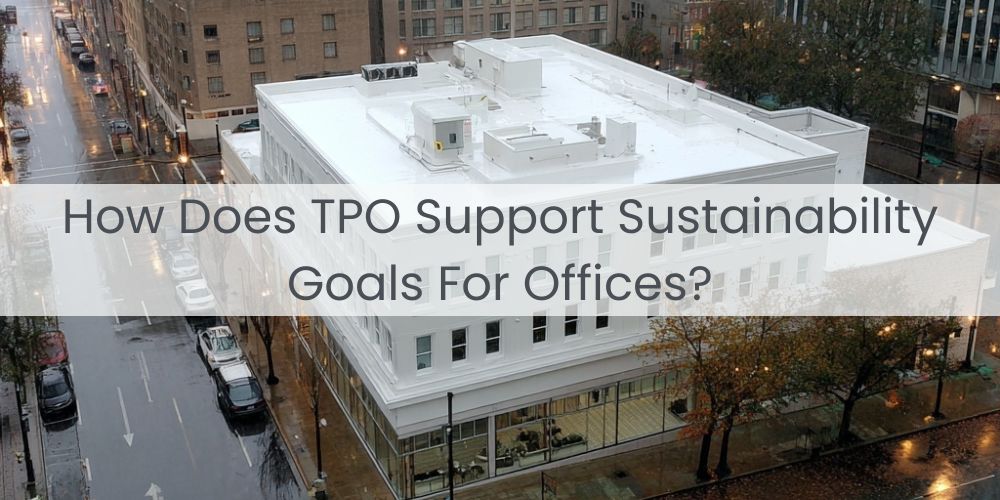
TPO roofing supports office sustainability goals by reducing operational energy demand, stabilizing envelope performance, and extending replacement cycles so office buildings can lower emissions intensity and material waste while maintaining occupant comfort and business continuity. Office complexes operate under tenant comfort expectations, ESG reporting and leasing pressures, and budget constraints that require measurable performance improvements rather than generalized “green” claims. TPO roofing systems are used on offices where uncontrolled roof-surface heat gain would increase cooling demand, where roof failures would disrupt occupied workspaces, and where premature replacement would inflate lifecycle emissions and waste. Office roof assemblies are subjected to sustained solar exposure, daily thermal cycling, wind uplift forces, rooftop mechanical congestion, and frequent service access that concentrate risk at seams, penetrations, edges, and drainage low points. If office roof systems are not engineered to manage reflective behavior, seam continuity, insulation continuity, air leakage control, and drainage performance, heat and moisture risks can propagate beneath the membrane surface and undermine both energy outcomes and durability targets. Once solar heat enters the roof assembly it increases cooling load, and once moisture wets insulation it reduces thermal resistance, raises HVAC runtime, and accelerates deterioration that shortens service life and increases replacement frequency. TPO roofing for office sustainability focuses on controlling upstream heat gain, preserving watertight integrity, and maintaining thermal resistance over time so operational energy and lifecycle impacts remain predictable. TPO office roofing is the process of installing a reflective, heat-welded thermoplastic membrane system with defined attachment methods, engineered detailing at penetrations and perimeters, compatible insulation configuration, and controlled transitions to create a watertight roof assembly that also limits solar-driven heat input. Unlike sustainability strategies that rely only on procurement claims or surface-level efficiency statements, roof-driven sustainability requires system-level performance that reduces cooling demand and prevents moisture-driven thermal degradation across the service life of the building envelope. Without correct system design, insulation discontinuity, poorly controlled transitions, air leakage routes, and drainage deficiencies can preserve high heat transfer and enable insulation wetting, reducing measurable energy savings and accelerating replacement timelines that increase waste. TPO Roofing Contractor installs and maintains TPO roofing systems for offices as sustainability-control assemblies, engineered to reduce roof-surface heat loading, limit heat transfer into conditioned space, prevent moisture intrusion that degrades insulation performance, and extend service life across office buildings throughout the United States.
How Does TPO Roofing Reduce Office Energy Demand and Improve Lifecycle Sustainability?
Office sustainability performance declines when roof systems increase cooling demand, degrade insulation performance through moisture intrusion, or require premature replacement that adds material waste and embodied impact. Solar exposure elevates roof surface temperatures, thermal cycling stresses seams and attachments, and rooftop equipment and service pathways concentrate penetrations and traffic where discontinuities can form. On office buildings, these forces act across wide roof areas, so small seam, flashing, or drainage weaknesses can translate into higher HVAC runtime, recurring repairs, and shortened service life that undermines sustainability targets tied to energy and lifecycle efficiency. TPO roofing systems control these outcomes by using reflective membrane surfaces that limit solar heat absorption, heat-welded seams that preserve continuous membrane behavior under movement, and attachment and detailing strategies that maintain watertight integrity at penetrations and perimeters. When insulation continuity and air leakage control are maintained, roof-driven heat transfer is reduced and conditioned spaces experience lower peak cooling demand. When drainage performance prevents ponding and insulation wetting, thermal resistance remains stable, HVAC load does not creep upward over time, and the roof achieves longer service life with fewer disruptive interventions. The goal is to reduce operational energy intensity while extending replacement cycles so offices lower both ongoing emissions and lifecycle waste associated with premature roof failure.
The office TPO roofing system creates the following system-level performance relationships:
- Reflective TPO membrane surface → limits solar heat absorption → roof surface temperature remains lower during peak sun
- Lower roof surface temperature → reduces heat flux into the assembly → cooling load and HVAC runtime decrease in cooling-dominant operation
- Heat-welded TPO seams → form continuous membrane joints → thermal cycling does not separate seams or create leakage pathways
- Watertight membrane continuity → prevents insulation wetting → thermal resistance remains stable and HVAC load does not rise over time
- Insulation continuity and air leakage control → maintain the thermal boundary → roof-driven heat transfer does not bypass control layers into occupied office zones
- Extended service life from controlled heat and moisture exposure → reduces replacement frequency → lifecycle waste and embodied impact decrease
Each of these outcomes results from coordinated roof-system design and maintenance decisions, ensuring that TPO roofing functions as an operational energy and lifecycle sustainability control layer rather than a passive membrane selected without performance integration.
How Does TPO Roofing Translate Roof Performance Into Office Sustainability Outcomes?
Office sustainability gains from TPO are realized when the roof assembly produces measurable reductions in operational energy demand and measurable extensions of service life under continuous tenant occupancy. The roof influences office sustainability through three linked control targets: (1) roof-surface solar heat control that lowers cooling load, (2) envelope reliability that prevents moisture entry and disruption, and (3) thermal resistance stability over time so energy performance does not decay as insulation becomes wet or details deteriorate. If any of these controls fail, sustainability outcomes degrade even if the membrane is nominally “reflective” or “recyclable,” because the building experiences higher HVAC runtime, more repairs, and earlier replacement cycles—each of which increases emissions intensity and waste. Operational energy intensity in offices is highly sensitive to roof-driven heat gain in upper zones, especially during peak solar periods when cooling systems operate at high capacity and utility pricing can be punitive. Reflective TPO reduces the upstream boundary condition by keeping the roof surface cooler, but the downstream benefit depends on continuity: heat-welded seams must remain fused under thermal cycling, insulation must remain continuous to prevent thermal bridging, and transitions and penetrations must be air-controlled so convective bypass does not deliver roof heat into occupied zones. At the same time, sustainability performance depends on keeping insulation dry. Once moisture enters the assembly, thermal resistance declines, HVAC runtime increases, and durability deteriorates—shortening replacement cycles and increasing lifecycle impact. Lifecycle sustainability in office buildings is therefore not a label-driven outcome; it is a system outcome: lower cooling demand + preserved R-value + fewer failure events = fewer replacements and less waste. TPO supports that outcome when reflective behavior and watertight integrity are engineered together, and when drainage and detailing prevent ponding-driven stress and insulation wetting that would otherwise force premature intervention.
The office TPO roofing system produces the following system-level performance relationships:
- Reflective TPO membrane surface → reduces solar absorptance at the roof boundary → roof surface temperature remains lower during peak sun
- Lower roof surface temperature → reduces the thermal gradient across the roof assembly → conductive heat flux into insulation and deck decreases
- Reduced roof heat flux → lowers deck and plenum heat buildup → top-floor office-zone cooling load decreases during peak hours
- Lower top-floor cooling load → reduces peak HVAC demand and runtime → operational energy intensity and cooling cost volatility decrease
- Heat-welded TPO seams → preserve fused membrane continuity under thermal cycling → seams do not open into leak paths or thermal discontinuities
- Watertight continuity at penetrations, perimeters, and transitions → prevents moisture entry into the assembly → insulation does not become saturated and lose R-value
- Stable, dry insulation performance over time → prevents energy-performance drift → HVAC load does not creep upward across the service life
- Extended service life from controlled heat and moisture exposure → reduces replacement frequency → lifecycle waste and embodied impact decrease
Each of these outcomes results from coordinated roof-system design and maintenance decisions that treat the office roof as an operational energy and lifecycle control layer, ensuring sustainability performance is delivered through verifiable heat-control, watertight reliability, and long-term thermal stability rather than assumed from product category or surface-level “green” positioning.
Have a question about an upcoming project?
When Should an Office Building Engage TPO Roofing Contractor to Support Sustainability Goals?
If an office building is pursuing measurable ESG outcomes, targeting lower operational energy intensity, or trying to extend roof replacement cycles to reduce lifecycle waste, the roof assembly should be treated as a sustainability-control system rather than a commodity cover. Indicators such as rising summer HVAC runtime, persistent top-floor warm zones during clear-sky afternoons, recurring minor leaks, ponding at low points, seam stress near high-traffic service routes, or evidence of insulation wetting can signal that roof-driven heat gain and moisture risk are undermining both energy performance and durability. Office properties should also engage TPO Roofing Contractor during planned roof replacement, tenant improvement cycles, capital planning, or energy-upgrade initiatives, because reflective performance, seam integrity, insulation continuity, air leakage control, and drainage behavior must be coordinated at the same decision point if sustainability outcomes are expected to be real, documentable, and durable. A sustainability-focused TPO evaluation or specification review examines whether roof-surface solar loading is materially contributing to cooling demand and whether the roof assembly is capable of preserving thermal resistance over time. This includes reviewing membrane reflectivity condition, seam weld continuity, attachment security under thermal cycling and wind uplift, insulation continuity and moisture condition, air leakage risks at curbs, parapets, and penetrations, and drainage behavior that can drive ponding-related stress and wet-insulation failure. It also assesses rooftop service access patterns and protection planning, because repeated traffic can initiate punctures and detailing fatigue that shorten service life and increase lifecycle waste. For offices in design or tender, this process validates that the specified TPO system is detailed to preserve reflectivity and watertight continuity while preventing thermal and air bypass pathways that dilute operational energy gains. For existing office buildings, it identifies whether targeted seam reinforcement, transition sealing, wet-insulation remediation, drainage correction, surface cleaning protocols, or full replacement is the technically appropriate path to reduce cooling load, prevent performance drift, and extend service life. Engaging TPO Roofing Contractor at the evaluation or specification stage is a risk-management decision that aligns roof performance with office sustainability goals by reducing roof-driven energy demand, preserving envelope reliability under continuous occupancy, and lowering lifecycle waste through longer replacement intervals.