
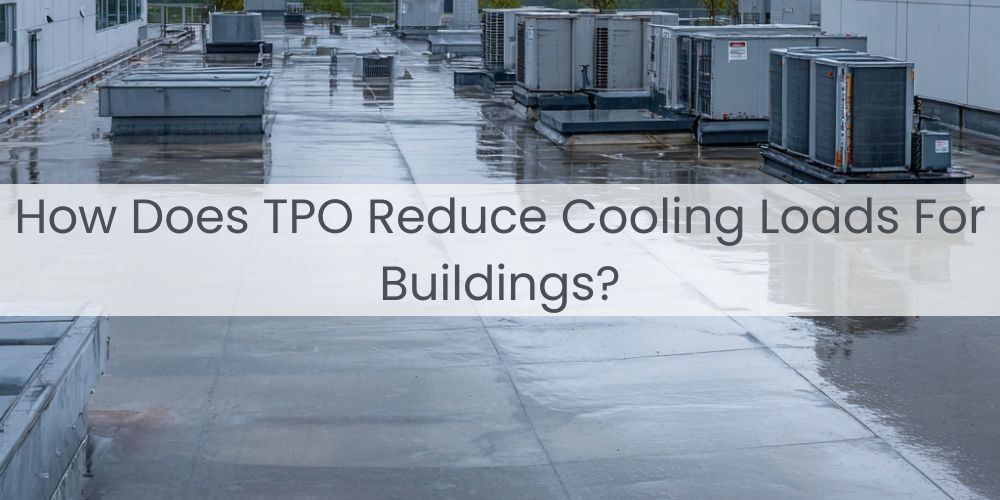
TPO roofing supports commercial buildings by reducing roof-driven cooling load through reflective surface behavior and continuous membrane integrity that limits solar heat gain entering the roof assembly. Commercial facilities operate under HVAC capacity constraints, comfort tolerances, and utility cost exposure that make peak cooling demand and warm-season runtime direct operating cost variables. TPO roofing systems are used where uncontrolled solar heat gain at the roof surface would elevate deck and plenum temperatures, increase top-floor zone load, and force longer air-conditioning runtime to maintain setpoint. Low-slope commercial roofs are subjected to sustained solar irradiance, daily thermal cycling, rooftop mechanical congestion, wind uplift forces, and continuous environmental exposure that can amplify heat buildup across large roof areas. If roof assemblies are not designed to manage reflective performance, seam continuity, insulation continuity, and air leakage pathways, roof heat gain can propagate through the system and concentrate in upper zones even when a reflective membrane is installed. Once solar heat enters a roof assembly, it can conduct through insulation and deck layers, raise plenum temperatures, increase conditioned-zone cooling load, and elevate HVAC runtime and demand costs during peak utility periods. TPO roofing for cooling-load reduction focuses on controlling roof-surface heat input and limiting downstream heat transfer into conditioned space, not merely choosing a white membrane and assuming savings. TPO cooling-load roofing is the process of installing a reflective, heat-welded thermoplastic membrane system with defined attachment methods, compatible insulation detailing, controlled transitions, and watertight flashing design to create a roof assembly that limits solar-driven heat input while preserving envelope reliability. Unlike cooling strategies that respond after heat has already entered the building, TPO reduces cooling load by controlling the upstream boundary condition at the roof surface so less heat is available to flow into the assembly in the first place. Without proper system design, insulation discontinuity, poor transition detailing, and air leakage routes can preserve high heat transfer even with a reflective membrane, reducing measurable cooling-load reduction and leaving HVAC runtime largely unchanged. TPO Roofing Contractor installs and maintains TPO roofing systems as roof-surface heat-gain control assemblies, engineered to reduce membrane heating, limit heat flux into the roof system, and lower peak cooling demand across commercial buildings throughout the United States.
How Does TPO Roofing Reduce Roof Heat Gain and Lower Building Cooling Load?
Cooling load increases when solar radiation heats the roof surface and that temperature rise drives conductive heat flow into insulation, deck, and upper-zone boundaries. During peak sun exposure, higher membrane surface temperature increases the thermal gradient across the roof assembly, deck and plenum temperatures rise, and top-floor zones absorb additional heat that HVAC systems must remove to maintain setpoint. On large low-slope roofs, this pathway scales with roof area, increasing peak cooling demand and runtime during high-cost utility periods. TPO roofing reduces this escalation by limiting solar absorption at the membrane surface and maintaining a cooler roof surface during peak hours, which reduces heat flux into insulation and deck layers. Heat-welded seams preserve membrane continuity so reflective performance is not undermined by seam separation under thermal movement, while insulation continuity and controlled transitions reduce conductive and convective bypass paths that would otherwise deliver roof heat into occupied space. When these system elements are coordinated, the building experiences lower peak cooling load, reduced HVAC runtime, and improved temperature stability in upper zones during warm-season operation.
The TPO cooling-load roof system creates the following system-level performance relationships:
- Reflective TPO membrane surface → limits solar heat absorption → roof surface temperature remains lower during peak sun
- Lower roof surface temperature → reduces heat flux into the assembly → less heat enters insulation and deck
- Less heat entering insulation and deck → reduces deck and plenum heat buildup → top-floor zone load decreases during peak hours
- Lower top-floor zone load → reduces peak cooling demand → HVAC runtime and cooling energy use decrease
- Insulation continuity → maintains thermal resistance across the roof system → roof-driven heat transfer does not bypass control layers
- Air leakage control at transitions and penetrations → reduces convective heat transfer → indoor setpoint stability improves and HVAC cycling decreases
Each of these outcomes results from coordinated roof-system design decisions, ensuring that TPO roofing functions as a roof-surface cooling-load control layer rather than a membrane selected without energy-performance integration.
How Do Reflective Performance and Membrane Continuity Translate Into Measurable Cooling-Load Reduction?
Cooling-load reduction from TPO does not occur because a roof is “white.” It occurs when roof-surface solar absorption is reduced and the roof assembly is kept thermally and air-tight continuous so roof-surface conditions cannot re-enter the building through bypass paths. The measurable variable you are controlling is heat flux into the roof assembly during peak solar periods, because that flux becomes deck/plenum heat buildup, which becomes top-floor zone load, which becomes HVAC runtime and demand cost. Reflective TPO reduces the upstream driver (solar heat input), but the downstream benefit only materializes when seams, insulation, and transitions preserve continuity so the reduced surface temperature actually results in reduced heat transfer to the interior boundary conditions. On large low-slope commercial roofs, the mechanism is area-scaled: a small reduction in heat flux per square foot becomes a large reduction in total heat gain across the roof field. However, the same scaling works against the building if air leakage at penetrations, insulation discontinuity, wet insulation, or seam discontinuities allow convective and conductive bypass. In those cases, roof-surface reflectance may be high, but effective assembly performance is low, so cooling demand remains elevated. Cooling-load reduction therefore depends on a system outcome: lower roof surface temperature + preserved continuity = reduced interior load, not one isolated product attribute. The operational goal is to keep the roof acting as a heat-control boundary: limit solar absorption at the membrane surface, prevent thermal bridging and convective bypass, and prevent moisture-driven loss of R-value that would increase conductive flow over time. When those controls are coordinated, peak-hour roof contribution to cooling demand decreases, upper-zone setpoint drift is reduced, and HVAC cycles less aggressively during high utility-rate periods.
The TPO cooling-load system produces the following system-level performance relationships:
- Reflective membrane surface → reduces solar absorptance at the boundary → roof surface temperature remains lower during peak sun
- Lower roof surface temperature → reduces thermal gradient across the assembly → conductive heat flux into insulation and deck decreases
- Reduced conductive heat flux → limits deck and plenum heat accumulation → top-floor zone sensible load decreases during peak hours
- Lower top-floor zone load → reduces peak cooling demand → HVAC runtime and demand charges decrease where applicable
- Heat-welded seam continuity → prevents joint separation under thermal cycling → reflective and waterproof performance is not interrupted across the roof field
- Continuous insulation and controlled transitions → block thermal bridging and bypass routes → roof-driven heat transfer does not re-enter occupied zones through discontinuities
- Air-sealed penetrations and perimeter interfaces → reduce convective heat transport → conditioned space stability improves and HVAC cycling frequency decreases
Each of these outcomes results from coordinated roof-system design decisions that preserve both reflective boundary control and assembly continuity, ensuring the TPO roof functions as a scalable cooling-load reduction mechanism rather than a reflective surface that is undermined by seams, transitions, or air-leakage pathways.
Have a question about an upcoming project?
When Should a Commercial Building Engage TPO Roofing Contractor to Reduce Cooling Loads?
If a commercial building is experiencing high peak-hour cooling demand, persistent upper-zone overheating, or HVAC runtime that spikes during clear-sky afternoons, the roof assembly should be treated as a cooling-load control boundary rather than a passive cover. Indicators such as elevated deck or plenum temperatures, repeated comfort complaints on top floors, rising summer demand charges, localized hot zones near penetrations, or evidence of insulation wetting or seam stress can signal that roof-driven heat gain is materially contributing to cooling load. Buildings should also engage TPO Roofing Contractor during planned roof replacement, energy-upgrade planning, HVAC modernization, or major rooftop equipment changes, because membrane reflectivity, seam continuity, insulation specification, transition detailing, and penetration sealing must be coordinated at the same decision point if cooling-load reduction is expected to be measurable rather than assumed.
A cooling-load-focused TPO evaluation examines whether roof-surface solar heating is currently driving interior load and whether the roof assembly is capable of converting reduced surface temperature into reduced heat transfer. This includes reviewing membrane reflectivity condition, seam weld integrity, insulation continuity and moisture condition, thermal bypass risks at transitions and edges, and air leakage pathways at curbs, penetrations, and perimeter interfaces. It also reviews drainage behavior because ponding and chronic wetting can reduce effective R-value and erode the cooling-load benefit over time, even when the membrane surface is reflective. For existing buildings, this process identifies whether targeted seam reinforcement, insulation corrections, transition air-sealing, wet-insulation remediation, drainage improvements, or full replacement is the technically appropriate path to reduce roof-driven cooling load. For projects in design or tender, it validates that the specified TPO system is detailed to preserve reflectivity and continuity across the roof field so reductions in roof surface temperature translate into lower deck and plenum heat buildup, reduced top-floor zone load, and reduced HVAC runtime during peak utility periods. Engaging TPO Roofing Contractor at the evaluation or specification stage is a risk-management decision that aligns roof-system design with measurable cooling-load reduction and predictable warm-season operating cost control across commercial buildings.