
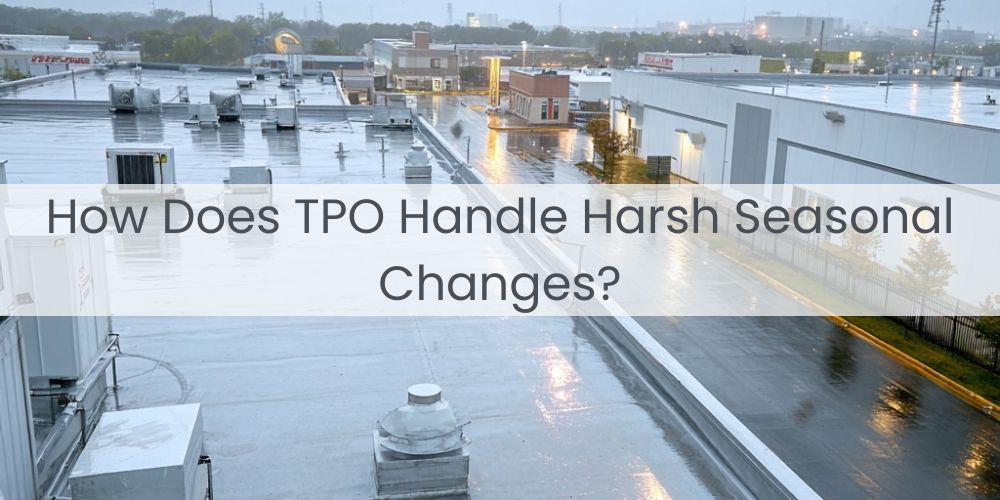
TPO roofing supports commercial roof assemblies through harsh seasonal changes by maintaining membrane continuity and watertight performance as temperatures swing between heat-driven expansion and cold-driven contraction. Commercial buildings operate year-round under weather exposure that includes summer peak solar loading, winter freeze conditions, wind events, and repeated seasonal transitions that impose mechanical stress on roof membranes and details. TPO roofing systems are used where seasonal thermal cycling would otherwise fatigue seams, loosen attachment zones, and open leakage pathways that lead to recurring water intrusion and escalating maintenance. Low-slope commercial roofs are subjected to daily and seasonal temperature swings, UV exposure, wind uplift forces, rooftop mechanical congestion, and service traffic that concentrate stress at seams, penetrations, perimeter edges, and drainage low points. If roof assemblies are not engineered to manage thermal movement, seam integrity, attachment performance, and drainage behavior, seasonal stress can propagate beneath the membrane surface and turn minor weaknesses into active failure zones. Once thermal movement compromises seams or flashings, water entry can begin, insulation can become saturated, thermal resistance can decline, and interior damage can occur far from the original defect location. TPO roofing for seasonal resilience focuses on controlling movement, preserving seam continuity, and preventing moisture intrusion as conditions change, not merely selecting a membrane based on nominal “flexibility.” TPO seasonal-performance roofing is the process of installing a heat-welded thermoplastic membrane system with compatible attachment methods, engineered flashing details, controlled transitions, and drainage design that preserves watertight integrity while the assembly expands and contracts across seasonal cycles. Unlike roof systems that rely on bonded joints or brittle interfaces that can crack under repeated movement, properly installed TPO uses fused seams and compatible details that maintain continuity as the roof undergoes thermal cycling. Without correct system design, perimeter restraint, penetration detailing, and drainage control, seasonal movement can concentrate stress at seams and edges, leading to seam fatigue, edge lifting, ponding stress, and repeated leak events. TPO Roofing Contractor installs and maintains TPO roofing systems as seasonal-stability assemblies, engineered to accommodate thermal cycling, resist wind uplift, and preserve watertight performance across commercial buildings throughout the United States.
How Does TPO Roofing Maintain Watertight Integrity Through Thermal Cycling and Seasonal Stress?
Seasonal roof failures occur when thermal movement, wind uplift, and moisture loads exploit weak joints and detailing that cannot tolerate repeated expansion and contraction. Hot-weather solar loading elevates membrane surface temperatures and increases expansion forces, cold-weather conditions contract materials and stiffen interfaces, and freeze–thaw cycling amplifies stress at laps, flashings, and drainage zones where water can linger. On large commercial roofs, these forces act repeatedly across months, increasing the probability that small seam deficiencies, attachment weaknesses, or poorly detailed penetrations will open into active water-entry paths. TPO roofing systems control these risks by using heat-welded seams that form continuous joints, attachment strategies that maintain secure connection to the deck under movement and uplift, and flashing systems that seal penetrations and edges where seasonal stress concentrates. When drainage is maintained, ponding is minimized, reducing hydraulic loading and freeze-related stress at low points that can accelerate seam fatigue. The goal is to keep the membrane system continuous and watertight across seasonal cycles so thermal movement does not translate into recurring leaks or progressive subsurface deterioration.
The seasonal TPO roofing system creates the following system-level performance relationships:
- Thermal cycling → drives expansion and contraction forces → seams and details experience repeated movement stress
- Heat-welded TPO seams → form fused membrane joints → thermal movement does not separate field seams
- Engineered attachment systems → maintain securement under movement and uplift → membrane flutter does not fatigue seams and edges
- Integrated flashing at penetrations and perimeters → seals stress concentration zones → seasonal movement does not open water-entry paths
- Freeze–thaw conditions at low points → amplify stress around trapped moisture → controlled drainage reduces ponding and limits freeze-related damage
- Maintained watertight continuity → prevents insulation wetting → thermal resistance and system stability do not degrade season over season
Each of these outcomes results from coordinated system design and detailing decisions, ensuring that TPO roofing functions as a seasonal-stability and watertightness control layer rather than a membrane selected without thermal-cycling engineering.
How Do Seasonal Stress Failure Modes Develop on TPO Roofs, and Where Do They Start?
Seasonal failure on TPO roofs is not random; it follows repeatable initiation patterns where thermal movement, wind uplift, moisture loading, and service activity concentrate stress into specific roof zones. Commercial roofs experience expansion during hot-weather solar loading and contraction during cold-weather conditions, and that cyclic movement repeatedly loads the same interfaces: field seams, perimeter restraint details, penetration flashings, and drainage low points. Where detailing creates stiffness changes, restraint points, or unsupported membrane span, seasonal movement concentrates into micro-slippage and edge fatigue that can open leakage pathways over time. Wind events amplify this by creating membrane flutter and edge lift forces that repeatedly flex seams, terminations, and attachment rows, accelerating fatigue at the same high-stress lines. Freeze–thaw conditions worsen this progression when water is retained at low points or within imperfectly sealed details; trapped moisture expands during freezing and mechanically pries at laps, flashings, and drain interfaces. Seasonal stress failure modes therefore develop as zone-specific fatigue and separation mechanisms that begin at predictable initiation points and then propagate laterally beneath the membrane once water entry starts. The practical objective of seasonal performance management is to identify and control the first-failure zones—the locations where stress accumulates fastest and where small defects can transition into active water-entry paths. TPO roofs that remain watertight through harsh seasonal cycling do so because seams, terminations, penetrations, and drainage interfaces are engineered and maintained as movement-tolerant continuity controls, not treated as static details. When those controls are missing or degraded, the same seasonal drivers that your introduction describes—thermal cycling, uplift, freeze–thaw, and moisture loading—convert into repeatable failure modes that start in the same places on most low-slope commercial roofs.
The seasonal TPO roof develops the following first-failure patterns, each tied to a specific initiation zone:
- Thermal expansion and contraction → concentrates movement at restraint transitions → edge details and terminations become first-fatigue zones
- Wind uplift and negative pressure → induces membrane flutter → perimeter zones and attachment rows become fatigue initiators
- Freeze–thaw at low points → expands trapped water volumes → drains, scuppers, and ponding zones become separation initiators
- Rooftop traffic during cold conditions → increases puncture probability → service routes and equipment zones become breach initiators
- Detail stiffness changes at penetrations → concentrate cyclic stress → flashing corners and pipe clusters become crack-and-lift initiators
- Moisture entry at any initiation zone → enables lateral migration → insulation and deck interfaces become propagation pathways
Each of these initiation patterns is the observable surface expression of the same underlying system logic: seasonal loads concentrate at joints, edges, penetrations, and low points, and any discontinuity in seam integrity, restraint control, flashing geometry, or drainage performance converts that load into progressive separation and leak initiation.
Have a question about an upcoming project?
When Should a Commercial Building Engage TPO Roofing Contractor to Manage Harsh Seasonal Changes?
If a commercial building operates through large temperature swings, recurring wind events, or freeze–thaw exposure, the roof assembly must function as a movement-tolerant watertight system rather than a membrane that is only “weather rated” on paper. Indicators such as recurring leaks that reappear after seasonal transitions, edge lifting, seam stress, wintertime ponding or ice formation at low points, repeated repairs around drains and penetrations, or visible membrane flutter after wind events can signal that seasonal loads are concentrating at details that are not controlling movement and moisture reliably. Buildings should also engage TPO Roofing Contractor ahead of winter or before peak storm season, and during planned maintenance cycles, because attachment strategy, termination restraint, penetration detailing, and drainage behavior are the variables that determine whether seasonal cycling stays a controlled condition or becomes repeat failure. A seasonal-performance evaluation focuses on the roof’s first-failure zones, the places where expansion and contraction, uplift, and moisture loading predictably initiate defects. This includes reviewing field seam condition and weld continuity, perimeter and termination restraint behavior, flashing geometry at penetrations and equipment clusters, attachment security where flutter can fatigue the system, and drainage function at low points where ponding and freeze stress accelerate deterioration. It also includes confirming whether repairs were executed as heat-welded continuity restorations or as temporary surface fixes that reopen under movement. For existing roofs, this process identifies whether targeted seam reinforcement, edge and termination corrections, penetration re-detailing, wind-zone securement upgrades, drainage corrections, or localized membrane restoration is the technically appropriate path to stop seasonal recurrence. For replacement projects or retrofits, it validates that the specified TPO system is detailed around thermal movement, wind exposure, and freeze–thaw behavior so the roof remains watertight through seasonal cycles instead of relying on reactive repairs after the first stress season. Engaging TPO Roofing Contractor at the evaluation and detailing stage is a risk-management decision that aligns the roof system with predictable seasonal loading, reduces repeat leak incidents, and preserves long-term roof stability across commercial buildings.