
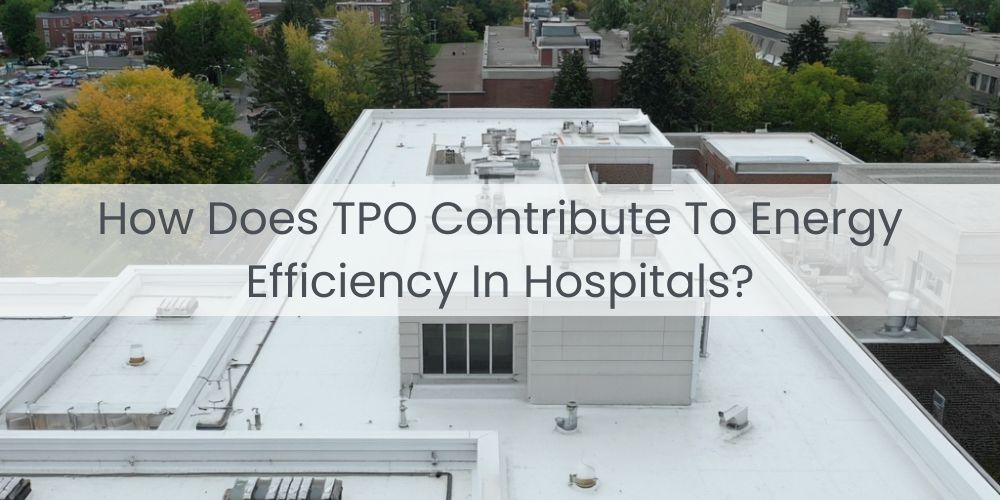
TPO roofing supports hospital facilities by maintaining thermal stability, reducing roof-driven cooling load, and preserving envelope reliability under continuous occupancy and critical operating conditions. Hospitals operate 24/7 within healthcare environments that impose strict indoor climate tolerances, infection control requirements, and regulatory oversight, placing exceptional demands on roof assemblies during year-round operation. TPO roofing systems are used on hospitals where uncontrolled solar heat gain, moisture intrusion, or membrane failure would increase HVAC demand, destabilize temperature control, and introduce operational risk to patient care environments. Hospital roof systems are subjected to sustained internal heat loads, rooftop mechanical congestion, frequent service access, and continuous environmental exposure common to healthcare campuses. If hospital roof assemblies are not engineered to manage reflective performance, seam integrity, attachment security, and drainage behavior, heat and moisture risks can propagate beneath the membrane surface and compromise interior environmental control. Once heat is absorbed at the roof surface, it can conduct through insulation and deck layers, raise plenum temperatures, increase cooling demand, and stress HVAC systems that must maintain tight setpoints across occupied clinical spaces. Once moisture enters a hospital roof assembly, it can migrate laterally through insulation layers, reduce thermal resistance, and create conditions that undermine environmental stability and occupied-space reliability below. TPO roofing for hospital energy efficiency focuses on controlling these upstream heat-gain and moisture-risk mechanisms, not merely improving surface appearance or making generalized sustainability claims. TPO hospital roofing is the process of installing a continuous, heat-welded thermoplastic membrane system with defined attachment methods, reflective membrane options, engineered detailing, and compatible insulation design to create a watertight roof assembly that also limits solar-driven heat input. Unlike general commercial applications, hospital roofing systems must maintain consistent performance under constant internal load, frequent maintenance traffic, and zero-tolerance disruption thresholds inherent to healthcare environments. Without proper system design, minor deficiencies in seams, flashings, insulation continuity, or drainage geometry can preserve excessive heat transfer, increase HVAC runtime, and elevate the probability of disruption from leaks or thermal instability. TPO Roofing Contractor installs TPO roofing systems for hospitals as operational control systems, engineered to reduce roof-surface heat loading, limit heat transfer into conditioned spaces, block moisture intrusion, and preserve interior environmental stability across hospitals, medical centers, and clinical campuses throughout the United States.
How Does TPO Hospital Roofing Reduce HVAC Load and Support Energy Efficiency?
Hospital cooling demand increases when solar radiation elevates roof surface temperatures and that heat input drives conductive heat flow into the roof assembly and upper building zones. Daily thermal cycling stresses seams and attachments, while rooftop equipment and service pathways concentrate penetrations and traffic that can compromise envelope integrity if detailing is not engineered for continuous healthcare operation. On hospitals, these forces act continuously, increasing the likelihood that heat gain and minor envelope weaknesses translate into elevated HVAC runtime and higher peak demand during warm-season operation. TPO roofing systems reduce this escalation by using reflective membrane surfaces that limit solar heat absorption and by forming heat-welded seams that preserve continuous membrane behavior under movement, so roof-surface heat loading is reduced without creating discontinuities that undermine performance. Engineered attachment systems maintain secure connection to the deck, preventing flutter and movement that can compromise seams and increase air and moisture pathways that degrade thermal resistance. When insulation continuity and drainage behavior are maintained, roof heat transfer is reduced, HVAC systems operate with lower peak load, and interior setpoint stability improves in upper zones that are most sensitive to roof-driven heat gain.
The hospital TPO roofing system creates the following system-level performance relationships:
- Reflective membrane surfaces → limit solar heat gain → roof surface temperature remains lower during peak sun
- Lower roof surface temperature → reduces conductive heat flux → less heat enters insulation and deck
- Reduced roof heat flux → lowers deck and plenum heat buildup → upper-zone cooling load decreases
- Lower upper-zone cooling load → reduces peak cooling demand → HVAC runtime and cooling energy use decrease
- Heat-welded TPO seams → form continuous membrane joints → thermal cycling does not open seams or create performance breaks
- Maintained drainage and insulation continuity → prevent ponding and wet insulation → thermal resistance remains stable and HVAC load does not rise over time
Each of these outcomes results from coordinated system design decisions, ensuring that TPO roofing functions as a heat-control and envelope-stability layer rather than a passive membrane covering in hospital and healthcare environments.
How Do Hospitals Maintain TPO Roof Performance Without Disrupting Clinical Operations?
Hospital roofing performance degrades fastest when routine wear mechanisms are allowed to accumulate in high-risk zones that cannot tolerate failure, such as mechanical penthouses, curb and penetration fields, and service corridors used by trades year-round. Constant rooftop access for HVAC service, medical-gas infrastructure, exhaust systems, and emergency equipment increases puncture probability, seam edge scuffing, and flashing fatigue at exactly the interfaces most likely to become water-entry points. At the same time, hospital operating requirements create narrow maintenance windows, strict safety controls, and zero-tolerance disruption thresholds that make deferred roof work disproportionately risky. If reflective surfaces become heavily soiled, if seams are not periodically verified, or if drainage outlets are not kept functional, roof-surface temperature rises, ponding duration increases, and moisture-risk pathways become more likely to activate during peak weather events. Once a small defect becomes an active leak on a hospital, moisture can spread beneath the membrane, saturate insulation, reduce thermal resistance, and destabilize upper-zone temperature control that HVAC systems must keep within tight tolerances. Operationally, this converts a roof issue into a facilities incident: interior protection measures, emergency access coordination, infection-control constraints, and potential clinical-space disruption. Hospital TPO roof stewardship therefore functions as an operational control routine: targeted inspection of high-traffic and high-penetration areas, protection of membrane surfaces in service routes, verification of seam continuity where thermal cycling concentrates stress, and drainage management that prevents ponding-driven degradation. The goal is to keep the roof assembly predictable over time so heat-control performance remains stable, moisture pathways remain blocked, and clinical operations are not exposed to unplanned envelope failures.
The hospital TPO roof stewardship process creates the following system-level performance relationships:
- Routine rooftop access → increases puncture and scuff risk → designated walk paths and protection reduce membrane damage
- Mechanical curb and penetration density → concentrates flashing stress → focused interface inspection prevents water-entry initiation
- Seam verification in high-stress zones → identifies early discontinuity → corrective heat-welding restores seam continuity
- Surface soiling on reflective membranes → raises roof surface temperature → cleaning preserves reflectivity and limits heat gain
- Restricted drainage outlets → extend ponding duration → drain maintenance reduces hydraulic loading at seams and curbs
- Ponding exposure → accelerates seam and insulation stress → reduced ponding lowers failure probability over time
- Early defect correction → prevents insulation wetting → thermal resistance remains stable and HVAC load does not creep upward
- Maintained membrane continuity → blocks moisture migration → subsurface saturation does not spread beyond the defect zone
Each of these outcomes results from coordinated operational maintenance decisions, ensuring that hospital TPO roofing remains an energy-efficiency and envelope-reliability control layer under continuous occupancy rather than a roof system that is only addressed after disruption occurs.
Have a question about an upcoming project?
When Should a Hospital Engage TPO Roofing Contractor to Improve Energy Efficiency and Protect Clinical Operations?
If a hospital is operating under continuous occupancy, tight temperature and humidity tolerances, and high rooftop mechanical density, the roof assembly must function as a stable heat-control and moisture-control system rather than a passive covering. Indicators such as rising warm-season HVAC runtime, increased peak cooling demand, persistent upper-zone heat buildup, recurring roof leaks, chronic ponding near drains, seam stress at equipment corridors, repeated flashing repairs at curbs and penetrations, visible membrane scuffing along service routes, or reflectivity loss from exhaust deposition can signal that roof-driven heat gain and envelope degradation are increasing operational risk. Hospitals should also engage TPO Roofing Contractor before planned equipment replacements, penthouse upgrades, expansion work, or any project that adds rooftop penetrations, because even small interface changes can introduce leak pathways and increase heat transfer if detailing and protection are not engineered for healthcare constraints. A hospital TPO evaluation or energy-efficiency-focused roof review examines whether the roof is contributing materially to cooling load and whether the system is maintaining the continuity required to keep thermal resistance stable over time. This includes assessing membrane reflectivity condition, verifying seam continuity in high-stress and high-traffic zones, reviewing flashing integrity at curbs and penetrations, confirming insulation and drainage conditions that prevent wetting and ponding-driven degradation, and identifying service-route risks that increase puncture probability. For hospitals, this process also defines an operational stewardship approach that matches clinical constraints, including targeted inspections of mechanical corridors, controlled access routes, protection at high-traffic areas, and corrective work plans that minimize disruption. For projects in planning or tender, this review validates that attachment strategy, insulation continuity, penetration detailing, and drainage geometry are aligned with 24/7 operating requirements and energy-performance expectations. For existing facilities, it identifies whether targeted seam reinforcement, drainage correction, membrane cleaning, interface repairs, or broader restoration is the technically appropriate path to reduce HVAC load, preserve interior environmental stability, and prevent unplanned incidents. Engaging TPO Roofing Contractor at the evaluation and stewardship stage is a risk-management decision that aligns roof performance with energy efficiency, envelope reliability, and uninterrupted clinical operations across hospitals and healthcare campuses.