
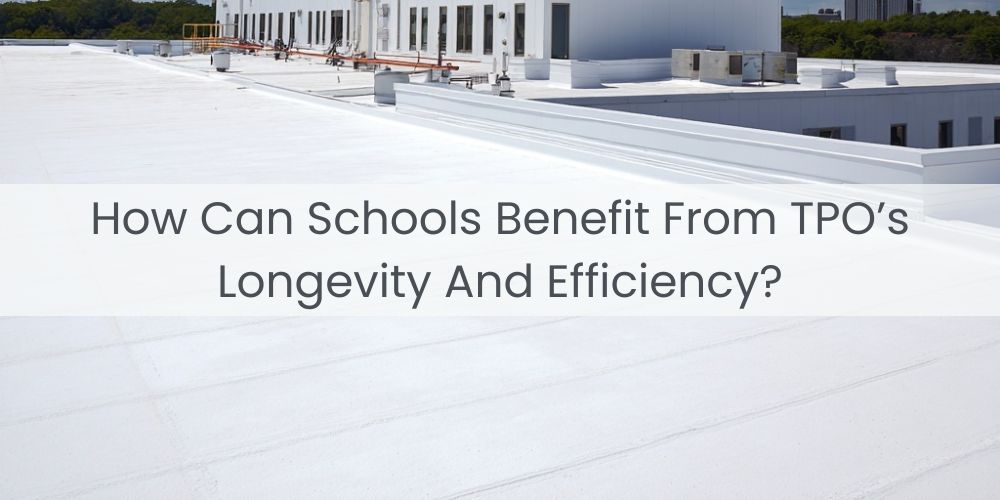
TPO roofing supports school facilities by preserving watertight reliability and reducing operating cost volatility through long service life and reflective thermal performance under institutional budget and scheduling constraints. Schools operate within fixed academic calendars, limited shutdown windows, public-sector procurement cycles, and strict occupant safety requirements, placing exceptional demands on roof assemblies that must perform without disruption. TPO roofing systems are used on schools where unplanned leaks, repeated repairs, or heat-driven comfort instability would interrupt instruction, damage interior finishes, and force emergency spending outside planned maintenance budgets. School roofing systems are subjected to seasonal weather exposure, summer peak solar loading, rooftop mechanical congestion, frequent service access, and drainage stress that concentrates risk at seams, penetrations, and equipment zones. If school roof assemblies are not engineered to manage seam integrity, attachment performance, reflective behavior, and drainage control, failures can propagate beneath the membrane surface and escalate into building-wide disruption. Once moisture enters a school roof assembly, it can migrate laterally through insulation layers, reduce thermal resistance, compromise ceiling systems, and create indoor air and safety risks that affect occupied spaces below. TPO roofing for schools focuses on preventing these disruption mechanisms and stabilizing life-cycle cost, not merely selecting a membrane based on upfront price. TPO school roofing is the process of installing a continuous, heat-welded thermoplastic membrane system with defined attachment methods, reflective membrane options, engineered detailing at penetrations and edges, and compatible insulation design to create a watertight and thermally controlled roof assembly. Unlike general commercial applications, school roofing systems must sustain performance through academic-year occupancy, summer heat extremes, and constrained repair windows where downtime is costly and schedule flexibility is limited. Without proper system design, small deficiencies in seams, flashings, traffic protection, or drainage geometry can escalate into repeated leak events, interior damage, and budget overruns that disrupt school operations. TPO Roofing Contractor installs TPO roofing systems for schools as operational control systems, engineered to extend service life, reduce unplanned maintenance demand, limit solar-driven heat gain, and preserve interior environmental stability across schools, academies, and educational campuses throughout the United States.
How Does TPO Roofing Control Longevity, Energy Efficiency, and Operational Risk in Schools?
School roof failures occur when moisture entry, thermal cycling, and service-related stress overwhelm roof assemblies that are not designed for continuous institutional operation. Summer solar exposure elevates roof surface temperatures, daily thermal cycling stresses seams and attachments, and rooftop equipment concentrates vibration, condensation discharge, and foot traffic at penetrations and service zones. On school buildings, these forces act repeatedly across seasonal cycles, increasing the risk of seam fatigue, puncture events, attachment loosening, and drainage restriction that can lead to interior disruption during the academic year. TPO roofing systems control these risks by forming a monolithic, non-porous membrane barrier with heat-welded seams that maintain continuity under thermal movement and by using reflective membrane surfaces that reduce roof surface temperatures and limit heat transfer into conditioned spaces. Engineered attachment systems maintain secure connection to the deck, reducing movement that can compromise watertight integrity, while integrated flashing and protection at penetrations and traffic zones prevent damage where school roofs are most vulnerable. When drainage is correctly designed and maintained, water is evacuated efficiently, limiting ponding stress and reducing the probability of seam and insulation degradation. The goal is to keep the roof assembly predictable over its service life so schools avoid emergency leak response, protect instructional space, and stabilize long-term maintenance and energy budgets.
The school TPO roofing system creates the following system-level performance relationships:
- Heat-welded TPO seams → form continuous membrane joints → thermal cycling does not separate seams during seasonal temperature swings
- Non-porous TPO membrane structure → blocks moisture migration → water does not spread laterally through the roof assembly
- Engineered attachment systems → secure membrane under movement loads → uplift and flutter do not loosen the roofing assembly
- Reinforced detailing at penetrations and edges → seals high-risk interfaces → leaks do not enter classrooms, corridors, or occupied spaces below
- Reflective membrane surfaces → limit solar heat gain → top-floor heat buildup and peak cooling demand decrease during warm-season operation
- Designed drainage geometry → evacuates water efficiently → ponding does not saturate insulation or stress seams over time
Each of these outcomes results from coordinated system design decisions, ensuring that TPO roofing functions as a longevity, efficiency, and risk-control layer rather than a passive surface covering in school and educational environments.
What School-Specific Roof Conditions Most Often Trigger Premature TPO Failure?
Premature TPO failure on schools is driven by school-specific stress concentration at penetrations, traffic routes, and drainage low points, where institutional access patterns and seasonal operation cycles repeatedly load the same interfaces until continuity is lost. Schools create predictable roof-risk geographies: HVAC and ventilation units cluster on instructional wings, service routes repeat along the same walk paths, and roof drains and gutters must handle heavy seasonal runoff while maintenance is often deferred to narrow breaks. These conditions amplify puncture probability at service corridors, seam fatigue near unit curbs and transition details, and ponding stress in low-slope zones where drainage is marginal or insulation has compressed. During the academic year, even small defects become operational events because interior disruption thresholds are low and response windows are constrained; during summer, peak solar loading and thermal cycling accelerate stress at seams and attachment zones; during storm seasons, water volume and wind-driven rain exploit any weak interface. The practical control objective is to identify where school roofs accumulate repeated stress, then harden those zones with protection, detailing discipline, and drainage reliability so the system remains predictable across semesters and budget cycles.
The school roof failure drivers create the following system-level performance relationships:
- Rooftop service traffic routes → concentrate footfall and tool-drop risk → punctures initiate at repeated access corridors
- Mechanical equipment curbs and condensate discharge → localize moisture and movement → penetration interfaces become leak initiators
- Seasonal thermal cycling (summer/winter) → repeatedly loads seams and terminations → weld fatigue emerges at stressed joints
- Deferred access windows (break-only repairs) → delay early defect correction → small discontinuities expand before intervention
- Drainage low points and restricted outlets → increase ponding duration → seam stress and insulation saturation risk increases
- Unprotected edge and transition zones → experience wind uplift and flutter → attachment loosening elevates leak probability
Each of these outcomes results from school-specific operating patterns interacting with roof geometry, ensuring that longevity depends on controlling stress concentrations rather than relying on membrane selection alone.
Have a question about an upcoming project?
When Should a School Engage TPO Roofing Contractor to Maximize TPO Longevity, Efficiency, and Budget Predictability?
If a school is operating under fixed academic calendars, limited shutdown windows, or recurring roof-related disruptions that threaten instructional continuity, the roof assembly must function as a long-life control system rather than a “repair-as-needed” surface. Indicators such as recurring leaks after seasonal storms, ceiling tile staining, localized ponding that persists after rainfall, seam stress or splitting near high-traffic service routes, flashing wear around rooftop units, or comfort complaints on upper floors during warm-season peak sun can signal that the roof is drifting out of watertight and thermal-control stability. Schools should also engage TPO Roofing Contractor during planned capital cycles—roof replacement planning, campus expansion, HVAC upgrades, or envelope modernization—because attachment strategy, seam detailing, penetration protection, insulation continuity, and drainage geometry must be engineered together if longevity and energy benefits are expected to be durable rather than temporary. A school-focused TPO evaluation or specification review determines whether the existing roof is still controllable through targeted reinforcement and moisture containment, or whether system-level replacement is required to eliminate repeat disruption pathways. This includes assessing heat-welded seam integrity, membrane condition in high-exposure zones, attachment performance under wind and thermal movement, drainage behavior at low points, penetration detailing at mechanical curbs and edge conditions, and traffic protection needs around routine service areas. For projects in design or tender, this process validates that the specified TPO system is configured to perform through summer heat extremes, seasonal cycling, and constrained maintenance windows without forcing emergency interventions during the academic year. For occupied campuses, it also helps sequence work around safety requirements and operational access so disruption is minimized while long-term reliability is restored. Engaging TPO Roofing Contractor at the evaluation or specification stage is a risk-management decision that aligns roof performance with instructional continuity, predictable maintenance planning, and life-cycle cost stability across schools and educational campuses.