
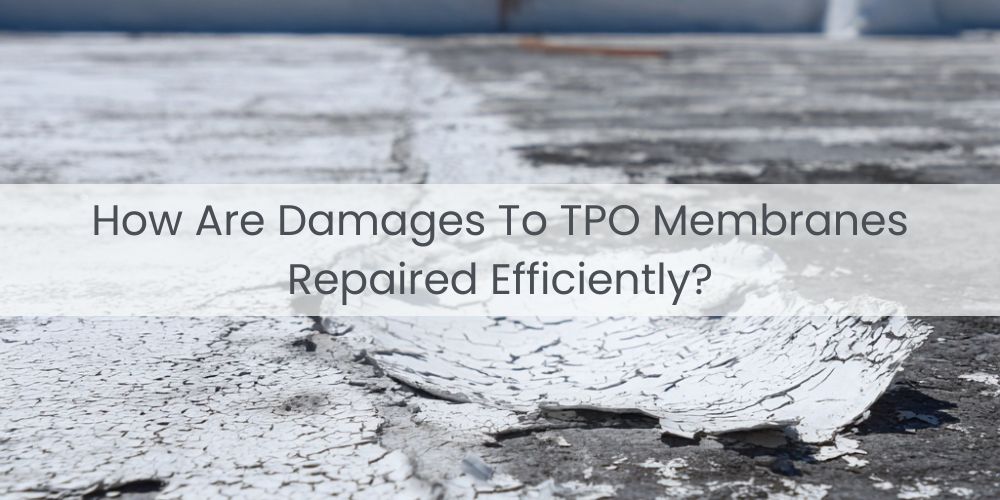
TPO membrane repair supports commercial roofing systems by restoring watertight continuity and preventing moisture migration when membrane damage has created an active water-entry path into the roof assembly. Commercial buildings operate under occupancy, asset-protection, and operational continuity requirements that make rapid leak control and predictable roof performance non-negotiable. TPO membrane damages are repaired efficiently on facilities where punctures, tears, or seam failures would otherwise allow water intrusion to compromise insulation performance, interior finishes, and ongoing operations. TPO roof membranes are subjected to frequent service access, rooftop mechanical congestion, windborne debris, hail impact, UV exposure, and daily thermal cycling that concentrates stress at seams, penetrations, and high-traffic zones. If damaged membrane areas are not repaired using compatible materials, controlled heat-welding, correct patch geometry, and verified seam continuity, repairs can fail under movement and reopen as recurring leak paths. Once water enters a TPO roof assembly, it can migrate laterally through insulation layers, reduce thermal resistance, weaken attachment performance, and cause interior damage far from the original defect location. Efficient TPO membrane repair focuses on stopping active water entry and re-establishing membrane continuity, not merely masking surface damage. Efficient TPO membrane repair is the process of locating the active defect, isolating the damaged zone, preparing the membrane surface to welding condition, and installing a correctly sized TPO patch that is heat-welded to the existing membrane to restore continuous watertight integrity. Unlike adhesive-only or makeshift surface fixes, heat-welded patch repairs recreate a fused membrane joint that resists thermal movement and maintains waterproof performance across repeated weather cycles. Without correct surface cleaning, controlled welding technique, adequate patch overlap, edge consolidation, and post-weld seam probing, small punctures and seam defects can expand into repeated leaks and progressive subsurface saturation that increases repair scope and cost. TPO Roofing Contractor performs TPO membrane repair as a moisture-entry containment service, engineered to interrupt water intrusion, limit subsurface migration, and preserve the integrity of the remaining roof system across commercial buildings throughout the United States.
How Does Efficient TPO Membrane Repair Stop Active Leaks and Prevent Repeat Failure?
TPO membrane leak conditions escalate when water, movement, and surface contamination exploit weakened areas of the roofing system. Wind-driven rain forces water across the membrane surface, thermal movement stresses seams and patch edges, and rooftop residues prevent reliable fusion when repairs are applied over unprepared membrane. On large commercial roofs, these forces act repeatedly, allowing a small breach to become a recurring leak as water migrates into insulation and destabilizes membrane support beneath the repair zone. Efficient TPO membrane repair stops this escalation by restoring a fused, continuous waterproof layer over the defect so environmental forces can no longer drive water beneath the membrane surface. Heat-welded patch perimeters recreate continuous joints that do not separate under thermal cycling when properly executed, and correct patch sizing distributes stress away from the defect edge to prevent lifting and edge failure. Seam probing and visual inspection confirm weld continuity along the patch perimeter and eliminate voids that would function as leak paths. The goal is to regain control of moisture entry and membrane continuity so the roof system can continue operating without progressive saturation or expanding failure zones.
The efficient TPO membrane repair process creates the following system-level performance relationships:
- Punctures or tears → create direct water-entry paths → heat-welded patch repairs restore watertight continuity
- Separated TPO seams → open under thermal movement → re-welding restores seam continuity
- Contaminated membrane surfaces → prevent reliable fusion → cleaning restores weldable conditions
- Undersized patches → concentrate stress at edges → correct overlap prevents edge lifting
- Incomplete weld fusion → leaves leak paths at the perimeter → probing and consolidation confirm continuity
- Moisture entering insulation → migrates laterally beneath the membrane → rapid containment limits subsurface spread
Each of these outcomes results from controlled repair decisions that restore fused membrane integrity, ensuring that TPO repairs function as continuity restoration rather than temporary surface covering.
What Steps Ensure a Heat-Welded TPO Patch Repair Bonds Correctly?
A heat-welded TPO patch repair succeeds when surface preparation, patch geometry, welding parameters, and post-weld verification are controlled as a single continuity-restoration workflow. Efficient repair is not defined by speed alone; it is defined by whether the repaired zone remains watertight after thermal cycling, wind-driven rain, and repeated service traffic. The workflow begins with defect isolation so the repair footprint extends beyond compromised material and beyond any moisture-softened or unsupported membrane area. Surface preparation then establishes weldable conditions by removing residues that block fusion and by creating a dry, stable substrate at the repair interface. Patch geometry controls stress distribution: correct patch sizing and overlap move strain away from the defect edge, while rounded corners and edge consolidation reduce peel initiation points that can lift under movement. Welding control then converts two membrane surfaces into a fused joint through correct heat, speed, and pressure, producing a continuous perimeter bond rather than intermittent tack points. Finally, verification confirms the joint is continuous and closed: seam probing, visual inspection, and edge consolidation identify voids before they become leak paths. The objective is to produce a repair perimeter that behaves like a welded membrane joint under real operating stress, so the roof system regains watertight continuity without creating a new failure edge around the patch.
The heat-welded TPO patch workflow creates the following system-level performance relationships:
- Defect isolation → defines repair boundary beyond compromised material → patch covers the full failure zone
- Dry, clean weld interface → enables polymer fusion → weld strength is not undermined by contamination
- Correct patch overlap and geometry → distributes stress away from defect → patch perimeter resists edge lifting
- Controlled heat + speed + pressure → produces continuous fused seam → perimeter does not separate under thermal cycling
- Edge consolidation → closes micro-voids at the weld toe → capillary leak paths are eliminated
- Post-weld seam probing → detects discontinuities immediately → rework occurs before water intrusion resumes
Each of these outcomes results from controlling the repair as a continuity-restoration system, ensuring the patch perimeter behaves as a durable welded joint rather than a temporary cover over damaged membrane.
Have a question about an upcoming project?
When Should a Commercial Building Engage TPO Roofing Contractor for Efficient TPO Membrane Repair?
If a commercial building is experiencing active leaks, recurring moisture staining, or operational disruption risk from roof water entry, the TPO membrane must be treated as a watertight continuity system rather than a surface that can be “patched quickly” without weld control. Indicators such as interior dripping during wind-driven rain, repeat leaks near prior repair locations, punctures in high-traffic service routes, open or stressed seams, flashing wear at penetrations, or localized ponding that coincides with leak events can signal a defect that is allowing moisture entry and lateral migration within the roof assembly. Buildings should engage TPO Roofing Contractor when rapid containment is required to prevent wet insulation spread, when prior repairs have failed due to poor surface preparation or incomplete fusion, or when rooftop conditions (contamination, membrane aging, heavy equipment congestion) make correct heat-welded repair technique and verification the difference between a durable fix and repeat failure. An efficient TPO membrane repair evaluation confirms the true defect location, determines whether moisture has migrated beyond the visible entry point, and defines the correct repair scope to restore welded continuity rather than sealing symptoms. This includes assessing membrane condition around the breach, seam integrity, contamination level at the weld interface, substrate stability, patch sizing requirements, and the verification steps needed to confirm full perimeter fusion. For buildings with mission-critical occupancy or tight maintenance windows, this process ensures repairs are executed as controlled continuity restoration with seam probing and consolidation so the repaired zone remains watertight under thermal cycling and service traffic. For facilities with multiple punctures or recurring seam issues, it also identifies whether targeted repair plus protection upgrades (walk paths, reinforced service zones, localized re-weld programs) are technically required to reduce repeat damage frequency. Engaging TPO Roofing Contractor at the first sign of membrane breach or repeat leak behavior is a risk-management decision that aligns repair speed with weld integrity, moisture containment, and predictable roof performance across commercial buildings.