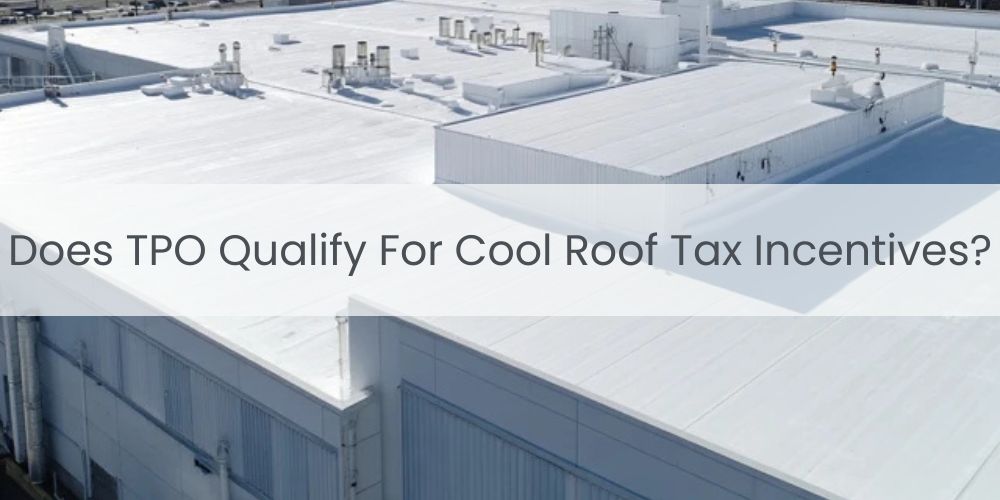
TPO roofing can qualify for cool-roof tax incentives in the United States only when the specific membrane product, the installed roof system, and the tax-incentive program rules align on documented cool-roof performance and verification requirements. Commercial facilities pursue cool-roof tax incentives because capital budgets, compliance targets, and operating-cost constraints make verified eligibility financially material, but eligibility is not awarded simply because a roof is labeled “TPO” or described as “reflective.” TPO is used in tax-incentive-driven projects where the program requires proof that the installed membrane meets defined cool-roof thresholds through a recognized rating pathway and where the submission record must trace the rated product to the installed scope. Cool-roof tax-incentive pathways are governed by jurisdiction-specific criteria that can include initial and aged solar reflectance thresholds, thermal emittance requirements, eligible building categories, climate or zone applicability, approved product listings, and proof-of-installation documentation. If a project treats membrane type as automatic eligibility without confirming the exact product’s rated values, confirming the project’s program applicability, and producing a complete documentation record, the tax-incentive claim can fail even when the roof performs well in service. Once a tax-incentive claim fails, the project can lose expected financial offsets, trigger redesign or resubmittal cycles, and create budget friction that undermines the ROI case used to justify the roof upgrade. TPO cool-roof tax-incentive qualification focuses on meeting program-defined criteria and producing verifiable proof of compliance, not on making generalized energy-savings claims. TPO cool-roof tax-incentive qualification is the process of selecting a TPO membrane with recognized third-party cool-roof ratings, confirming the program’s thresholds and applicability rules, and installing the roof system in a way that preserves rated surface performance while generating traceable records for submission. Unlike generic “energy-efficient roofing” language that relies on implied savings, tax-incentive qualification requires named criteria, rated values, and auditable traceability linking the installed membrane to the program’s eligibility rules. Without correct product verification, applicability alignment, and complete traceability documentation, a reflective TPO roof can still fail tax-incentive requirements even if it reduces cooling load in practice. TPO Roofing Contractor supports cool-roof tax-incentive-driven TPO projects as compliance-aligned installations, designed to meet program criteria, preserve reflective performance at the roof surface, and deliver the traceability record required for tax-incentive approval across commercial buildings throughout the United States.
How Does TPO Roofing Meet Cool-Roof Tax-Incentive Requirements and Avoid Claim Failure?
Cool-roof tax-incentive eligibility is achieved when rated TPO membrane performance is converted into program-compliant, auditable traceability that proves the installed roof system meets the program’s thresholds and applicability rules. Tax-incentive claims fail when program criteria, rated product performance, and documentation traceability do not align in a way that allows eligibility to be validated from the record. Programs typically require evidence that the installed membrane meets specified thresholds through a recognized rating pathway and that the project falls within the program’s eligible jurisdiction, building category, and scope definition. If the membrane’s rated values are not verified, if the project is outside program applicability, or if documentation cannot trace product identity and installed scope to the rated listing, the claim can be denied regardless of field performance. TPO can qualify predictably when the project controls three inputs: (1) product selection tied to recognized cool-roof ratings, (2) program matching tied to jurisdiction and applicability rules, and (3) documentation traceability tied to records that connect the rated membrane to the completed installation. Installation scope controls matter because tax-incentive verification depends on identity preservation: the installed membrane and roof system must match the rated product and the documented scope that the program evaluates. The objective is to treat qualification as a compliance pathway with verifiable controls so tax-incentive eligibility is a planned outcome rather than a speculative assumption.
The TPO cool-roof tax-incentive qualification pathway creates the following system-level performance relationships:
- Rated TPO membrane product → meets program cool-roof thresholds → eligibility criteria can be satisfied
- Recognized rating pathway → provides listed performance values → compliance can be verified against thresholds
- Program applicability rules → define eligible jurisdictions and building categories → ineligible projects are excluded regardless of membrane type
- Documentation traceability → links rated product identity to installed scope → eligibility can be substantiated during review
- Incomplete traceability record → breaks compliance substantiation → processing delays or denial occur
- Unverified membrane selection → fails threshold confirmation → claim can be denied even if cooling load decreases
Each of these outcomes results from coordinated program-compliance decisions that convert membrane reflectivity into auditable eligibility, ensuring “TPO qualifies” is supported by verified ratings and traceable installation records rather than implied performance claims.
What Documentation Proves TPO Cool-Roof Tax-Incentive Eligibility?
The documentation package is the control layer that converts rated TPO cool-roof performance into verifiable tax-incentive eligibility by preserving traceability from the listed product to the installed roof scope. Tax-incentive review is fundamentally a record-validation process: the program must be able to confirm that the membrane product installed on the roof is the same product that appears on an approved rating listing and that the installed scope matches what the program rules define as eligible work. This package is built around identity, ratings, scope, and completion evidence, because a cool-roof claim fails when any link in that traceability chain is missing or inconsistent. Product identity evidence anchors the claim to a specific manufacturer, product line, thickness, color, and listing identifier so the rated values being submitted cannot be disputed. Rating evidence supplies the program-facing performance numbers (initial and aged reflectance where applicable, plus any required companion metrics) in the exact format the program recognizes. Scope evidence ties the rated product to the project footprint by showing where the membrane was installed, what assembly components were included, and whether the work constitutes a qualifying replacement, retrofit, or new installation under the program’s definitions. Completion evidence closes the chain by proving that the specified product and scope were actually installed, on the stated property, within the required time window. When these records are assembled as a single traceable narrative, eligibility becomes auditable and predictable instead of dependent on interpretation during review.
The TPO tax-incentive documentation pathway creates the following system-level performance relationships:
- Product identity records → uniquely specify rated membrane product → rating values can be matched to the installed material
- Third-party rating listing → provides recognized cool-roof performance values → compliance can be evaluated against program thresholds
- Program-required scope definition → determines what work qualifies → installation scope can be validated as eligible
- Installed-scope evidence → ties membrane identity to roof area and assembly → eligibility is substantiated for the actual project footprint
- Completion evidence → confirms installation occurred as specified → claim review can be closed without resubmittal
- Missing or inconsistent records → break traceability at a single link → claim delay or denial becomes likely
Each of these outcomes results from traceability-preserving documentation controls, ensuring that TPO cool-roof tax-incentive eligibility is proven through auditable records rather than assumed from membrane type or generalized “cool roof” language.
Have a question about an upcoming project?
When Should a Commercial Building Engage TPO Roofing Contractor to Improve Indoor Temperature Stability?
If a commercial building is experiencing peak-hour temperature drift on upper floors, relies on tight comfort tolerances, or is operating near HVAC capacity during warm-season conditions, the roof assembly must function as a thermal-control system rather than a passive covering. Indicators such as elevated plenum temperatures during clear-sky afternoons, persistent hot zones near the roofline, recurring ponding, seam stress, flashing wear, unexplained increases in cooling runtime, or comfort complaints that align with high-solar periods can signal roof-driven heat gain and envelope instability that reflective TPO is designed to control. Buildings should also engage TPO Roofing Contractor during planned roof replacement, energy-upgrade projects, tenant improvement cycles, or HVAC modernization, because roof reflectivity, insulation continuity, airtight transitions, drainage behavior, and rooftop traffic design must be coordinated at the same decision point if indoor temperature benefits are expected to be measurable rather than assumed. A reflective TPO evaluation or specification review examines whether the roof is a material contributor to peak-hour heat gain and whether the assembly conditions required for indoor stabilization are achievable and maintainable. This includes reviewing membrane and seam continuity, insulation condition and continuity, leakage risk at curbs and penetrations, drainage behavior, contamination risk that can reduce reflectivity, and rooftop access patterns that influence puncture probability and long-term performance drift. For projects in design or tender, this process validates that the specified reflective TPO system is detailed to preserve reflectance and prevent bypass pathways before installation begins. For existing buildings, it identifies whether targeted repairs, insulation correction, transition sealing, cleaning and maintenance controls, or full replacement is the technically appropriate path to stabilizing indoor temperatures. Engaging TPO Roofing Contractor at the evaluation or specification stage is a risk-management decision that aligns reflective TPO performance with measurable indoor temperature stability, cooling-load control, and long-term envelope reliability across commercial buildings.