
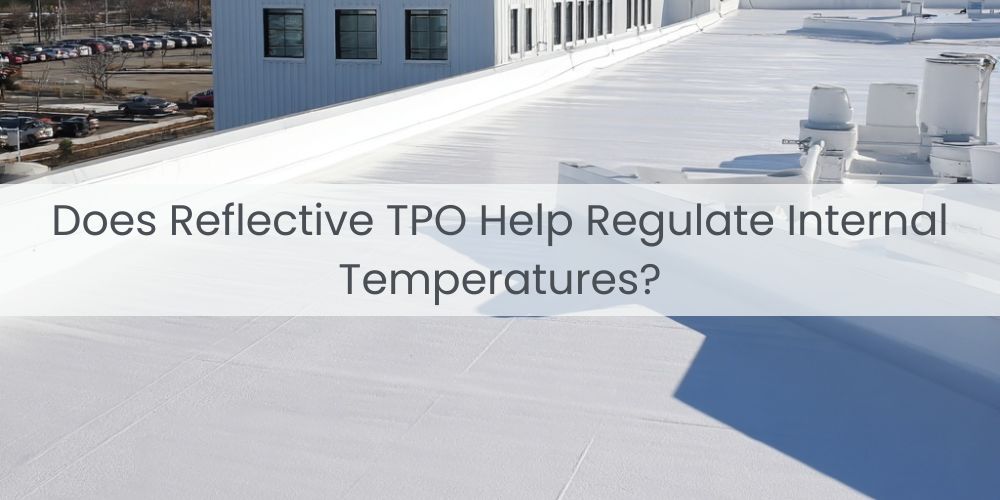
Yes, reflective TPO roofing supports commercial building thermal control by limiting roof-surface heat loading and reducing roof-driven heat transfer into conditioned space during peak sun exposure. Commercial facilities operate with defined comfort tolerances, equipment heat loads, and HVAC capacity constraints, placing measurable performance demands on the roof assembly during warm-season operation. Reflective TPO roofing systems are used where uncontrolled solar heat gain at the roof surface would increase top-floor zone load, elevate plenum temperatures, and drive higher cooling runtime to maintain setpoint. Low-slope commercial roofs are subjected to sustained solar irradiance, daily thermal cycling, rooftop mechanical congestion, and continuous environmental exposure that can amplify heat buildup across large roof areas. If roof assemblies are not designed to manage solar reflectance, membrane temperature behavior, insulation continuity, and air leakage pathways, heat gain can propagate through the assembly and concentrate in upper zones. Once heat enters a roof assembly, it can conduct through insulation and deck layers, increase plenum temperature, reduce effective thermal resistance, and force HVAC systems to offset the added load to preserve interior stability. Reflective TPO roofing focuses on reducing these heat-gain mechanisms, not merely improving surface appearance or making general energy claims. Reflective TPO roofing is the process of installing a reflective thermoplastic membrane system with heat-welded seams, defined attachment methods, and compatible insulation detailing to create a watertight roof assembly that also limits solar-driven heat input. Unlike general membrane selection that treats the roof as a passive cover, reflective TPO is selected and detailed to control the upstream boundary condition created by sunlight so roof-driven load is reduced before it reaches the interior. Without proper system design, gaps in insulation, air leakage at transitions, and poor detailing around penetrations can preserve high heat transfer even when the membrane surface is reflective, reducing the measurable indoor benefit. TPO Roofing Contractor installs and maintains reflective TPO systems as roof-surface heat-gain control systems, engineered to reduce membrane heating, limit conductive heat transfer into the assembly, and support stable interior temperatures across commercial buildings throughout the United States.
How Does Reflective TPO Roofing Control Roof-Driven Heat Gain and Indoor Temperature Drift?
Roof-driven heat gain escalates when solar radiation elevates membrane surface temperature and that temperature increase drives conductive heat flow into the roof assembly. Daily thermal cycling increases surface temperatures during peak sun, insulation continuity determines how easily that heat crosses the assembly, and air leakage pathways allow heat to bypass thermal resistance at transitions and service zones. On large low-slope commercial roofs, these forces act across wide areas, increasing deck and plenum temperatures and raising top-floor zone load during peak hours. Reflective TPO roofing controls this pathway by limiting solar absorption at the membrane surface and reducing membrane temperature rise under sustained exposure, which reduces heat flux into insulation and deck layers. Heat-welded seams preserve membrane continuity so reflective performance is not undermined by separation under thermal movement. Continuous insulation and controlled transitions reduce conductive pathways and air leakage that would otherwise deliver roof heat into occupied zones. When these system elements are coordinated, the building experiences lower peak cooling demand and improved temperature stability in upper zones during high-solar periods.
The reflective TPO roofing system creates the following system-level performance relationships:
- Reflective membrane surface → limits solar heat absorption → membrane surface temperature remains lower during peak sun
- Lower membrane surface temperature → reduces conductive heat flux → less heat enters insulation and deck
- Reduced roof heat flux → lowers deck and plenum heat buildup → top-floor zone load decreases during peak hours
- Lower top-floor zone load → reduces peak cooling demand → HVAC runtime and cooling energy use decrease
- Insulation continuity → preserves effective R-value → roof heat transfer does not bypass control layers
- Air leakage control at transitions and penetrations → reduces convective heat delivery → indoor temperature stability improves near the roofline
Each of these outcomes results from coordinated roof-system design decisions, ensuring that reflective TPO functions as a roof-surface heat-control layer rather than a passive membrane covering.
How Can Commercial Buildings Verify Whether Reflective TPO Will Stabilize Indoor Temperatures?
Reflective TPO improves interior temperature stability only when roof-surface solar heat loading is a measurable driver of peak-hour heat gain into occupied zones through the specific roof assembly. The practical question is whether top-floor temperature drift and peak cooling runtime track high-sun exposure in a way that indicates roof-driven load rather than internal gains. This condition occurs when large low-slope roof areas receive sustained irradiance, the roof assembly transmits heat toward the plenum and conditioned space, and HVAC capacity must offset that roof-driven heat input to hold setpoint. The simplest field signal is correlation: if upper-zone temperatures, plenum temperatures, or HVAC runtime rise disproportionately during clear-sky peak sun hours and relax under cloud cover at similar outdoor air temperatures, roof-surface loading is influencing interior behavior. If the roof assembly has insulation discontinuities, compressed insulation, thermal bridging, or uncontrolled air leakage at transitions, roof-surface heat can bypass intended resistance layers and express as temperature instability near the roofline, increasing the likelihood that reflective control will translate into indoor improvement. If the building heat balance is dominated by internal loads such as equipment, process heat, lighting density, or high occupancy, reflective TPO can still reduce roof heat flux but the measurable indoor temperature change may be limited unless internal gains or HVAC control strategy are also addressed. The purpose of this assessment step is to confirm that roof-surface heat input is currently contributing to peak-hour indoor instability so reflective TPO is evaluated as a targeted roof-system control on solar heat gain rather than assumed as a universal comfort guarantee.
The reflective TPO evaluation pathway creates the following system-level performance relationships:
- Clear-sky peak sun hours → increase roof-surface heat loading → upper-zone temperature drift and HVAC runtime rise if the roof is a major heat source
- Cloud cover at similar outdoor temperature → reduces roof-surface irradiance → reduced drift supports a solar-driven roof mechanism
- Elevated plenum temperature near roofline → indicates roof-to-plenum heat transfer → reflective control is more likely to stabilize upper zones
- Wet or compressed insulation → reduces effective R-value → roof heat transfers into plenums and top-floor zones more readily
- Air leakage at curbs, parapets, and penetrations → enables convective heat delivery → reduced roof heat flux is partially bypassed
- Roof-driven heat gain confirmed → reflective TPO lowers membrane temperature rise → peak-hour drift and cooling runtime decrease
Each of these outcomes results from roof-surface heat control interacting with roof assembly resistance and building operating loads, which determines whether reflective TPO produces a measurable reduction in indoor temperature drift and peak cooling runtime.
Have a question about an upcoming project?
How Should Commercial Buildings Specify and Detail Reflective TPO So Temperature Benefits Are Real, Not Assumed?
Reflective TPO improves indoor temperature stability only when reflectivity is preserved and the roof assembly prevents conductive and convective bypass that would otherwise deliver heat into plenums and upper zones. Commercial buildings do not gain control of temperature drift by selecting a “white membrane” in isolation; they gain control when the reflective surface remains reflective, seams remain continuous under movement, insulation remains continuous and dry, and transitions remain airtight so roof-surface heat reduction is not bypassed into occupied space. In that context, the practical follow-on question after “does it help” is “what must be true for it to help here,” because reflectivity reduces upstream heat input while assembly continuity determines whether that reduction reaches the interior. A roof that is reflective but dirty, wet, discontinuous, or leaky can still run hot at the deck and plenum because heat bypass routes dominate. This section therefore defines the controllable specification variables that convert reflective TPO from a material attribute into a measurable interior outcome: reflectance retention, insulation continuity, airtight detailing, dry R-value preservation, and rooftop complexity controls that protect the system from puncture-driven degradation before the reflectivity advantage has paid back. The goal is to specify and maintain a reflective TPO roof as a heat-gain control assembly, not as a cosmetic surface choice, so reduced membrane heating translates into lower plenum temperature, reduced upper-zone drift, and lower peak cooling runtime under high-solar conditions.
The reflective TPO control assembly creates the following system-level performance relationships:
- Reflectance retention (cleaning, deposit control) → preserves effective solar reflectance → membrane temperature stays lower under the same irradiance
- Seam continuity and weld stability → maintains monolithic membrane behavior → moisture entry does not degrade insulation performance
- Continuous insulation with correct transitions → prevents thermal bypass → reduced roof heat flux reaches the interior as lower zone load
- Dry insulation condition → preserves R-value over time → cooling-load reduction does not drift upward season over season
- Airtight transitions at curbs, parapets, and penetrations → blocks convective heat delivery → plenum temperature rise is reduced
- Drainage performance and ponding control → reduces wetting duration → contamination and moisture-risk do not concentrate at low points
- Rooftop traffic management (walk pads/routes) → reduces puncture initiation → watertight integrity and reflectivity benefits remain stable
Each of these outcomes results from specification and detailing choices that preserve reflectivity and eliminate bypass pathways, ensuring reflective TPO produces measurable indoor temperature stability rather than intermittent benefits that degrade as the roof surface and assembly drift out of control.
What Detailing and Maintenance Practices Preserve Reflective TPO Performance Over Time?
After the enablement layer, the next logical section is the persistence layer: how to keep the reflective benefit and the indoor-stability benefit from degrading over the service life. At this point, the reader understands (1) the mechanism, (2) how to verify roof-driven influence, and (3) the assembly conditions required for the benefit to show up indoors. The remaining question is what operational practices prevent reflectivity loss, seam degradation, moisture intrusion, and thermal drift from eroding the outcome. This section should define the specific degradation pathways that reduce reflectivity and reintroduce roof-driven heat gain, then map them to the exact controls that prevent performance decay. Reflective membranes can lose effective reflectance through dirt loading, biological growth, and rooftop exhaust deposition, which raises membrane temperature under the same irradiance and shrinks the cooling-load reduction. Seams and transitions can also degrade under thermal cycling and traffic, creating air and moisture pathways that bypass insulation and reintroduce plenum heat buildup. Drainage performance must remain stable because ponding increases wetting duration, accelerates contamination, and increases the probability of insulation wetting that collapses thermal resistance.
The reflective TPO performance persistence pathway creates the following system-level performance relationships:
- Surface contamination accumulation → lowers effective solar reflectance → membrane temperature rises under the same sun exposure
- Scheduled cleaning and deposit control → restores reflectance → roof-surface heat loading remains reduced during peak sun
- Rooftop exhaust discharge zones → concentrate soiling → reflectivity loss localizes around equipment areas
- Drainage restriction and ponding → increase debris capture and wetting duration → contamination and moisture risk accelerate at low points
- Seam aging under thermal cycling and traffic → increases micro-separation risk → watertight continuity becomes vulnerable at laps and edges
- Seam inspection and targeted re-weld reinforcement → restores fused continuity → moisture pathways are eliminated before insulation wetting
- Moisture intrusion and wet insulation → reduces effective R-value → plenum temperatures rise and HVAC runtime drifts upward
- Defined walk paths and protection → reduces puncture frequency → long-term performance remains predictable under repeated access
Each of these outcomes results from persistence-focused controls that keep the roof dry, reflective, and continuous, ensuring the indoor-temperature regulation benefit remains durable rather than fading as reflectance, seams, and insulation performance drift over time.
When Should a Commercial Building Engage TPO Roofing Contractor to Improve Indoor Temperature Stability?
If a commercial building is experiencing peak-hour temperature drift on upper floors, relies on tight comfort tolerances, or is operating near HVAC capacity during warm-season conditions, the roof assembly must function as a thermal-control system rather than a passive covering. Indicators such as elevated plenum temperatures during clear-sky afternoons, persistent hot zones near the roofline, recurring ponding, seam stress, flashing wear, unexplained increases in cooling runtime, or comfort complaints that align with high-solar periods can signal roof-driven heat gain and envelope instability that reflective TPO is designed to control. Buildings should also engage TPO Roofing Contractor during planned roof replacement, energy-upgrade projects, tenant improvement cycles, or HVAC modernization, because roof reflectivity, insulation continuity, airtight transitions, drainage behavior, and rooftop traffic design must be coordinated at the same decision point if indoor temperature benefits are expected to be measurable rather than assumed. A reflective TPO evaluation or specification review examines whether the roof is a material contributor to peak-hour heat gain and whether the assembly conditions required for indoor stabilization are achievable and maintainable. This includes reviewing membrane and seam continuity, insulation condition and continuity, leakage risk at curbs and penetrations, drainage behavior, contamination risk that can reduce reflectivity, and rooftop access patterns that influence puncture probability and long-term performance drift. For projects in design or tender, this process validates that the specified reflective TPO system is detailed to preserve reflectance and prevent bypass pathways before installation begins. For existing buildings, it identifies whether targeted repairs, insulation correction, transition sealing, cleaning and maintenance controls, or full replacement is the technically appropriate path to stabilizing indoor temperatures. Engaging TPO Roofing Contractor at the evaluation or specification stage is a risk-management decision that aligns reflective TPO performance with measurable indoor temperature stability, cooling-load control, and long-term envelope reliability across commercial buildings.